
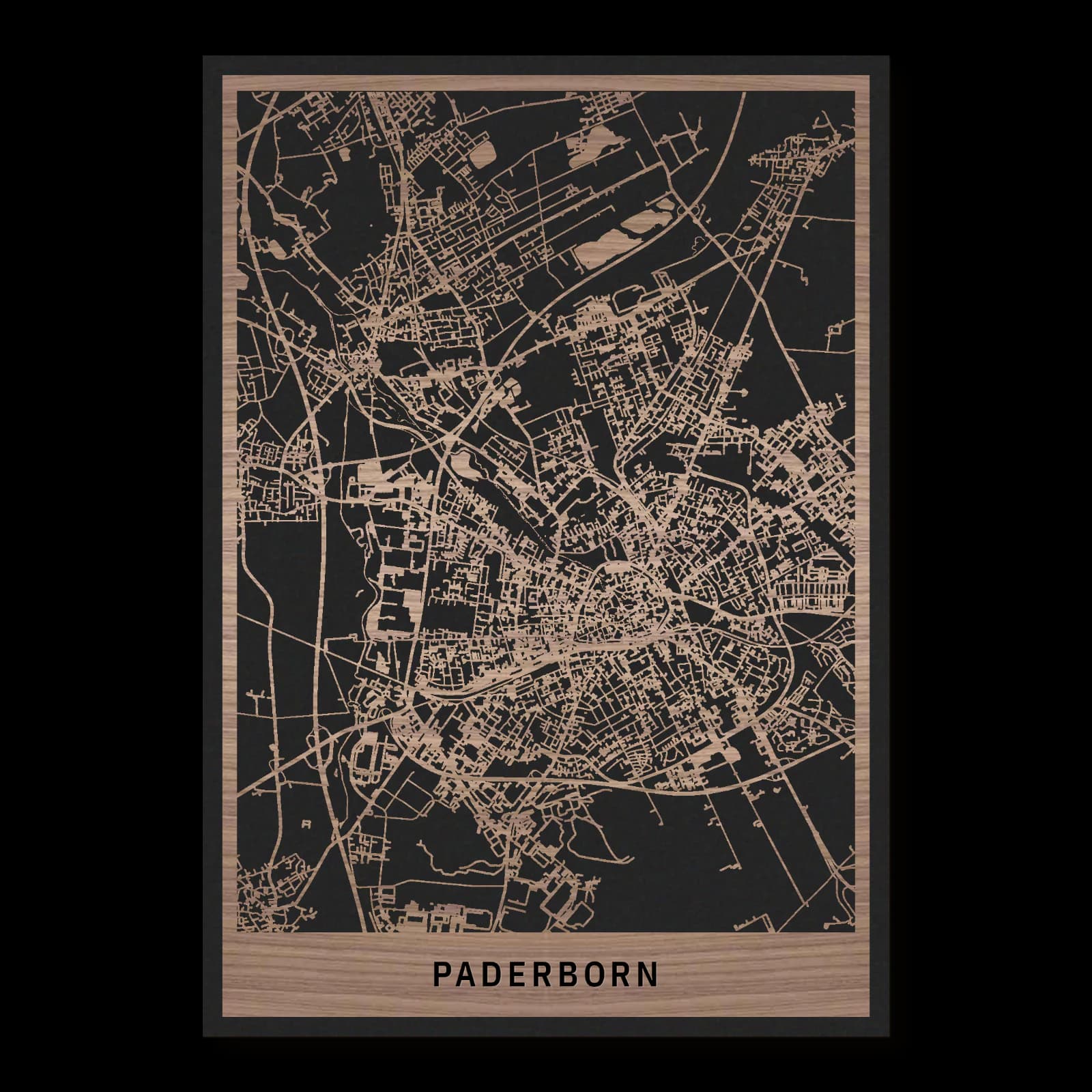
Paderborn.Pader springs, Neuhaus and places of learning
Rectangular wooden city map made from oiled walnut – two layers with a black back plate.
About the product
Paderborn links its central springs with Neuhaus Palace and modern places of learning. The cathedral, Heinz Nixdorf MuseumsForum and university occupy separate parts of the city, connected through residential streets and river spaces. Wood gives this combination of older institutions and newer knowledge a calm material presence. The map presents a wider urban relationship, extending beyond the familiar cathedral district into Paderborn’s surrounding neighbourhoods.
What does the map show?
- Paderborn Cathedral
- Pader springs
- Neuhaus Palace
- Heinz Nixdorf MuseumsForum
- University
- Precisely cut and engraved
- Fine laser details with clear depth
- Carefully inspected and securely packed
- Handmade in Germany
Configuration
Shape: Rectangular · Design: Layered · Material: Walnut · Sizes: 20 × 30 cm, 35 × 50 cm, 50 × 70 cm
The configuration shown in the cart and at the time of ordering is authoritative. The preview is not a dimensioned technical drawing.
Availability & production
- Availability
- Made to order
- Production time
- Ships in 3-5 business days
Production starts after successful payment and complete product configuration.
Materials & care
Depending on the variant, lacquered or oiled MDF or oiled real-wood veneer on MDF; optional stainless-steel mounting screws. Acrylic lacquer spray, hard-wax oil and white glue are used in production.
Wood is a natural material. Grain and color may vary slightly from the product images.
Clean with a dry, soft cloth and protect from prolonged moisture and direct heat.
Included & installation
The selected product in the ordered configuration, securely packed and prepared for installation.
- Maximum dimensions 50 × 70 cm and maximum product weight 2 kg.
- Wall-fixing screws and wall plugs are not included. Use fixings suitable for the wall type, substrate and product weight.
- Installation must be carried out by an adult. Keep optional mounting screws and other small parts away from children until installation.
Shipping & returns
Securely packed shipping. Return and cancellation information is available in the legal section.
Shipping costs and delivery options depend on the destination and format. The published cancellation right applies to non-personalised standard goods; it may be excluded for individually made products.
Manufacturer & product identifier
- Manufacturer
- Benjamin Nöst - Lightworks
Rorichmoorer Str. 76
26802 Moormerland, Deutschland
kontakt@lightworks.de - Product identifier
- LW-CAT-95981B36074F-S, LW-CAT-95981B36074F-M, LW-CAT-95981B36074F-L
Together with the order or production batch, the relevant SKU enables traceability. Safety questions and incidents can be reported to the email address shown above.
Product safety
- Decorative product for dry indoor use only; not a toy and not intended for children.
- Protect from moisture, high heat and open flames.
- Do not continue to hang the product after a fall, breakage or visible damage. Keep damaged parts away from children.
Paderborn’s springs, residence and changing fields of knowledge
The Pader begins in the centre and links the spring district with Neuhaus to the northwest. Cathedral and palace reflect different aspects of ecclesiastical history. The Heinz Nixdorf MuseumsForum and university add more recent centres of knowledge. Their separate locations reveal a connected city extending well beyond its historical core.
A river beginning in the centre
The Pader gives Paderborn a distinctive relationship with water. Its springs occupy the central city, from which the short river continues towards Neuhaus and joins the Lippe. Water therefore connects the historic core with a second important urban area rather than simply forming a boundary outside it. The proximity of springs, buildings and flowing water is essential to the city’s geography. Following that relationship provides a useful starting point for understanding how the central district belongs to a wider pattern of settlement and landscape.
Earlier buildings within the cathedral’s story
Paderborn Cathedral stands in the historical centre. Its development includes earlier buildings and substantial later changes. The cathedral consecrated under Bishop Imad in 1068 established important elements of the present ground plan. This long history means the building cannot be explained by one architectural period alone. It remains a religious and built reference close to the springs. In the broader city, the compact cathedral district offers a different scale from larger university grounds and the residential and palace areas farther from the centre.
A princely residence at Neuhaus
Neuhaus Palace lies northwest of the core and served as the residence of Paderborn’s prince-bishops until 1802. It is associated with the early development of Weser Renaissance architecture. Four wings, round corner towers and a surrounding moat bring building form and water together in a separate setting. The palace adds a residential and representative function to the religious history visible at the cathedral. Its location demonstrates that historic authority operated through more than one spatial centre. The grounds and intervening neighbourhoods are consequently important to the larger city portrait.
Computing becomes cultural history
The Heinz Nixdorf MuseumsForum introduces a substantially different field of knowledge. Its subjects extend from early writing and calculating techniques to computers and contemporary digital technologies. This connects the museum with the history of recording, processing and communicating information. It also recalls Paderborn’s relationship with computer development. The museum’s position northwest of the centre adds another cultural destination between the inner city and Neuhaus. Its themes complement the older religious buildings without presenting modern technological history as a continuation of precisely the same institutional story.
The university and the wider city
The university southeast of the centre brings higher education and research into the picture. Its location reveals the city’s growth beyond the compact cathedral area. Residential districts and major roads occupy the spaces between campus, museum and palace. Paderborn thus appears as a connected city with several different scales and functions. Springs and historic places of authority remain visible alongside newer educational and technological settings. Their coexistence is distinctive because each occupies a separate part of the city, with everyday neighbourhoods providing the connections that bring those histories into one urban landscape.
Sources
- Die Pader - Deutschlands kürzester Fluß - Die Stadt Paderborn — https://www.paderborn.de/tourismus-kultur/sehenswuerdigkeiten/Pader_Sehensw.php
- Schloß Neuhaus - Die Stadt Paderborn — https://www.paderborn.de/tourismus-kultur/sehenswuerdigkeiten/SchlossNeuhaus_Sehensw.php
- Hoher Dom zu Paderborn - Erzbistum Paderborn — https://www.erzbistum-paderborn.de/erzbistum-und-erzbischof/hoher-dom-zu-paderborn/
- HNF - Heinz Nixdorf MuseumsForum - Weltgrößtes ... — https://www.hnf.de/home.html
- Paderborn | Paderborner Land — https://www.paderborner-land.de/deu/paderborner-land/paderborn.php

Still deciding?
Configure your motif in the studio and see how your city map will look in your space.



