
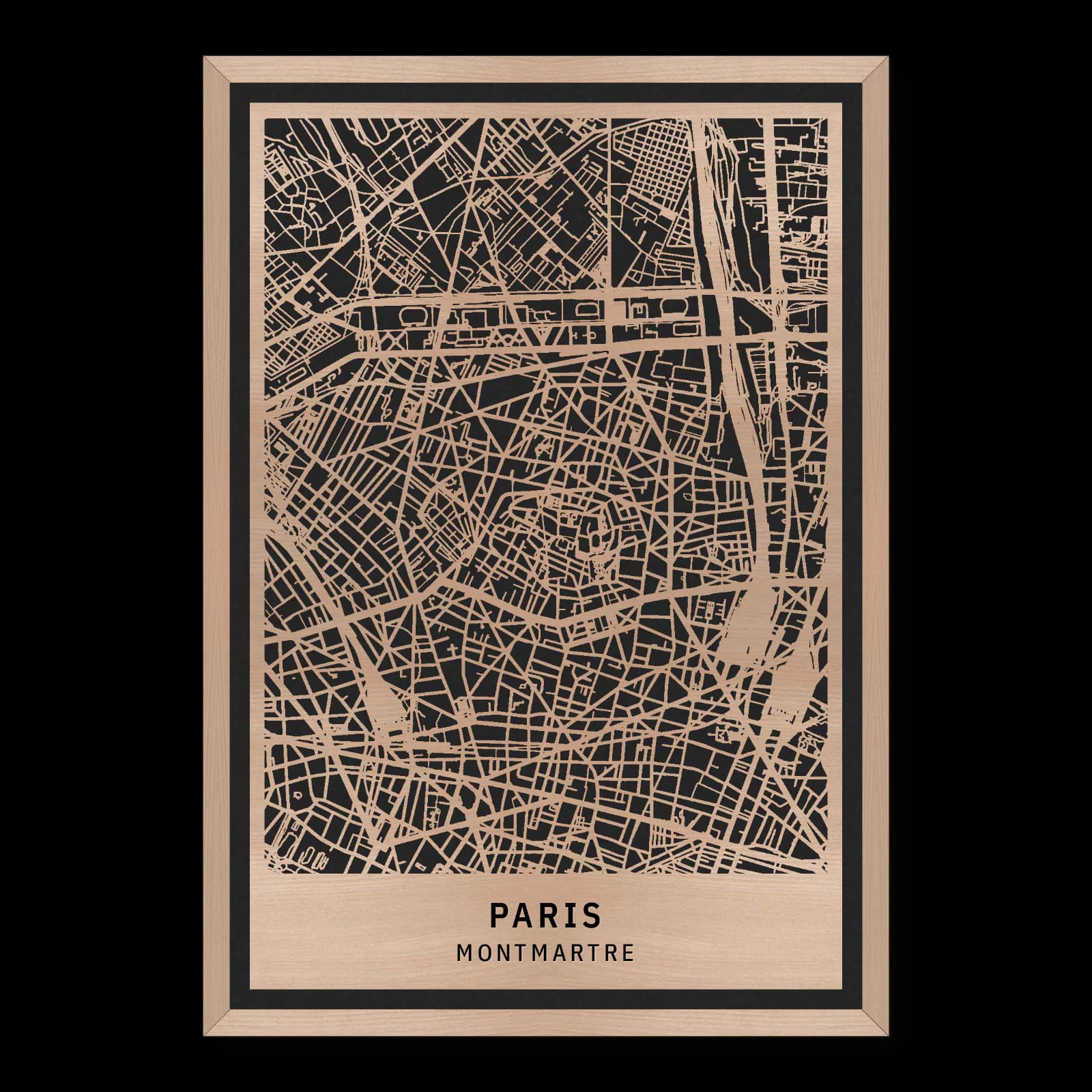
Paris.Montmartre
Framed wooden city map in oiled beech, portrait format.
About the product
Montmartre gives Paris a different rhythm, with climbing streets, turning paths and landmarks at changing heights. Sacré-Cœur, Place du Tertre, the Musée de Montmartre and Moulin Rouge provide a distinctive set of reference points. This view recalls ascents, unexpected side streets and the shift between busy squares and quieter corners. An oiled beech frame contains these climbing streets. A second layer gives the cut routes depth and keeps the hilltop around Sacré-Cœur connected to the squares and streets lower down Montmartre.
What does the map show?
- Sacré-Cœur
- Place du Tertre
- Moulin Rouge
- Musée de Montmartre
- Precisely cut and engraved
- Fine laser details with clear depth
- Carefully inspected and securely packed
- Handmade in Germany
Configuration
Shape: Rectangular · Design: Framed · Material: Beech · Sizes: 20 × 30 cm, 35 × 50 cm, 50 × 70 cm
The configuration shown in the cart and at the time of ordering is authoritative. The preview is not a dimensioned technical drawing.
Availability & production
- Availability
- Made to order
- Production time
- Ships in 3-5 business days
Production starts after successful payment and complete product configuration.
Materials & care
Depending on the variant, lacquered or oiled MDF or oiled real-wood veneer on MDF; optional stainless-steel mounting screws. Acrylic lacquer spray, hard-wax oil and white glue are used in production.
Wood is a natural material. Grain and color may vary slightly from the product images.
Clean with a dry, soft cloth and protect from prolonged moisture and direct heat.
Included & installation
The selected product in the ordered configuration, securely packed and prepared for installation.
- Maximum dimensions 50 × 70 cm and maximum product weight 2 kg.
- Wall-fixing screws and wall plugs are not included. Use fixings suitable for the wall type, substrate and product weight.
- Installation must be carried out by an adult. Keep optional mounting screws and other small parts away from children until installation.
Shipping & returns
Securely packed shipping. Return and cancellation information is available in the legal section.
Shipping costs and delivery options depend on the destination and format. The published cancellation right applies to non-personalised standard goods; it may be excluded for individually made products.
Manufacturer & product identifier
- Manufacturer
- Benjamin Nöst - Lightworks
Rorichmoorer Str. 76
26802 Moormerland, Deutschland
kontakt@lightworks.de - Product identifier
- LW-CAT-BAF8C7C29FC1-S, LW-CAT-BAF8C7C29FC1-M, LW-CAT-BAF8C7C29FC1-L
Together with the order or production batch, the relevant SKU enables traceability. Safety questions and incidents can be reported to the email address shown above.
Product safety
- Decorative product for dry indoor use only; not a toy and not intended for children.
- Protect from moisture, high heat and open flames.
- Do not continue to hang the product after a fall, breakage or visible damage. Keep damaged parts away from children.
Montmartre: a hill of studios, streets and performance
Montmartre changes the rhythm of walking in Paris. Slopes, steps and smaller streets connect Sacré-Cœur, Place du Tertre and former artists' houses, while the Moulin Rouge stands lower down. Considering these levels together reveals a neighbourhood whose familiar image was created by several different kinds of cultural and everyday activity.
Streets shaped by a hill
In Montmartre, changes of level influence many journeys. Roads follow the terrain, stairways shorten connections, and small squares become pauses along an ascent. The difference from flatter Parisian neighbourhoods is immediately apparent on foot. Sacré-Cœur supplies a conspicuous landmark at the summit, but the district contains much more than the route towards the basilica.
The church belongs to a later period than Paris's medieval religious buildings. Its history is connected with the political and religious disputes of the late nineteenth century. It also remains an active place of worship. That role deserves attention alongside its familiar presence in views of the city.
Artists and the places they occupied
Place du Tertre forms part of the established image of Montmartre. Its compact shape differs from the larger Parisian squares approached by broad avenues. It becomes more understandable within its surrounding smaller streets than as an isolated centre representing the whole neighbourhood. Its present fame is one aspect of local cultural history rather than a complete account of it.
The Musée de Montmartre on Rue Cortot offers another perspective. Its buildings were associated with artists including Renoir and Suzanne Valadon, and its collections explore studios, entertainment and life on the hill. House and garden introduce an intimate scale. Artistic activity is linked with particular working and domestic settings rather than with famous names alone.
The museum gardens also recall these earlier uses. They show that smaller sheltered spaces remain within the dense neighbourhood. Such places complicate an image of Montmartre based only on busy squares and celebrated viewpoints.
Entertainment at a lower level
Moulin Rouge stands farther down beside a broader urban route. Opened in 1889, the cabaret represents a different cultural setting from either a studio or the basilica. Its position at the hill's edge connects entertainment with the larger movement networks of the city. Changes of level between these places are therefore accompanied by changes in how they participate in urban life.
Between the Moulin Rouge and Sacré-Cœur, more changes than elevation. At the district's lower edge, entertainment belongs to a broader setting of urban movement; above, the church, smaller streets and successive squares shape the approach. Artists' addresses occupy this topography without explaining it completely. Montmartre's familiar images therefore come from neighbouring places with different functions. The separation between nightlife, artistic work and religious space is part of what makes the hill a layered piece of Paris rather than a single picturesque scene.
Sources
- Musée de Montmartre: Musée, artistes et jardins — https://museedemontmartre.fr/
- Basilique du Sacré-Cœur: Visiting the sanctuary — https://www.sacre-coeur-montmartre.com/english/
- Wikipedia: Sacré-Cœur — https://fr.wikipedia.org/wiki/Basilique_du_Sacr%C3%A9-C%C5%93ur_de_Montmartre
- Wikipedia: Place du Tertre — https://en.wikipedia.org/wiki/Place_du_Tertre
- Wikipedia: Moulin Rouge — https://en.wikipedia.org/wiki/Moulin_Rouge

Still deciding?
Configure your motif in the studio and see how your city map will look in your space.