
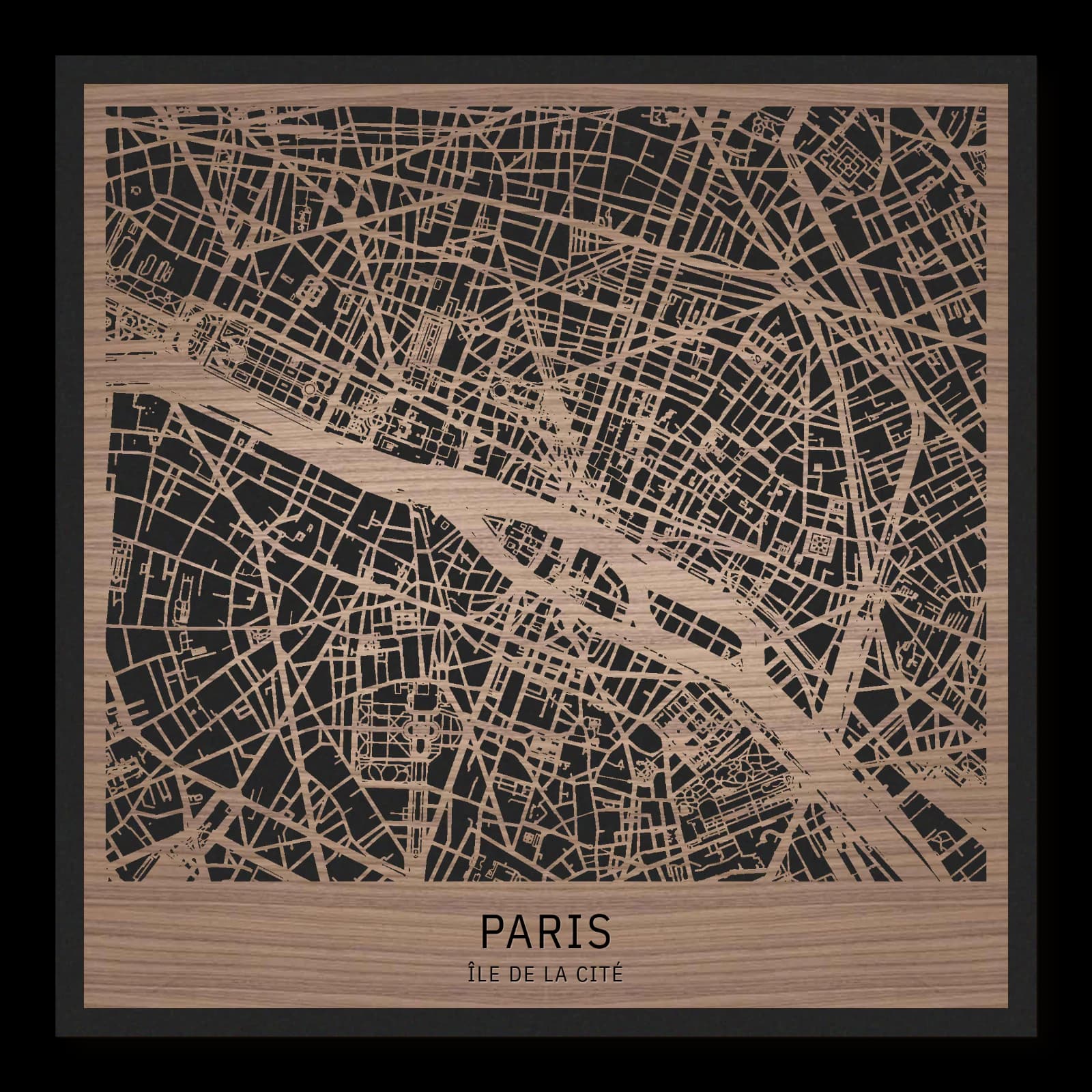
Paris.Île de la Cité
Layered wooden city map in oiled walnut, square format.
About the product
Paris gathers between two branches of the Seine on Île de la Cité. Notre-Dame, Sainte-Chapelle and the Conciergerie establish distinct historical centres, while Pont Neuf connects the island with the surrounding city. This view recalls bridge crossings and the movement from enclosed streets into open approaches, with water repeatedly providing orientation. The square view keeps the island and both arms of the Seine close together. Oiled walnut and a backing panel lend depth to the cut streets, while bridges tie the historic core to either bank.
What does the map show?
- Notre-Dame de Paris
- Sainte-Chapelle
- Conciergerie
- Pont Neuf
- Precisely cut and engraved
- Fine laser details with clear depth
- Carefully inspected and securely packed
- Handmade in Germany
Configuration
Shape: Square · Design: Layered · Material: Walnut · Sizes: 23 × 23 cm, 35 × 35 cm, 50 × 50 cm
The configuration shown in the cart and at the time of ordering is authoritative. The preview is not a dimensioned technical drawing.
Availability & production
- Availability
- Made to order
- Production time
- Ships in 3-5 business days
Production starts after successful payment and complete product configuration.
Materials & care
Depending on the variant, lacquered or oiled MDF or oiled real-wood veneer on MDF; optional stainless-steel mounting screws. Acrylic lacquer spray, hard-wax oil and white glue are used in production.
Wood is a natural material. Grain and color may vary slightly from the product images.
Clean with a dry, soft cloth and protect from prolonged moisture and direct heat.
Included & installation
The selected product in the ordered configuration, securely packed and prepared for installation.
- Maximum dimensions 50 × 70 cm and maximum product weight 2 kg.
- Wall-fixing screws and wall plugs are not included. Use fixings suitable for the wall type, substrate and product weight.
- Installation must be carried out by an adult. Keep optional mounting screws and other small parts away from children until installation.
Shipping & returns
Securely packed shipping. Return and cancellation information is available in the legal section.
Shipping costs and delivery options depend on the destination and format. The published cancellation right applies to non-personalised standard goods; it may be excluded for individually made products.
Manufacturer & product identifier
- Manufacturer
- Benjamin Nöst - Lightworks
Rorichmoorer Str. 76
26802 Moormerland, Deutschland
kontakt@lightworks.de - Product identifier
- LW-CAT-2C6FC33BFC14-S, LW-CAT-2C6FC33BFC14-M, LW-CAT-2C6FC33BFC14-L
Together with the order or production batch, the relevant SKU enables traceability. Safety questions and incidents can be reported to the email address shown above.
Product safety
- Decorative product for dry indoor use only; not a toy and not intended for children.
- Protect from moisture, high heat and open flames.
- Do not continue to hang the product after a fall, breakage or visible damage. Keep damaged parts away from children.
Île de la Cité: church, monarchy and justice between riverbanks
Île de la Cité concentrates several different institutions within a small island. Notre-Dame, Sainte-Chapelle and the Conciergerie connect ecclesiastical, royal and judicial histories, while Pont Neuf links the island with both banks. Their relationships reveal how a bounded site can also become a central place of movement within a much larger city.
An island that connects
Île de la Cité stands between two branches of the Seine. Water separates it from neighbouring districts while bridges make it an important crossing point. At the western end, Pont Neuf spans both channels, establishing an especially clear connection between the island and the wider city.
Its name, meaning New Bridge, can be misleading today. Completed in the early seventeenth century, Pont Neuf is among the oldest surviving bridges in Paris. Its significance also lies in the routes it brings together. Crossing here reveals the island as part of an urban movement network, rather than as a detached enclosure surrounded by water.
Two religious buildings with different purposes
Notre-Dame occupies a substantial position in the island's eastern area. Its medieval architecture developed over time and underwent later alteration and restoration. The cathedral belongs to the ecclesiastical history of Paris while carrying a much broader cultural significance. Open ground around it changes the scale experienced in the island's tighter streets.
Sainte-Chapelle had a different original function. Louis IX commissioned it in the thirteenth century as a royal palace chapel to contain important Passion relics. Its connection with the monarchy distinguishes it from the cathedral. The celebrated stained glass belongs to an architectural programme in which religious meaning and royal representation were closely combined.
A palace with changing political roles
The Conciergerie also formed part of the former royal palace. Later uses, particularly its role as a prison during the French Revolution, added further meanings to the site. Its medieval origins alone cannot explain its history. The same architectural setting supported different forms of political authority at different times.
Public streets and routes pass between these institutions. The island is therefore not one closed monumental complex, but a group of substantial sites with separate boundaries and entrances. Their proximity enables comparison, while the river gives them a shared geographic frame.
Exploring the area through several approaches helps make these relationships clear. A bridge view explains the island's outline; streets reveal the distances between institutions; an open forecourt brings one building into focus. Together these perspectives connect church, monarchy, justice and present-day movement. Île de la Cité becomes understandable as a specific part of Paris, where major histories remain embedded in the practical experience of crossing water and moving between public places.
Sources
- Centre des monuments nationaux: History of the Sainte-Chapelle — https://www.sainte-chapelle.fr/en/discover/history-of-the-sainte-chapelle
- Wikipedia: Notre-Dame de Paris — https://en.wikipedia.org/wiki/Notre-Dame_de_Paris
- Wikipedia: Conciergerie — https://en.wikipedia.org/wiki/Conciergerie
- Wikipedia: Pont Neuf — https://en.wikipedia.org/wiki/Pont_Neuf

Still deciding?
Configure your motif in the studio and see how your city map will look in your space.