
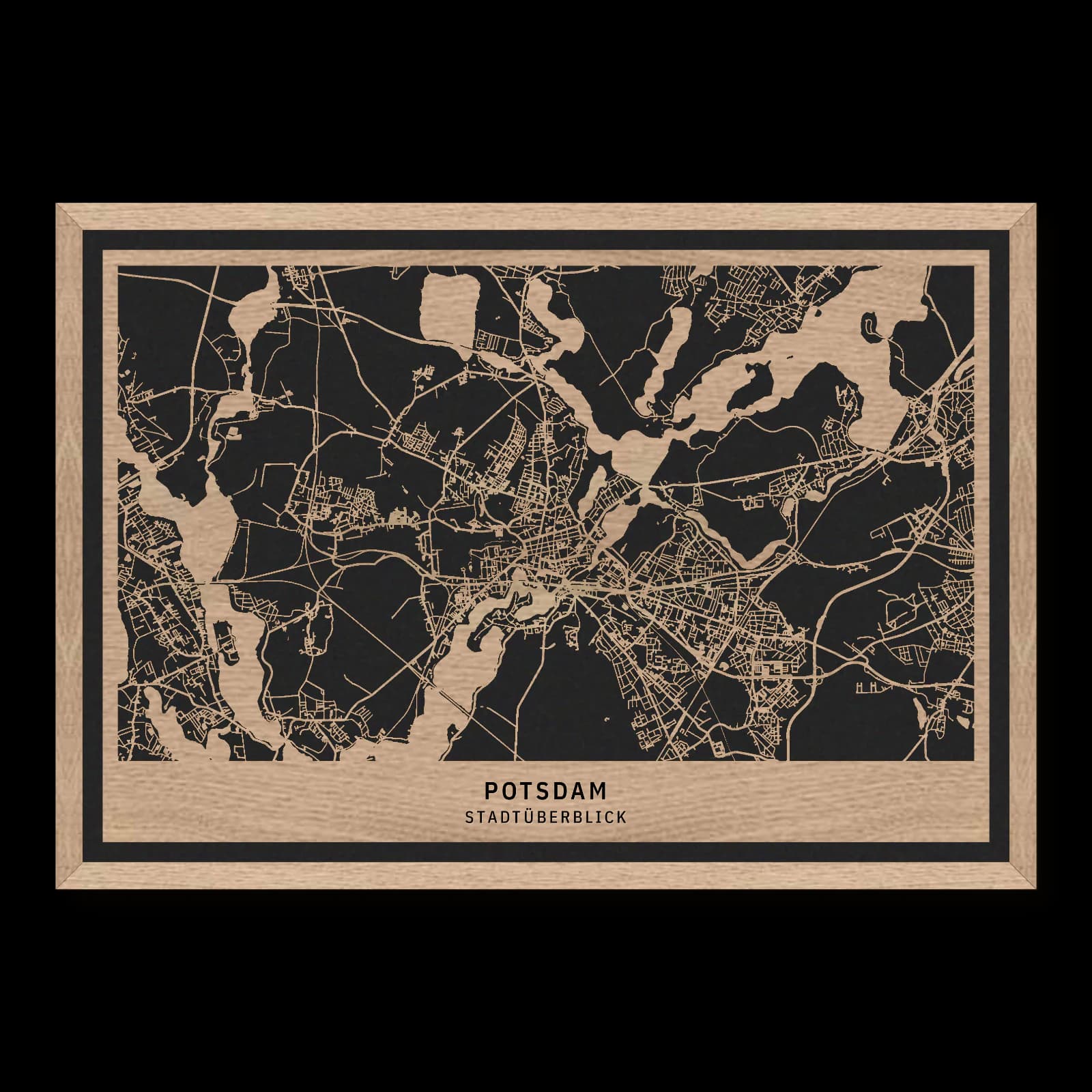
Potsdam.City overview
Rectangular wooden city map of City overview made from oiled oak – two layers with a black back plate and frame.
About the product
Potsdam’s formal garden axes meet the curving shores of the Havel across this wider city view. The map includes the New Palace, Sanssouci, Cecilienhof and Babelsberg Palace, with the main station extending its urban context southwards. Streets connect those separate landscapes to the everyday city between them. Framed in a rectangular format, the oiled oak map sits above a black backing, adding depth to a composition shaped by both planned routes and irregular shorelines.
What does the map show?
- New Palace and Sanssouci to the west
- Cecilienhof and Babelsberg Palace in the overview
- Havel shores and routes towards the main station
- Precisely cut and engraved
- Fine laser details with clear depth
- Carefully inspected and securely packed
- Handmade in Germany
Configuration
Shape: Rectangular · Design: Framed · Material: Oak · Sizes: 20 × 30 cm, 35 × 50 cm, 50 × 70 cm
The configuration shown in the cart and at the time of ordering is authoritative. The preview is not a dimensioned technical drawing.
Availability & production
- Availability
- Made to order
- Production time
- Ships in 3-5 business days
Production starts after successful payment and complete product configuration.
Materials & care
Depending on the variant, lacquered or oiled MDF or oiled real-wood veneer on MDF; optional stainless-steel mounting screws. Acrylic lacquer spray, hard-wax oil and white glue are used in production.
Wood is a natural material. Grain and color may vary slightly from the product images.
Clean with a dry, soft cloth and protect from prolonged moisture and direct heat.
Included & installation
The selected product in the ordered configuration, securely packed and prepared for installation.
- Maximum dimensions 50 × 70 cm and maximum product weight 2 kg.
- Wall-fixing screws and wall plugs are not included. Use fixings suitable for the wall type, substrate and product weight.
- Installation must be carried out by an adult. Keep optional mounting screws and other small parts away from children until installation.
Shipping & returns
Securely packed shipping. Return and cancellation information is available in the legal section.
Shipping costs and delivery options depend on the destination and format. The published cancellation right applies to non-personalised standard goods; it may be excluded for individually made products.
Manufacturer & product identifier
- Manufacturer
- Benjamin Nöst - Lightworks
Rorichmoorer Str. 76
26802 Moormerland, Deutschland
kontakt@lightworks.de - Product identifier
- LW-CAT-C2DD64ED30DB-S, LW-CAT-C2DD64ED30DB-M, LW-CAT-C2DD64ED30DB-L
Together with the order or production batch, the relevant SKU enables traceability. Safety questions and incidents can be reported to the email address shown above.
Product safety
- Decorative product for dry indoor use only; not a toy and not intended for children.
- Protect from moisture, high heat and open flames.
- Do not continue to hang the product after a fall, breakage or visible damage. Keep damaged parts away from children.
Potsdam between garden axes and the Havel
Potsdam’s palaces have helped shape the landscape around them, influencing views, paths and open spaces well beyond their walls. Sanssouci, Cecilienhof and Babelsberg demonstrate different versions of that relationship. Together with the built-up centre and the Havel, they reveal a city that cannot be understood through one palace alone.
Sanssouci and the western landscape
Sanssouci is closely associated with Frederick the Great. Its position above vineyard terraces and its relatively intimate scale support the idea of a personal retreat. The effect depends on more than the building itself. Palace, slope and garden work together to establish a distinctive place.
Further west, the New Palace introduces another architectural emphasis within the same park landscape. Comparing the two makes clear that Potsdam’s palaces are not interchangeable examples of one design. Different ambitions for representation and residence produced different buildings and outdoor spaces. Garden paths connect them while allowing their individual scales to remain apparent.
A landscape made through relationships
UNESCO recognises the Palaces and Parks of Potsdam and Berlin as an ensemble of architecture and garden design developed over an extended period. In Potsdam, the way individual places address their surroundings is especially instructive. Axes, openings and relationships with water create connections beyond the boundaries of a single building.
This does not mean that the entire landscape follows one formal scheme. Its interest comes partly from changes between ordered gardens, freer parkland and built-up neighbourhoods. A route can begin along a clear axis and later meet a shoreline or an everyday street. Those transitions are central to experiencing the city rather than incidental interruptions between major sights.
Other palaces and other histories
Cecilienhof lies northeast of the urban centre. Built in the early twentieth century, it is particularly associated with the Potsdam Conference of 1945. Its appearance differs markedly from Sanssouci, showing that the palace landscape did not emerge within a single historical period.
Babelsberg Palace establishes another relationship with the Havel to the east. From its park, the Havel adds a long, open direction to a landscape otherwise organised by slopes, paths and planted areas. Considering it alongside Cecilienhof and Sanssouci reveals several distinct ways in which architecture can occupy and interpret a landscape.
The main station and southern streets bring everyday urban life into this picture. They connect the celebrated estates with housing, work and movement through the city. Keeping those links visible helps avoid treating Potsdam merely as a sequence of isolated palaces. What emerges instead is a place where buildings, gardens and ordinary streets have developed in relation to one another over many generations.
Sources
- Stiftung Preußische Schlösser und Gärten: Sanssouci Palace — https://www.spsg.de/en/palaces-gardens/object/sanssouci-palace/
- UNESCO World Heritage Centre: Palaces and Parks of Potsdam and Berlin — https://whc.unesco.org/en/list/532/
- Wikipedia: Cecilienhof — https://en.wikipedia.org/wiki/Cecilienhof
- Wikipedia: Babelsberg Palace — https://en.wikipedia.org/wiki/Babelsberg_Palace
- Wikipedia: New Palace, Potsdam — https://en.wikipedia.org/wiki/New_Palace,_Potsdam

Still deciding?
Configure your motif in the studio and see how your city map will look in your space.