
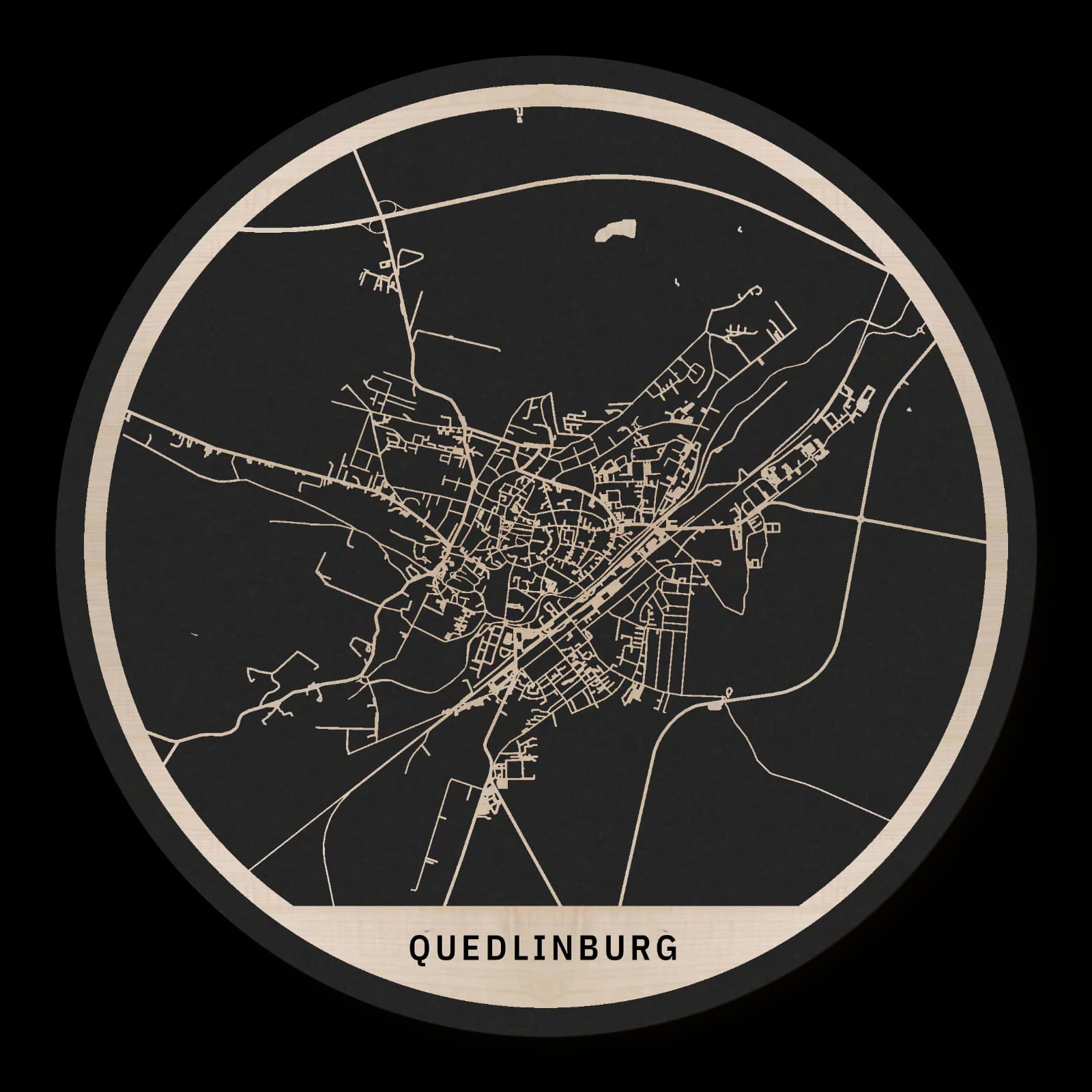
Quedlinburg.City overview
A round maple city map in two wooden layers, tracing Quedlinburg's historic centres against a black back plate.
About the product
Quedlinburg developed around several neighbouring centres rather than one uniform core. Castle Hill, the old town and Münzenberg each have a distinct presence, while St Wiperti recalls early religious and royal history to the southwest. Timber-framed streets extend towards the railway station in the east and later neighbourhoods to the south. Kleers adds a northern residential area to the picture. This wider relationship reveals a complete town behind the famous historic views. Heights, churches, close rows of houses and newer housing districts stand near one another. Their connection shows how older identities remained visible while transport routes and residential growth carried Quedlinburg into later periods. Cut into round maple, the streets bring these grown connections together; a black back plate gives the finer lines depth.
What does the map show?
- Castle Hill beside the old town
- Münzenberg and St Wiperti to the west
- Station side and southern districts within the crop
- Round maple relief over a black back plate
- Precisely cut and engraved
- Fine laser details with clear depth
- Carefully inspected and securely packed
- Handmade in Germany
Configuration
Shape: Round · Design: Layered · Material: Maple · Diameter: Ø 23 cm, Ø 35 cm, Ø 50 cm
The configuration shown in the cart and at the time of ordering is authoritative. The preview is not a dimensioned technical drawing.
Availability & production
- Availability
- Made to order
- Production time
- Ships in 3-5 business days
Production starts after successful payment and complete product configuration.
Materials & care
Depending on the variant, lacquered or oiled MDF or oiled real-wood veneer on MDF; optional stainless-steel mounting screws. Acrylic lacquer spray, hard-wax oil and white glue are used in production.
Wood is a natural material. Grain and color may vary slightly from the product images.
Clean with a dry, soft cloth and protect from prolonged moisture and direct heat.
Included & installation
The selected product in the ordered configuration, securely packed and prepared for installation.
- Maximum dimensions 50 × 70 cm and maximum product weight 2 kg.
- Wall-fixing screws and wall plugs are not included. Use fixings suitable for the wall type, substrate and product weight.
- Installation must be carried out by an adult. Keep optional mounting screws and other small parts away from children until installation.
Shipping & returns
Securely packed shipping. Return and cancellation information is available in the legal section.
Shipping costs and delivery options depend on the destination and format. The published cancellation right applies to non-personalised standard goods; it may be excluded for individually made products.
Manufacturer & product identifier
- Manufacturer
- Benjamin Nöst - Lightworks
Rorichmoorer Str. 76
26802 Moormerland, Deutschland
kontakt@lightworks.de - Product identifier
- LW-CAT-08432CB8DC7B-S, LW-CAT-08432CB8DC7B-M, LW-CAT-08432CB8DC7B-L
Together with the order or production batch, the relevant SKU enables traceability. Safety questions and incidents can be reported to the email address shown above.
Product safety
- Decorative product for dry indoor use only; not a toy and not intended for children.
- Protect from moisture, high heat and open flames.
- Do not continue to hang the product after a fall, breakage or visible damage. Keep damaged parts away from children.
Quedlinburg’s connected historic centres
Quedlinburg’s history occupies several nearby places. The Ottonian associations of Castle Hill sit beside timber-framed streets, Münzenberg and the early religious site of St Wiperti. The station, southern districts and northern housing areas add later chapters, revealing a living town that continued to develop around its exceptionally well-preserved historic fabric.
Royal history above the streets
Quedlinburg has strong associations with the Ottonian period. The collegiate church of St Servatius and Castle Hill recall an important centre of royal and religious power. Their elevated position continues to distinguish them from the streets below. Terrain and historical significance reinforce one another: a place of early authority remains physically prominent within the present-day town.
The UNESCO World Heritage property brings this area together with the old town. That relationship is essential to understanding Quedlinburg. Its significance is not confined to one exceptional church. It also lies in the survival of a broader urban fabric formed from several historic settlement areas. These grew together without losing every trace of their separate origins, leaving several points of reference within a closely connected town.
Timber-framed streets and neighbouring heights
Timber-framed houses shape extensive parts of the older streets. Their periods and forms vary, producing something more complex than a uniform picturesque backdrop. Plot widths, building fronts and small changes in direction establish the rhythm of the public spaces. Individual houses often gain their effect from belonging to a longer sequence. The town’s architectural history is therefore especially clear at the scale of whole neighbourhoods.
Religious sites on different ground
Münzenberg adds another elevated setting west of Castle Hill. Its former convent history gives it an origin of its own. St Wiperti lies farther southwest and recalls a further early religious centre. The proximity of these places explains why Quedlinburg cannot be reduced to a single focal point with later streets arranged evenly around it. Its structure preserves relationships between several historically meaningful locations.
Expansion beyond the early town
The railway station establishes a later transport focus east of the historic centre. Southern neighbourhoods extend the built area in another direction, with the Bismarck Tower in Johannishain relating to the green edge of this part of town. Such places add the development of subsequent centuries to the better-known medieval and early modern story.
Kleers, to the north, represents another period of residential growth. It belongs to the inhabited town whose daily life extends beyond the oldest streets. Considering Castle Hill, the western religious sites, station area and northern districts together gives a fuller sense of Quedlinburg’s central urban body. Exceptional architectural survival and continuing change are both present. The town’s character rests on the recognisable origins of its older centres and on the connections that brought them into contact with later neighbourhoods.
Sources
- UNESCO – Stiftskirche, Schloss und Altstadt von Quedlinburg — https://whc.unesco.org/en/list/535/
- Wikipedia – Quedlinburg — https://de.wikipedia.org/wiki/Quedlinburg
- Wikipedia – Münzenberg (Quedlinburg) — https://de.wikipedia.org/wiki/M%C3%BCnzenberg_(Quedlinburg)
- Wikipedia – St. Wiperti (Quedlinburg) — https://de.wikipedia.org/wiki/St._Wiperti_(Quedlinburg)
- Wikipedia – Bismarckturm (Quedlinburg) — https://de.wikipedia.org/wiki/Bismarckturm_(Quedlinburg)

Still deciding?
Configure your motif in the studio and see how your city map will look in your space.



