
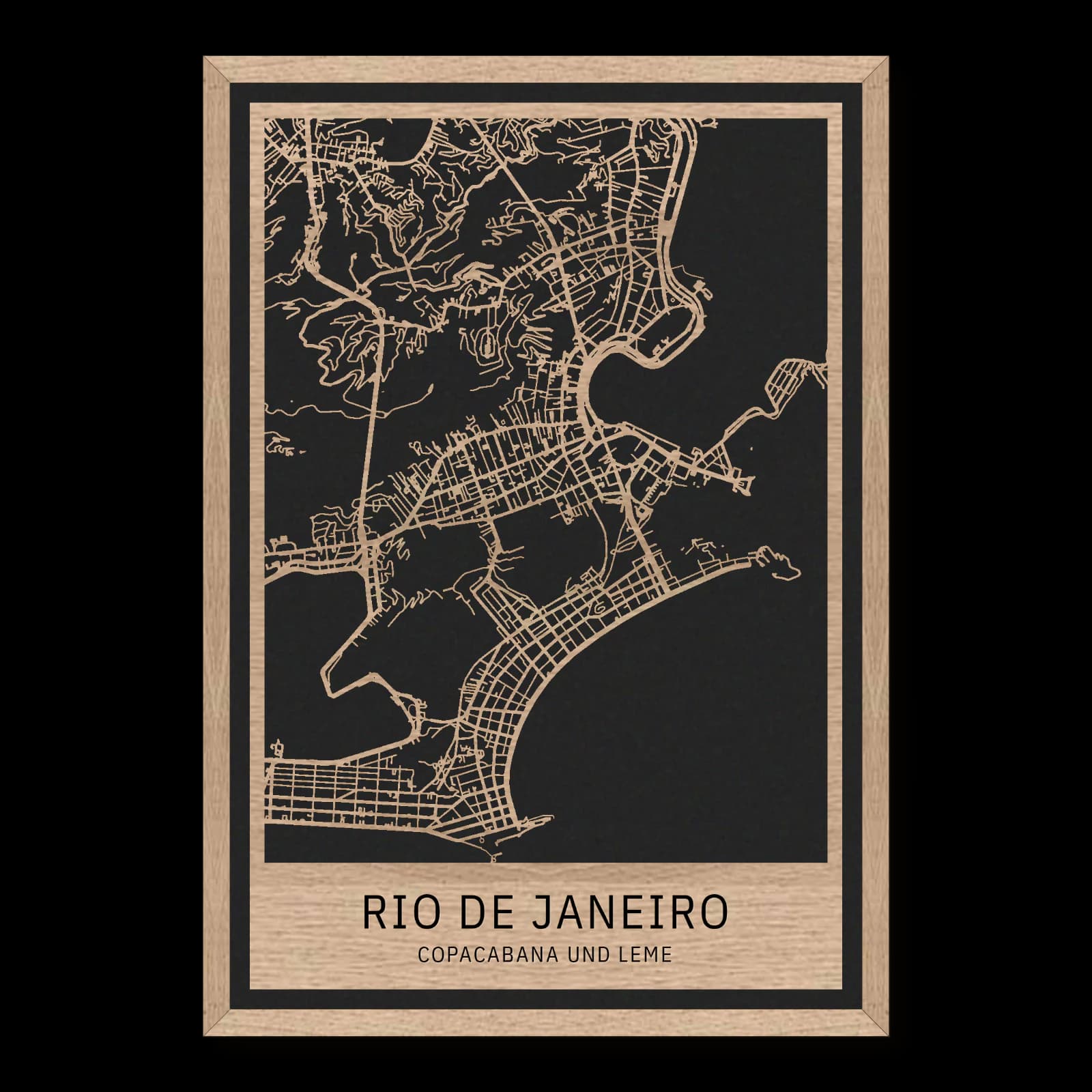
Rio de Janeiro.Copacabana and Leme
A framed oak city map of Copacabana and Leme, where city blocks meet the Atlantic.
About the product
Copacabana and Leme share a continuous beachfront while retaining distinct neighbourhood identities. Dense building fronts stand behind the sand and promenade, with Avenida Atlântica mediating between the city and the open Atlantic. Black-and-white paving gives the shore a recognisable visual rhythm. Fort Copacabana introduces a former military site at the southern end, while Leme shapes the northeastern section. The striking feature is the immediate contact between metropolitan density and expansive water. This beach belongs to an inhabited district of daily journeys and public meeting places. Its curved shoreline connects the different sections even as street alignments and views change along the way. The framed oak relief brings dense streets to a long, curved shoreline. Its black ground defines both structures while preserving the link between the neighbourhoods.
What does the map show?
- Curved coast from Copacabana to Leme
- Avenida Atlântica beside the promenade
- Fort Copacabana at the southern end
- Framed oak against a black ground
- Precisely cut and engraved
- Fine laser details with clear depth
- Carefully inspected and securely packed
- Handmade in Germany
Configuration
Shape: Rectangular · Design: Framed · Material: Oak · Sizes: 20 × 30 cm, 35 × 50 cm, 50 × 70 cm
The configuration shown in the cart and at the time of ordering is authoritative. The preview is not a dimensioned technical drawing.
Availability & production
- Availability
- Made to order
- Production time
- Ships in 3-5 business days
Production starts after successful payment and complete product configuration.
Materials & care
Depending on the variant, lacquered or oiled MDF or oiled real-wood veneer on MDF; optional stainless-steel mounting screws. Acrylic lacquer spray, hard-wax oil and white glue are used in production.
Wood is a natural material. Grain and color may vary slightly from the product images.
Clean with a dry, soft cloth and protect from prolonged moisture and direct heat.
Included & installation
The selected product in the ordered configuration, securely packed and prepared for installation.
- Maximum dimensions 50 × 70 cm and maximum product weight 2 kg.
- Wall-fixing screws and wall plugs are not included. Use fixings suitable for the wall type, substrate and product weight.
- Installation must be carried out by an adult. Keep optional mounting screws and other small parts away from children until installation.
Shipping & returns
Securely packed shipping. Return and cancellation information is available in the legal section.
Shipping costs and delivery options depend on the destination and format. The published cancellation right applies to non-personalised standard goods; it may be excluded for individually made products.
Manufacturer & product identifier
- Manufacturer
- Benjamin Nöst - Lightworks
Rorichmoorer Str. 76
26802 Moormerland, Deutschland
kontakt@lightworks.de - Product identifier
- LW-CAT-772F8CEA6DB9-S, LW-CAT-772F8CEA6DB9-M, LW-CAT-772F8CEA6DB9-L
Together with the order or production batch, the relevant SKU enables traceability. Safety questions and incidents can be reported to the email address shown above.
Product safety
- Decorative product for dry indoor use only; not a toy and not intended for children.
- Protect from moisture, high heat and open flames.
- Do not continue to hang the product after a fall, breakage or visible damage. Keep damaged parts away from children.
Copacabana and Leme along the urban beach
At Copacabana and Leme, the Atlantic lies directly in front of a densely built city. Beach, promenade and Avenida Atlântica form parallel spaces for different activities and kinds of movement. The southern fort and northeastern neighbourhood provide distinct reference points within a continuous, intensely urban waterfront.
Layers between the buildings and the sea
Copacabana’s beach sits immediately beside a densely developed neighbourhood. Several distinct spaces nevertheless intervene between buildings and water: the road, the promenade and the broad sand. Each supports a different activity. Traffic follows Avenida Atlântica, waterside paths allow movement along the coast, and the beach provides an extensive open area directly beside the sea.
This parallel arrangement explains the close relationship between metropolis and shoreline. The buildings meet a heavily used public edge rather than a remote natural setting. Streets from inside the neighbourhood lead towards the coast, connecting the urban interior with open water. The beach consequently belongs to everyday local life as well as to Rio’s internationally familiar image.
A public ground with a graphic identity
Black-and-white paving makes the promenade recognisable as a designed space. Roberto Burle Marx reworked the waterfront landscape in 1970, developing an existing graphic tradition. The design does more than decorate the ground in front of the buildings. It gives a rhythm to the long movement along the shore and provides visual continuity between different sections of the beachfront.
Rio’s UNESCO cultural landscape recognition includes the importance of designed coastal spaces of this kind. Natural form and human intervention are directly related here. The coast supplies the curve, while paving, paths and roads organise its use as part of the city. Open water and carefully shaped public ground remain visible together, giving the promenade a character that neither element would create on its own.
A fort and a neighbouring district
Fort Copacabana occupies the southern end. Built in the early twentieth century, it recalls the military role of the coast and now includes museum uses. Its compact position beside the water differs from the long building fronts around the bay. The site establishes a distinct historical reference for this end of the urban beach.
Leme forms the northeastern beachfront neighbourhood. The shoreline continues physically, while the district retains its own name and local identity. Following the curve changes the direction of façades and the angle of views across the water. The coast remains connected without feeling identical throughout. Copacabana and Leme thus demonstrate a particular form of public city: numerous everyday streets reach the sea, and the promenade joins those separate approaches into one extended shared waterfront.
Sources
- Wikipedia – Copacabana, Rio de Janeiro — https://en.wikipedia.org/wiki/Copacabana%2C_Rio_de_Janeiro
- Wikipedia – Fort Copacabana — https://en.wikipedia.org/wiki/Fort_Copacabana
- Wikipedia – Leme, Rio de Janeiro — https://en.wikipedia.org/wiki/Leme%2C_Rio_de_Janeiro
- UNESCO – Rio: Stadtlandschaft zwischen Bergen und Meer — https://whc.unesco.org/en/list/1100/
- Wikipedia – Avenida Atlântica — https://en.wikipedia.org/wiki/Avenida_Atl%C3%A2ntica

Still deciding?
Configure your motif in the studio and see how your city map will look in your space.