
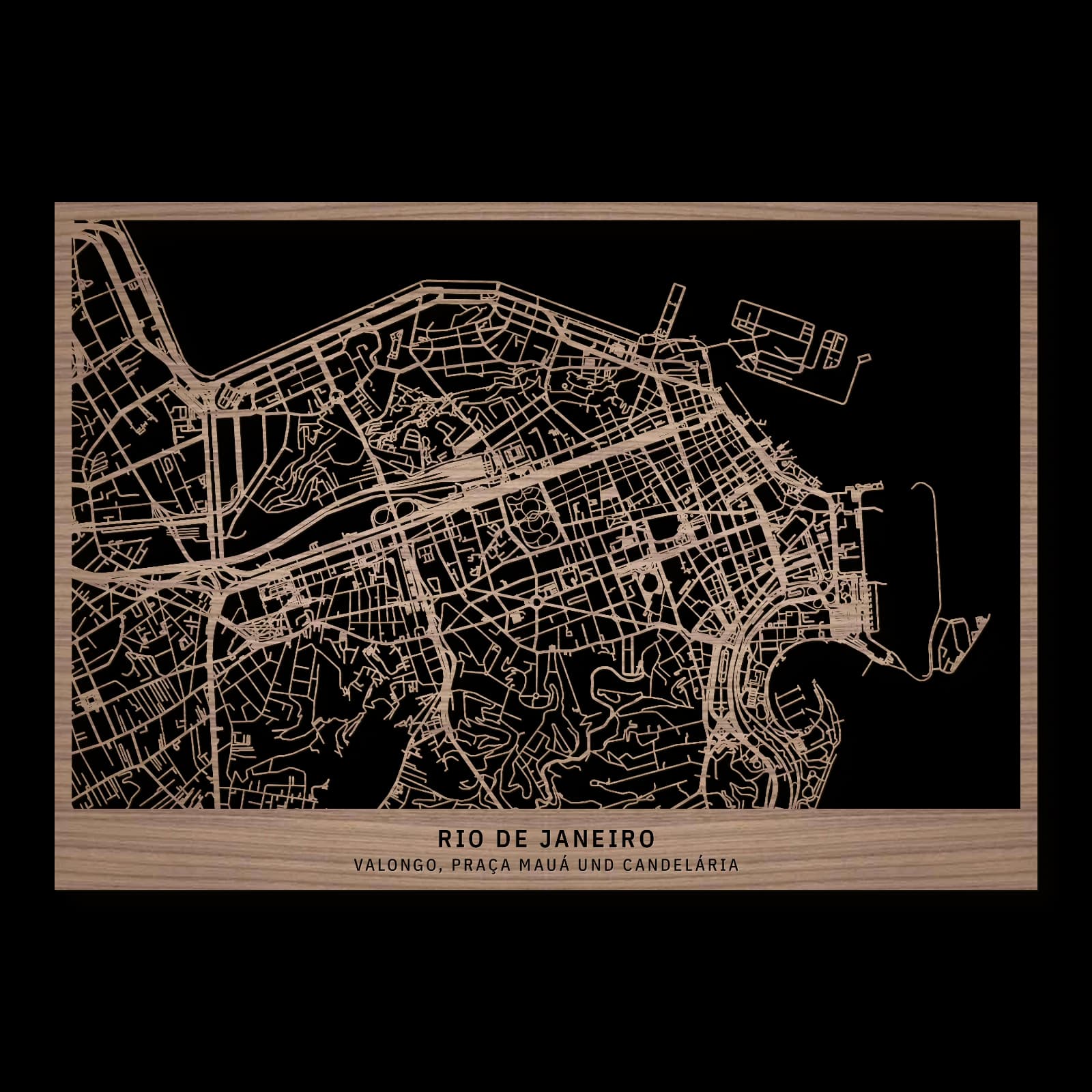
Rio de Janeiro.Valongo, Praça Mauá and Candelária
A Classic city map in oiled walnut, focused on Rio's harbour district from Valongo to Candelária.
About the product
Rio’s harbour district brings places of very different significance into close proximity. Valongo Wharf preserves evidence of the forced arrival of enslaved African people and anchors that history in the ground of the city. Praça Mauá and the Museum of Tomorrow represent a more recent transformation of public space, while Candelária Church provides an older architectural focus to the southeast. Streets connect archaeological memory, religious history and a science museum at the water’s edge. The area becomes understandable as a layered urban place. Its recent renewal gains historical depth only when surviving buildings and the evidence of violence and exploitation remain part of the account. The walnut Classic cut follows the streets between these places without treating their histories as interchangeable. The harbour's newer buildings stand beside evidence of a painful past.
What does the map show?
- Valongo Wharf as a place of remembrance
- Praça Mauá and Museum of Tomorrow by the water
- Candelária southeast of the harbour
- Classic cut in oiled walnut
- Precisely cut and engraved
- Fine laser details with clear depth
- Carefully inspected and securely packed
- Handmade in Germany
Configuration
Shape: Rectangular · Design: Classic · Material: Walnut · Sizes: 20 × 30 cm, 35 × 50 cm, 50 × 70 cm
The configuration shown in the cart and at the time of ordering is authoritative. The preview is not a dimensioned technical drawing.
Availability & production
- Availability
- Made to order
- Production time
- Ships in 3-5 business days
Production starts after successful payment and complete product configuration.
Materials & care
Depending on the variant, lacquered or oiled MDF or oiled real-wood veneer on MDF; optional stainless-steel mounting screws. Acrylic lacquer spray, hard-wax oil and white glue are used in production.
Wood is a natural material. Grain and color may vary slightly from the product images.
Clean with a dry, soft cloth and protect from prolonged moisture and direct heat.
Included & installation
The selected product in the ordered configuration, securely packed and prepared for installation.
- Maximum dimensions 50 × 70 cm and maximum product weight 2 kg.
- Wall-fixing screws and wall plugs are not included. Use fixings suitable for the wall type, substrate and product weight.
- Installation must be carried out by an adult. Keep optional mounting screws and other small parts away from children until installation.
Shipping & returns
Securely packed shipping. Return and cancellation information is available in the legal section.
Shipping costs and delivery options depend on the destination and format. The published cancellation right applies to non-personalised standard goods; it may be excluded for individually made products.
Manufacturer & product identifier
- Manufacturer
- Benjamin Nöst - Lightworks
Rorichmoorer Str. 76
26802 Moormerland, Deutschland
kontakt@lightworks.de - Product identifier
- LW-CAT-D32A99284A47-S, LW-CAT-D32A99284A47-M, LW-CAT-D32A99284A47-L
Together with the order or production batch, the relevant SKU enables traceability. Safety questions and incidents can be reported to the email address shown above.
Product safety
- Decorative product for dry indoor use only; not a toy and not intended for children.
- Protect from moisture, high heat and open flames.
- Do not continue to hang the product after a fall, breakage or visible damage. Keep damaged parts away from children.
Valongo, Praça Mauá and Candelária: histories of the harbour
Different kinds of attention are needed along Rio’s harbour. Valongo is a site of remembrance for enslavement, Praça Mauá a renewed public space, and Candelária part of the centre’s longer architectural history. The Museum of Tomorrow adds a contemporary perspective without replacing or resolving the meanings of those neighbouring places.
Evidence of a history beneath the city
Valongo Wharf was an arrival point for enslaved African people in the early nineteenth century. Its archaeological remains document a system of forced displacement and exploitation. The site’s significance lies in remembering people whose freedom and lives were destroyed by the slave trade. It requires a different approach from a picturesque account of waterfront architecture or ordinary urban redevelopment.
Structures uncovered during works in 2011 made this history visible again within the present-day city. The site became a UNESCO World Heritage property in 2017, recognising its importance as evidence of enslavement and the African diaspora. Later streets and buildings had overlain the earlier use. Archaeology returned part of that concealed past to public awareness and established a physical place at which it could be addressed.
A public square facing the harbour
Praça Mauá lies east of Valongo at the waterfront. Created in the early twentieth century, it was redesigned during more recent harbour renewal. Its open ground connects the built streets with the water, introducing a broader scale than the neighbourhoods immediately behind it. The change from working harbour edge to public space is particularly apparent in this relationship.
A museum addressing the future
The Museum of Tomorrow occupies a pier beyond the square. Designed by Santiago Calatrava and opened in 2015, the museum addresses scientific and societal questions about the future. Its conspicuous form differs from the older architecture of the centre. The position over the water reinforces that distinction and establishes a new point of reference within the harbour landscape.
Candelária and the route into the centre
Candelária Church stands to the southeast. Its construction extended from the late eighteenth into the nineteenth century, combining different architectural forms. The church occupies an important position within the built centre and supplies a historical counterpoint to the newer museum. Its presence recalls the longstanding relationship between the harbour area, religious institutions and the wider life of the city.
Moving between Valongo, Praça Mauá and Candelária means encountering different kinds of historical evidence. Archaeological remains, redesigned public ground and an inherited church building each invite different questions. Together, they prevent harbour renewal from becoming a simple story of new architecture replacing an obsolete district. Uses and appearances can change, but understanding this place continues to require attention to its earlier layers, above all to the history of enslaved people preserved at Valongo.
Sources
- UNESCO – Archäologische Stätte Cais do Valongo — https://whc.unesco.org/en/list/1548/
- Wikipedia – Valongo Wharf — https://en.wikipedia.org/wiki/Valongo_Wharf
- Wikipedia – Museum of Tomorrow — https://en.wikipedia.org/wiki/Museum_of_Tomorrow
- Wikipedia – Candelária Church — https://en.wikipedia.org/wiki/Candel%C3%A1ria_Church
- Wikipedia – Praça Mauá — https://en.wikipedia.org/wiki/Pra%C3%A7a_Mau%C3%A1

Still deciding?
Configure your motif in the studio and see how your city map will look in your space.