
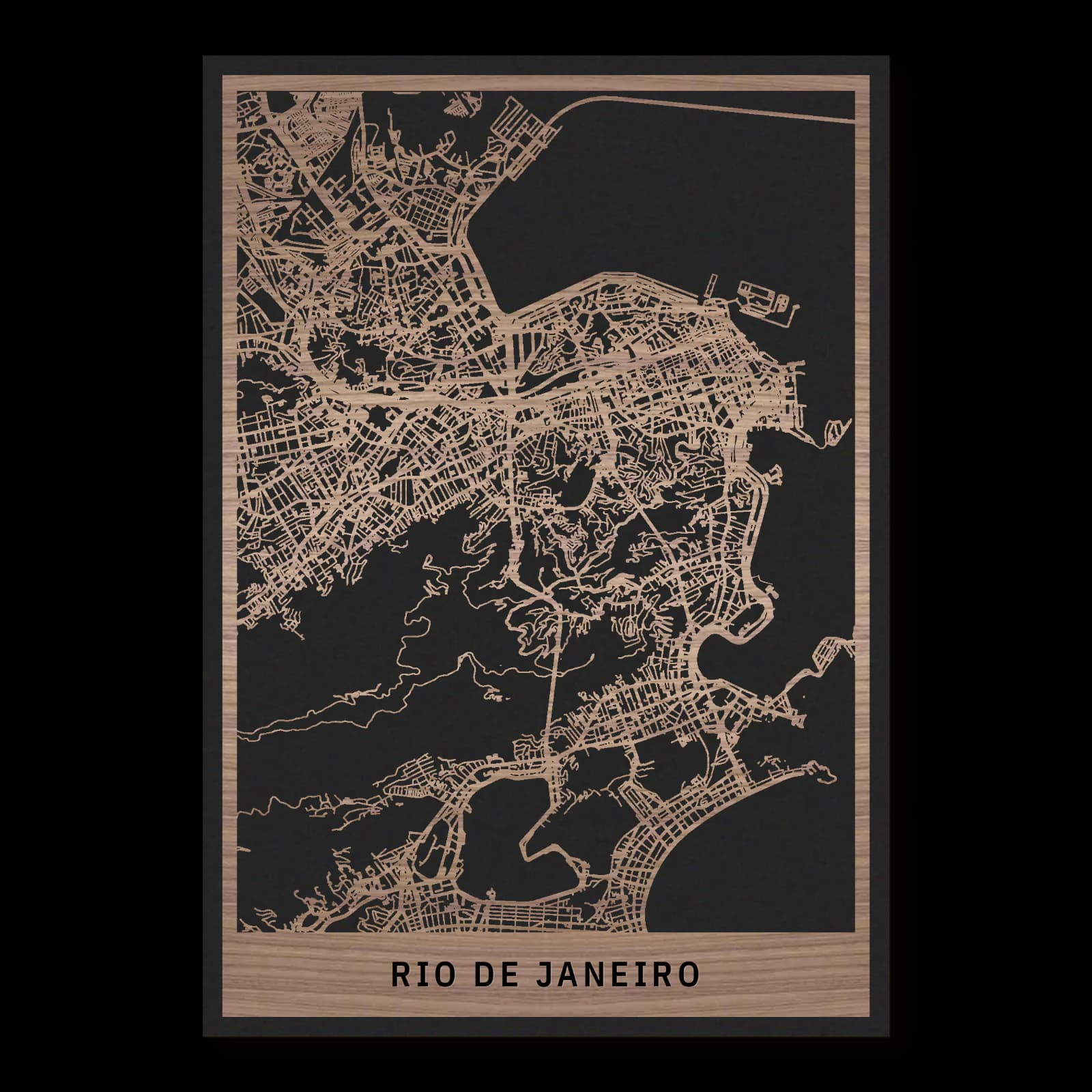
Rio de Janeiro.City overview
A two-layer walnut city map of Rio, connecting harbour, hills and Atlantic shore.
About the product
Rio de Janeiro’s central urban landscape cannot be separated from its terrain. Hills and water define neighbourhoods and guide the connections between them. Maracanã, Candelária Church and the Museum of Tomorrow establish different public settings in the northern and harbour areas. Farther south, the Botanical Garden and Copacabana bring greenery and open shoreline into close contact with densely built districts. Together, these places reveal a city of sport, religious history, scientific culture and everyday life beside the sea. Landscape is not a distant backdrop here. It enters the urban fabric and helps explain why neighbouring areas can have such different shapes and identities. Oiled walnut holds these far-reaching districts in a rectangular map. Against its black back plate, streets and shoreline form different kinds of order.
What does the map show?
- Maracanã north of the centre
- Candelária and the Museum of Tomorrow near the harbour
- Botanical Garden and Copacabana to the south
- Walnut over a black back plate
- Precisely cut and engraved
- Fine laser details with clear depth
- Carefully inspected and securely packed
- Handmade in Germany
Configuration
Shape: Rectangular · Design: Layered · Material: Walnut · Sizes: 20 × 30 cm, 35 × 50 cm, 50 × 70 cm
The configuration shown in the cart and at the time of ordering is authoritative. The preview is not a dimensioned technical drawing.
Availability & production
- Availability
- Made to order
- Production time
- Ships in 3-5 business days
Production starts after successful payment and complete product configuration.
Materials & care
Depending on the variant, lacquered or oiled MDF or oiled real-wood veneer on MDF; optional stainless-steel mounting screws. Acrylic lacquer spray, hard-wax oil and white glue are used in production.
Wood is a natural material. Grain and color may vary slightly from the product images.
Clean with a dry, soft cloth and protect from prolonged moisture and direct heat.
Included & installation
The selected product in the ordered configuration, securely packed and prepared for installation.
- Maximum dimensions 50 × 70 cm and maximum product weight 2 kg.
- Wall-fixing screws and wall plugs are not included. Use fixings suitable for the wall type, substrate and product weight.
- Installation must be carried out by an adult. Keep optional mounting screws and other small parts away from children until installation.
Shipping & returns
Securely packed shipping. Return and cancellation information is available in the legal section.
Shipping costs and delivery options depend on the destination and format. The published cancellation right applies to non-personalised standard goods; it may be excluded for individually made products.
Manufacturer & product identifier
- Manufacturer
- Benjamin Nöst - Lightworks
Rorichmoorer Str. 76
26802 Moormerland, Deutschland
kontakt@lightworks.de - Product identifier
- LW-CAT-35DCD39B719E-S, LW-CAT-35DCD39B719E-M, LW-CAT-35DCD39B719E-L
Together with the order or production batch, the relevant SKU enables traceability. Safety questions and incidents can be reported to the email address shown above.
Product safety
- Decorative product for dry indoor use only; not a toy and not intended for children.
- Protect from moisture, high heat and open flames.
- Do not continue to hang the product after a fall, breakage or visible damage. Keep damaged parts away from children.
Rio de Janeiro’s city of hills, gardens and water
Rio’s hills and shores are active elements in the structure of its central city. Harbour districts, Maracanã, the Botanical Garden and Copacabana occupy very different settings within one connected urban area. Their relationship shows how natural terrain and deliberately created public places together shape the identity of this distinctive landscape.
Terrain within the urban fabric
Rio de Janeiro’s UNESCO recognition concerns a cultural landscape between mountains and sea. The key relationship is between natural forms and human intervention. Hills, coasts and gardens do not simply sit beside the city. They influence where neighbourhoods develop, how connections are made and the way public spaces are experienced. Buildings respond differently to the varied conditions of this divided terrain.
In the southern districts, dense streets stand particularly close to open water. Copacabana combines a substantial urban neighbourhood with an extended beach. Farther west, the Botanical Garden provides a different kind of green setting within the city. These places have distinct origins, yet both demonstrate how landscape can become part of everyday public life.
The Botanical Garden was founded in 1808. Its history involves the introduction and study of plants, bringing scientific activity together with designed grounds. It is therefore more than an unbuilt space between residential districts. The garden has an institutional history and a purposeful internal arrangement within the wider urban landscape.
Maracanã, northwest of the southern shoreline, provides another form of shared public place. Opened for the 1950 football World Cup, the stadium became closely associated with the city’s sporting identity. Its scale differs sharply from ordinary surrounding streets and houses. Here, collective activity is concentrated in a structure intended for large crowds, while the garden and beach support different patterns of movement and gathering.
The historic centre and a changing harbour
Candelária Church introduces a historical focus near the central harbour area. Its construction combines different architectural phases within a setting unlike the southern beachfront districts. Farther north, the Museum of Tomorrow projects into the water on a pier. Opened in 2015, the science museum belongs to a more recent phase in the transformation of this waterfront.
The relationship between church and museum brings inherited urban history into contact with new public uses. Read alongside Maracanã, the Botanical Garden and Copacabana, it reveals the variety of central Rio. Large landforms divide the city, while institutions and designed open spaces create additional points of focus. Their different scales are part of the character of the whole: stadium, garden, church and beach neighbourhood belong to the same inhabited landscape without sharing one purpose or one physical form.
Sources
- UNESCO – Rio: Stadtlandschaft zwischen Bergen und Meer — https://whc.unesco.org/en/list/1100/
- Wikipedia – Maracanã Stadium — https://en.wikipedia.org/wiki/Maracan%C3%A3_Stadium
- Wikipedia – Rio de Janeiro Botanical Garden — https://en.wikipedia.org/wiki/Rio_de_Janeiro_Botanical_Garden
- Wikipedia – Rio de Janeiro — https://en.wikipedia.org/wiki/Rio_de_Janeiro
- Wikipedia – Museum of Tomorrow — https://en.wikipedia.org/wiki/Museum_of_Tomorrow
- Wikipedia – Copacabana, Rio de Janeiro — https://en.wikipedia.org/wiki/Copacabana%2C_Rio_de_Janeiro

Still deciding?
Configure your motif in the studio and see how your city map will look in your space.



