
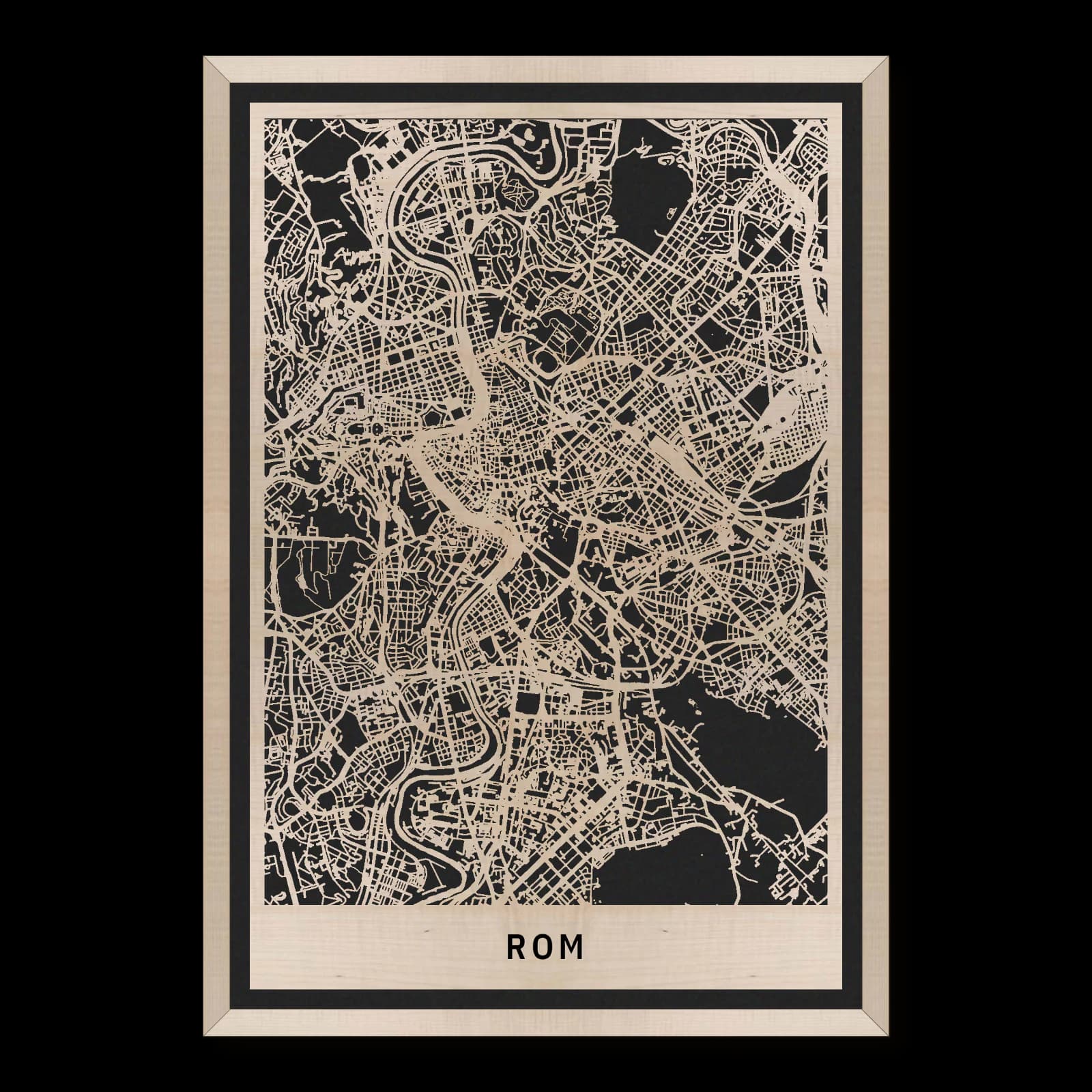
Rome.City overview
A framed city map in oiled maple, tracing Rome's historic layers through two wooden levels.
About the product
Rome brings many building periods into one continuous urban landscape. The Colosseum recalls the ancient city, while St John Lateran represents a long religious history. Villa Borghese opens an extensive garden setting to the north, and the Janiculum introduces higher ground west of the Tiber. St Paul Outside the Walls establishes another historic focus farther south. Dense neighbourhoods, major streets and river bends connect these places. Older monuments stand within the present city rather than apart from it. Terrain, water and changing uses have repeatedly reshaped Rome, while leaving earlier layers visible in the spaces through which ordinary urban life continues today. Framed maple brings river bends, slopes and streets into one map. The black back plate defines its lighter cut lines while keeping the city around the monuments in view.
What does the map show?
- Colosseum and St John Lateran
- Tiber bends below the Janiculum
- Villa Borghese as a northern green space
- Framed maple relief over a black ground
- Precisely cut and engraved
- Fine laser details with clear depth
- Carefully inspected and securely packed
- Handmade in Germany
Configuration
Shape: Rectangular · Design: Framed · Material: Maple · Sizes: 20 × 30 cm, 35 × 50 cm, 50 × 70 cm
The configuration shown in the cart and at the time of ordering is authoritative. The preview is not a dimensioned technical drawing.
Availability & production
- Availability
- Made to order
- Production time
- Ships in 3-5 business days
Production starts after successful payment and complete product configuration.
Materials & care
Depending on the variant, lacquered or oiled MDF or oiled real-wood veneer on MDF; optional stainless-steel mounting screws. Acrylic lacquer spray, hard-wax oil and white glue are used in production.
Wood is a natural material. Grain and color may vary slightly from the product images.
Clean with a dry, soft cloth and protect from prolonged moisture and direct heat.
Included & installation
The selected product in the ordered configuration, securely packed and prepared for installation.
- Maximum dimensions 50 × 70 cm and maximum product weight 2 kg.
- Wall-fixing screws and wall plugs are not included. Use fixings suitable for the wall type, substrate and product weight.
- Installation must be carried out by an adult. Keep optional mounting screws and other small parts away from children until installation.
Shipping & returns
Securely packed shipping. Return and cancellation information is available in the legal section.
Shipping costs and delivery options depend on the destination and format. The published cancellation right applies to non-personalised standard goods; it may be excluded for individually made products.
Manufacturer & product identifier
- Manufacturer
- Benjamin Nöst - Lightworks
Rorichmoorer Str. 76
26802 Moormerland, Deutschland
kontakt@lightworks.de - Product identifier
- LW-CAT-698E848377B2-S, LW-CAT-698E848377B2-M, LW-CAT-698E848377B2-L
Together with the order or production batch, the relevant SKU enables traceability. Safety questions and incidents can be reported to the email address shown above.
Product safety
- Decorative product for dry indoor use only; not a toy and not intended for children.
- Protect from moisture, high heat and open flames.
- Do not continue to hang the product after a fall, breakage or visible damage. Keep damaged parts away from children.
Rome between the Tiber, hills and inherited city
Central Rome combines different periods with a varied landscape. Ancient structures, major churches and public gardens occupy ground within a continuously inhabited city. Between Villa Borghese, the Janiculum, the Lateran and St Paul’s, the Tiber connects distinct areas without imposing one regular plan or reducing their history to a single age.
Antiquity inside the living city
The Colosseum was built in the first century CE as an amphitheatre. Its elliptical form remains a particularly clear point of reference in present-day Rome. The structure reveals the scale that public entertainment could assume in the ancient city. Yet it does not stand in a landscape isolated from subsequent life. Streets and later neighbourhoods have placed it within additional urban relationships.
That coexistence is fundamental to Rome. Earlier buildings survived, changed or acquired new surroundings. The cityscape consequently consists of relationships between periods as much as examples from each one. An ancient structure can continue to influence a street direction, an open area or the identity of a district long after its original function has ended. History remains an active physical condition for later development.
Churches establish further centres
St John Lateran is Rome’s cathedral. Its position east of the older ancient centre provides a distinct religious focus. Major churches became places towards which routes, squares and neighbourhoods were oriented. Their importance is therefore urban as well as religious. The Lateran adds a long and continuing institutional history to the city’s ancient layers.
St Paul Outside the Walls lies farther south, close to the Tiber corridor. The basilica was rebuilt after a major fire in 1823. Its history makes clear that significance does not depend entirely on physical fabric remaining unchanged. Continuity can also be expressed through reconstruction. The church’s southern location broadens the understanding of Rome beyond the concentration of monuments most often associated with its centre.
Gardens, higher ground and river bends
Villa Borghese provides an extensive designed green space to the north. Close to the built city, its garden landscape offers routes and distances different from those of surrounding streets. West of the Tiber, the Janiculum rises above neighbouring ground. This height introduces another spatial experience and demonstrates how strongly the terrain contributes to Rome’s urban character.
The Tiber changes direction as it passes through the city. Embankments and bridges establish connections while allowing the two sides to retain distinct settings. Gardens, hills, churches and ancient structures do not form a uniform collection of attractions. Each responds to different historical purposes and geographical conditions. Rome’s coherence emerges from their continued proximity within a densely inhabited city, where everyday streets keep these unlike places connected and successive periods remain physically present beside one another.
Sources
- UNESCO – Historisches Zentrum von Rom — https://whc.unesco.org/en/list/91/
- Wikipedia – Colosseum — https://en.wikipedia.org/wiki/Colosseum
- Wikipedia – Villa Borghese gardens — https://en.wikipedia.org/wiki/Villa_Borghese_gardens
- Wikipedia – Janiculum — https://en.wikipedia.org/wiki/Janiculum
- Wikipedia – Basilica of Saint Paul Outside the Walls — https://en.wikipedia.org/wiki/Basilica_of_Saint_Paul_Outside_the_Walls
- Wikipedia – Archbasilica of Saint John Lateran — https://en.wikipedia.org/wiki/Archbasilica_of_Saint_John_Lateran

Still deciding?
Configure your motif in the studio and see how your city map will look in your space.