
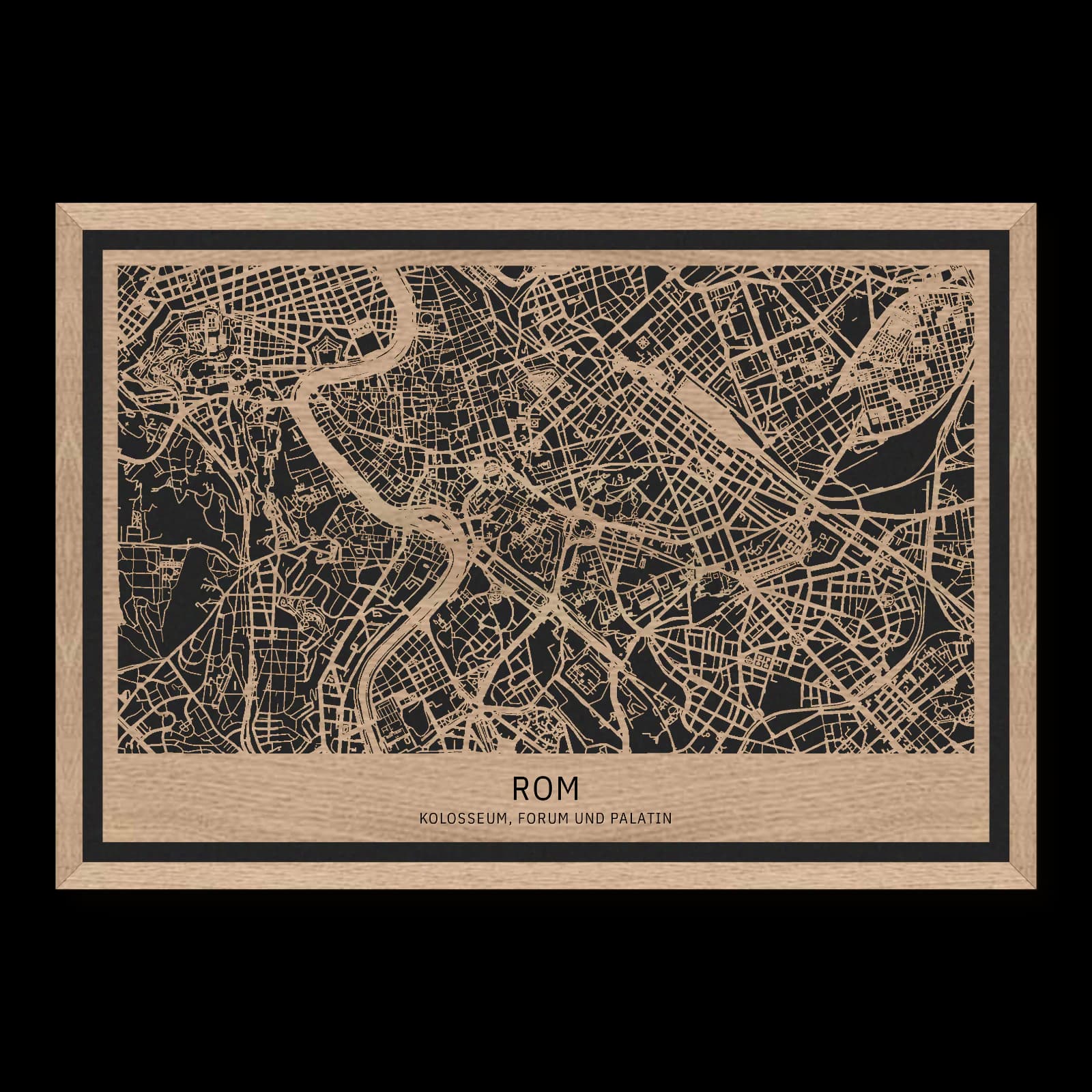
Rome.Colosseum, Forum and Palatine
A framed oak city map of ancient Rome around the Colosseum, Roman Forum and Palatine.
About the product
The Colosseum, Roman Forum and Palatine occupy neighbouring ground in ancient Rome. This crop joins the amphitheatre, public forum and hill of imperial residences through their surrounding routes. The places become part of a wooden street map rather than isolated landmarks. Framed in oiled oak, the landscape design has two layers, with a black back plate providing contrast beneath the cut surface.
What does the map show?
- Colosseum
- Roman Forum
- Palatine
- Two wooden layers with a black back plate
- Precisely cut and engraved
- Fine laser details with clear depth
- Carefully inspected and securely packed
- Handmade in Germany
Configuration
Shape: Rectangular · Design: Framed · Material: Oak · Sizes: 20 × 30 cm, 35 × 50 cm, 50 × 70 cm
The configuration shown in the cart and at the time of ordering is authoritative. The preview is not a dimensioned technical drawing.
Availability & production
- Availability
- Made to order
- Production time
- Ships in 3-5 business days
Production starts after successful payment and complete product configuration.
Materials & care
Depending on the variant, lacquered or oiled MDF or oiled real-wood veneer on MDF; optional stainless-steel mounting screws. Acrylic lacquer spray, hard-wax oil and white glue are used in production.
Wood is a natural material. Grain and color may vary slightly from the product images.
Clean with a dry, soft cloth and protect from prolonged moisture and direct heat.
Included & installation
The selected product in the ordered configuration, securely packed and prepared for installation.
- Maximum dimensions 50 × 70 cm and maximum product weight 2 kg.
- Wall-fixing screws and wall plugs are not included. Use fixings suitable for the wall type, substrate and product weight.
- Installation must be carried out by an adult. Keep optional mounting screws and other small parts away from children until installation.
Shipping & returns
Securely packed shipping. Return and cancellation information is available in the legal section.
Shipping costs and delivery options depend on the destination and format. The published cancellation right applies to non-personalised standard goods; it may be excluded for individually made products.
Manufacturer & product identifier
- Manufacturer
- Benjamin Nöst - Lightworks
Rorichmoorer Str. 76
26802 Moormerland, Deutschland
kontakt@lightworks.de - Product identifier
- LW-CAT-13DF7A5614EF-S, LW-CAT-13DF7A5614EF-M, LW-CAT-13DF7A5614EF-L
Together with the order or production batch, the relevant SKU enables traceability. Safety questions and incidents can be reported to the email address shown above.
Product safety
- Decorative product for dry indoor use only; not a toy and not intended for children.
- Protect from moisture, high heat and open flames.
- Do not continue to hang the product after a fall, breakage or visible damage. Keep damaged parts away from children.
Rome between the Forum, Palatine and Colosseum
A public centre, an imperial residential hill and an amphitheatre occupy neighbouring ground in ancient Rome. The Roman Forum, Palatine and Colosseum nevertheless served very different purposes. Their relationship brings valley, elevated terrain and a substantial individual building together, making several dimensions of the ancient city understandable within a compact area.
The Forum was an urban setting
The Roman Forum developed in a valley that had once been marshy ground. It became a centre for several aspects of public life, including political activity, religion, commerce and the administration of justice. The site should therefore not be understood as a single monument. Its importance depended on an arrangement of open spaces, routes and buildings serving different purposes.
Successive centuries added temples, basilicas and commemorative structures. New building altered the setting while earlier elements continued to influence it. The surviving remains consequently do not represent one uniform construction phase. They reveal a long process of development within the same central space, making the Forum different from a square designed and completed in a single campaign.
Imperial ground above the valley
The Palatine rises south of the Forum. Associated with Rome's early history, the hill later became an important setting for imperial residences. Elevation establishes a clear distinction from the public centre below. At the same time, their proximity makes the political and architectural relationship between these areas readily understandable. The hill and valley belonged to closely connected parts of the ancient city.
Later periods introduced further uses on the Palatine, including gardens. The site consequently contains several historical layers rather than one unchanged imperial landscape. Ruins and open ground now create an environment different from the enclosed residential complexes of antiquity. The hill's position above the Forum nevertheless preserves a fundamental geographical relationship from that earlier city.
An amphitheatre with its own form
The Colosseum stands east of the Forum and Palatine. Its purpose as an amphitheatre differed from that of either the political centre or the imperial residences. Its substantial oval structure is organised accordingly. The enclosed outline and arrangement around an arena contrast with the more open sequence of different buildings and public spaces in the Forum.
The short distances between these places make their differences especially informative. Public urban life, imperial residence and large-scale spectacle each required distinct forms of architecture and occupied ground in different ways. Their concentration explains the variety of monumental structures within this part of Rome, rather than suggesting that all ancient buildings served comparable roles.
Terrain remains essential to that understanding. The Forum occupies the valley, the Palatine rises above it, and the Colosseum establishes a sharply defined building beside them. This arrangement places the archaeological remains within an intelligible urban geography. Each is a major historical place, but their close relationships also reveal the different tasks that once operated together within an ancient metropolis.
Sources
- Turismo Roma – The Roman Forum and the Palatine — https://www.turismoroma.it/en/places/roman-forum-and-palatine
- Wikipedia – Colosseum — https://en.wikipedia.org/wiki/Colosseum
- Wikipedia – Forum Romanum — https://de.wikipedia.org/wiki/Forum_Romanum
- Wikipedia – Palatine Hill — https://en.wikipedia.org/wiki/Palatine_Hill

Still deciding?
Configure your motif in the studio and see how your city map will look in your space.