
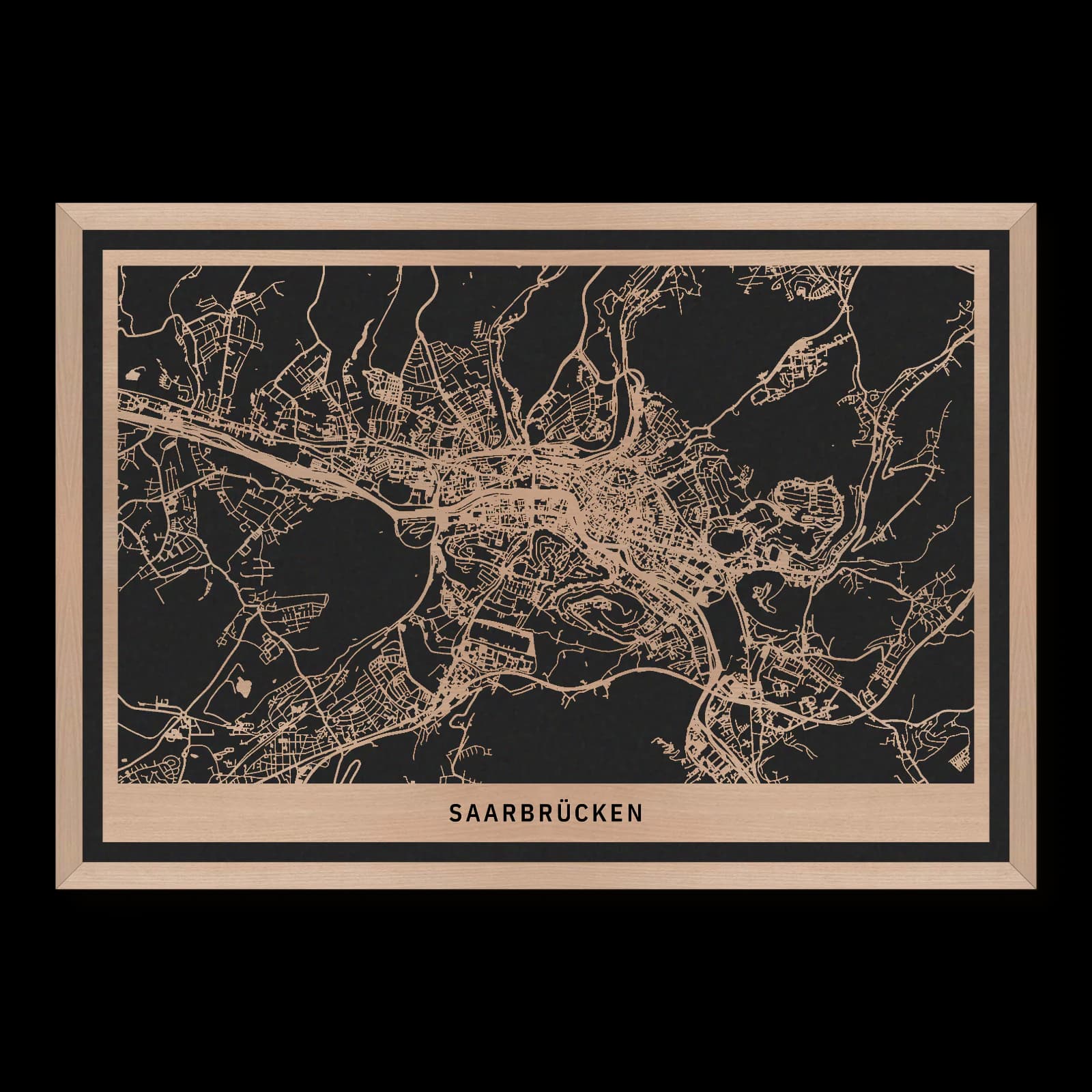
Saarbrücken.City overview
Rectangular wooden city map made from oiled beech – two layers with a black back plate and frame.
About the product
The Saar links several distinct parts of Saarbrücken. The castle and Ludwigskirche give the southern centre a formal historic presence, while St Johann extends the city on the opposite bank. Farther west lies Burbach, with its industrial associations; Sankt Arnual provides another older focus to the southeast. Rotenbühl broadens the view towards the northern residential districts. Bridges connect these different settings without making them uniform. Following the river reveals a city of changing scales, from carefully composed Baroque spaces to neighbourhood streets and larger working landscapes. Saarbrücken’s identity emerges from the relationship between these places and the water that gives them a common direction.
What does the map show?
- Castle and Ludwigskirche south of the Saar
- St Johann on the opposite bank
- Burbach and Sankt Arnual in the wider city
- Precisely cut and engraved
- Fine laser details with clear depth
- Carefully inspected and securely packed
- Handmade in Germany
Configuration
Shape: Rectangular · Design: Framed · Material: Beech · Sizes: 20 × 30 cm, 35 × 50 cm, 50 × 70 cm
The configuration shown in the cart and at the time of ordering is authoritative. The preview is not a dimensioned technical drawing.
Availability & production
- Availability
- Made to order
- Production time
- Ships in 3-5 business days
Production starts after successful payment and complete product configuration.
Materials & care
Depending on the variant, lacquered or oiled MDF or oiled real-wood veneer on MDF; optional stainless-steel mounting screws. Acrylic lacquer spray, hard-wax oil and white glue are used in production.
Wood is a natural material. Grain and color may vary slightly from the product images.
Clean with a dry, soft cloth and protect from prolonged moisture and direct heat.
Included & installation
The selected product in the ordered configuration, securely packed and prepared for installation.
- Maximum dimensions 50 × 70 cm and maximum product weight 2 kg.
- Wall-fixing screws and wall plugs are not included. Use fixings suitable for the wall type, substrate and product weight.
- Installation must be carried out by an adult. Keep optional mounting screws and other small parts away from children until installation.
Shipping & returns
Securely packed shipping. Return and cancellation information is available in the legal section.
Shipping costs and delivery options depend on the destination and format. The published cancellation right applies to non-personalised standard goods; it may be excluded for individually made products.
Manufacturer & product identifier
- Manufacturer
- Benjamin Nöst - Lightworks
Rorichmoorer Str. 76
26802 Moormerland, Deutschland
kontakt@lightworks.de - Product identifier
- LW-CAT-15B8223A9154-S, LW-CAT-15B8223A9154-M, LW-CAT-15B8223A9154-L
Together with the order or production batch, the relevant SKU enables traceability. Safety questions and incidents can be reported to the email address shown above.
Product safety
- Decorative product for dry indoor use only; not a toy and not intended for children.
- Protect from moisture, high heat and open flames.
- Do not continue to hang the product after a fall, breakage or visible damage. Keep damaged parts away from children.
Saarbrücken and the neighbourhoods of the Saar
Saarbrücken combines several urban histories along one river. A castle above the Saar, a planned Baroque church square and older neighbourhood centres occupy different positions within the city. The wider relationship between Burbach, the central river crossings, Rotenbühl and Sankt Arnual explains how those histories fit together.
Architecture above the southern bank
Saarbrücken Castle stands on raised ground close to the Saar. Its history extends back beyond the Baroque building to earlier fortifications, making the site a long-standing point of authority. The relationship with the terrain remains clear: the river lies below, while streets and public spaces connect the castle to the surrounding city. Its prominence depends on that combination of elevation, water and urban setting.
The Ludwigskirche expresses a different approach to public architecture. Designed by Friedrich Joachim Stengel, the church forms part of a coordinated square rather than standing as an unrelated monument. Consecrated in 1775, it gives the surrounding buildings a shared focus. Wartime destruction and subsequent restoration add another historical layer. The ensemble seen today therefore carries both an eighteenth-century urban idea and the experience of rebuilding.
Crossing between historic centres
St Johann occupies the opposite side of the river. The Saar separates the older urban areas, while bridges make them parts of one central network. Crossing the water brings changes in street alignment, sequences of squares and the way buildings meet the ground. These differences are useful reminders that Saarbrücken grew through the joining of distinct places, rather than simply expanding evenly from one original centre.
The river establishes a common axis without removing those distinctions. Water, riverside routes and crossings create a broad space within the built city. Connections concentrate around bridges, while the stretches between them retain the sense of two separate banks. The resulting structure gives Saarbrücken an identity that goes beyond its individual historic landmarks.
The wider chain of neighbourhoods
Burbach extends the urban landscape westwards and introduces the city’s industrial and residential history. Larger working areas belong to the same river corridor as the formal buildings in the centre. Rotenbühl, to the northeast, adds a different residential setting and shows how the city spreads away from the immediate waterside onto northern ground.
Sankt Arnual contributes another older centre to the southeast. Its position adds a further point of reference along the Saar rather than simply marking the end of a central district. Between these neighbourhoods, the character of the city changes repeatedly. Their connection lies in proximity, transport and their shared relationship with the river. Castle, church, working districts and older settlement cores together show the variety of activities accommodated within this single valley landscape.
Sources
- Deutsche Zentrale für Tourismus – Saarbrücken — https://www.germany.travel/en/cities-culture/saarbruecken.html
- Landeshauptstadt Saarbrücken – Ludwigskirche — https://tourismus.saarbruecken.de/besuchen/sehenswuerdigkeiten/ludwigskirche
- Wikipedia – Schloss Saarbrücken — https://de.wikipedia.org/wiki/Schloss_Saarbr%C3%BCcken
- Wikipedia – Burbach (Saarbrücken) — https://de.wikipedia.org/wiki/Burbach_(Saarbr%C3%BCcken)
- Wikipedia – Sankt Arnual — https://de.wikipedia.org/wiki/Sankt_Arnual
- Wikipedia – Rotenbühl — https://de.wikipedia.org/wiki/Rotenb%C3%BChl

Still deciding?
Configure your motif in the studio and see how your city map will look in your space.



