
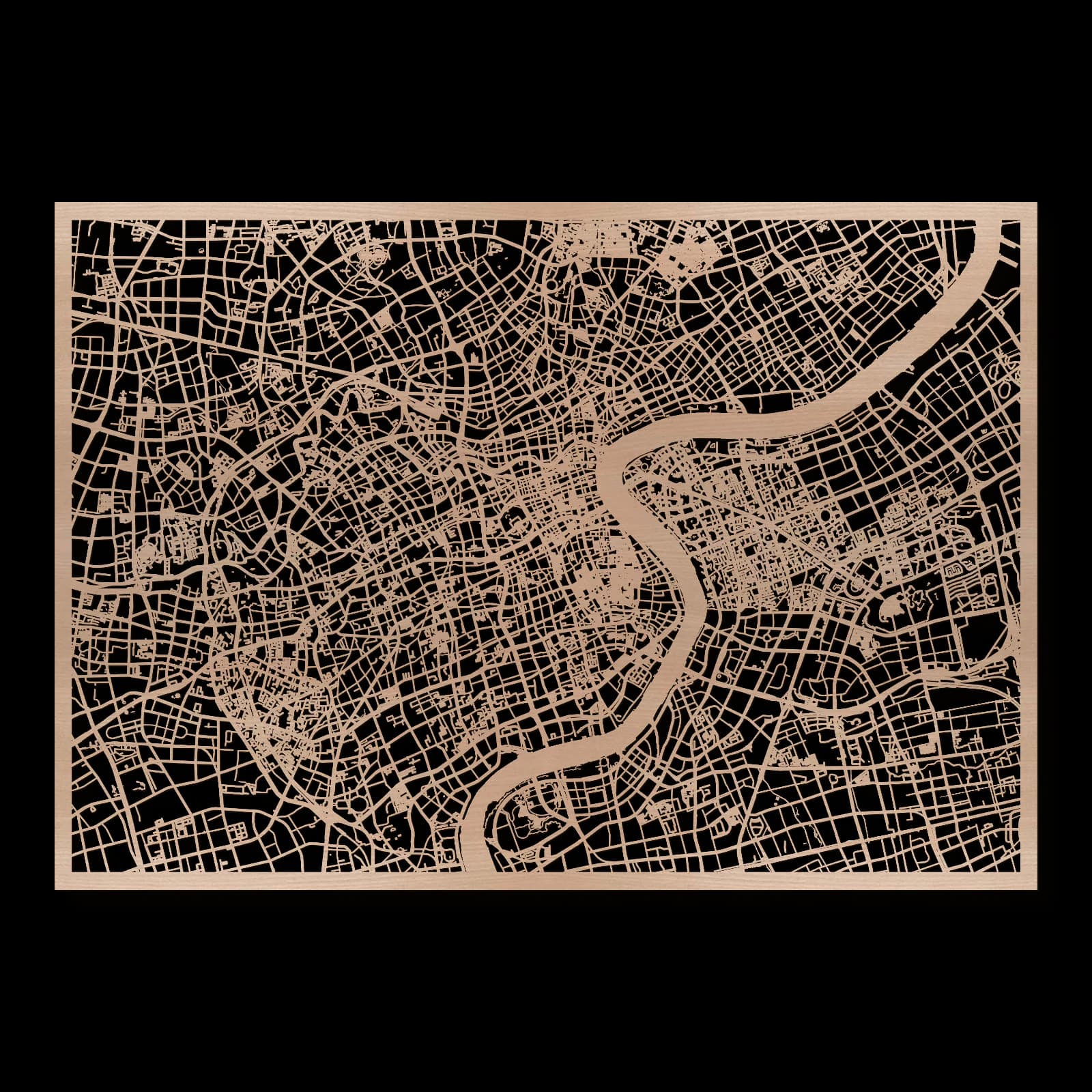
Shanghai.Huangpu, Bund and western city
Rectangular wooden city map made from oiled beech.
About the product
The Huangpu connects Shanghai's historic Bund waterfront with the high-rise districts opposite. Dense neighbourhoods and major routes stretch from Jing'an Temple in the west to Shanghai Tower, with Yu Garden adding an older urban layer. Wood lends the city map a calm, natural warmth. The broad river bend brings gardens, established streets and modern metropolitan forms into one composition.
What does the map show?
- Bund on the western Huangpu bank
- Shanghai Tower opposite
- Yu Garden in the older city
- Waibaidu Bridge over Suzhou Creek
- Precisely cut and engraved
- Fine laser details with clear depth
- Carefully inspected and securely packed
- Handmade in Germany
Configuration
Shape: Rectangular · Design: Classic · Material: Beech · Sizes: 20 × 30 cm, 35 × 50 cm, 50 × 70 cm
The configuration shown in the cart and at the time of ordering is authoritative. The preview is not a dimensioned technical drawing.
Availability & production
- Availability
- Made to order
- Production time
- Ships in 3-5 business days
Production starts after successful payment and complete product configuration.
Materials & care
Depending on the variant, lacquered or oiled MDF or oiled real-wood veneer on MDF; optional stainless-steel mounting screws. Acrylic lacquer spray, hard-wax oil and white glue are used in production.
Wood is a natural material. Grain and color may vary slightly from the product images.
Clean with a dry, soft cloth and protect from prolonged moisture and direct heat.
Included & installation
The selected product in the ordered configuration, securely packed and prepared for installation.
- Maximum dimensions 50 × 70 cm and maximum product weight 2 kg.
- Wall-fixing screws and wall plugs are not included. Use fixings suitable for the wall type, substrate and product weight.
- Installation must be carried out by an adult. Keep optional mounting screws and other small parts away from children until installation.
Shipping & returns
Securely packed shipping. Return and cancellation information is available in the legal section.
Shipping costs and delivery options depend on the destination and format. The published cancellation right applies to non-personalised standard goods; it may be excluded for individually made products.
Manufacturer & product identifier
- Manufacturer
- Benjamin Nöst - Lightworks
Rorichmoorer Str. 76
26802 Moormerland, Deutschland
kontakt@lightworks.de - Product identifier
- LW-CAT-70879A84408F-S, LW-CAT-70879A84408F-M, LW-CAT-70879A84408F-L
Together with the order or production batch, the relevant SKU enables traceability. Safety questions and incidents can be reported to the email address shown above.
Product safety
- Decorative product for dry indoor use only; not a toy and not intended for children.
- Protect from moisture, high heat and open flames.
- Do not continue to hang the product after a fall, breakage or visible damage. Keep damaged parts away from children.
Shanghai’s western city and the Huangpu banks
Central Shanghai contains several neighbouring areas with markedly different characters. Western districts, older gardens and streets, a historic waterfront and high-rise development opposite form a layered urban setting. The Huangpu and Suzhou Creek help explain their relationships, revealing the city’s development beyond its most familiar individual buildings and skyline landmarks.
The Bund as a historic riverfront
The Bund is one of Shanghai’s defining historic urban settings. Its riverside position brings a sequence of substantial buildings into direct contact with the Huangpu. The architecture recalls Shanghai’s development as an international centre of trade and finance from the nineteenth century. Spatially, the relationship between river, waterfront road and the districts behind it is particularly important. The Bund forms a linear frontage and the edge of a much larger street network. Its significance therefore lies in the individual buildings and in the way their collective front organises the western city beside the water.
A different scale across the river
Shanghai Tower stands opposite within a much more recent high-rise district. Large buildings and more generous road and open-space layouts introduce a different urban scale. The Huangpu separates the two banks while also placing them in direct relation. Historic commercial waterfront and modern tower belong to different phases of development within the same central river setting. Their proximity makes Shanghai’s transformation especially clear. Economic focal points expanded and shifted, while the river remained a shared geographical foundation, continuing to relate the neighbouring districts through the broad space between their contrasting urban forms.
Older places within the western city
Yu Garden lies south of the central Bund stretch within an older urban area. Its carefully divided garden spaces introduce a smaller, more enclosed setting among the surrounding streets. Jing’an Temple establishes another historical reference farther west within extensive built neighbourhoods. Major routes and districts between these places give the western city its continuity. The broad view consequently shows that Shanghai’s history is distributed beyond the celebrated waterfront. Older places remain embedded within the expanding urban area, each retaining a particular relationship with the streets and buildings that developed around it.
Two waterways and a crossing
At the northern end of the Bund setting, Waibaidu Bridge crosses Suzhou Creek near its meeting with the Huangpu. Two water lines running in different directions come together here. The bridge connects neighbouring districts while also marking a distinctive point within the river system. Alongside the Bund, Yu Garden, Jing’an Temple and Shanghai Tower, it completes an urban composition containing several scales and historical layers. The waterways provide a shared structure, while the different buildings and street patterns allow each area to remain recognisable as a distinct part of central Shanghai.
Sources
- Shanghai Municipal Government: The Bund Heritage Zone — https://english.shanghai.gov.cn/en-HeritageZones/20231208/f2ac293f546a4d32aba936f2e733a47c.html
- Shanghai Municipal Government: Suzhou Creek City Tour — https://english.shanghai.gov.cn/en-CityTour/20240108/60439c42c79c4265bb3418351a9da4e4.html
- Shanghai Municipal Administration of Culture and Tourism: Exploring Huangpu — https://www.meet-in-shanghai.net/en/shanghai-citywalk-route-recommendations/exploring-the-depths-of-huangpu-303853/
- Shanghai Municipal Government: The Bund — https://english.shanghai.gov.cn/en-ScenicSpots/20231205/584672cc6d044eabb5f7f6fc9049a19f.html

Still deciding?
Configure your motif in the studio and see how your city map will look in your space.