Solingen.Linked town centres and Wupper hills
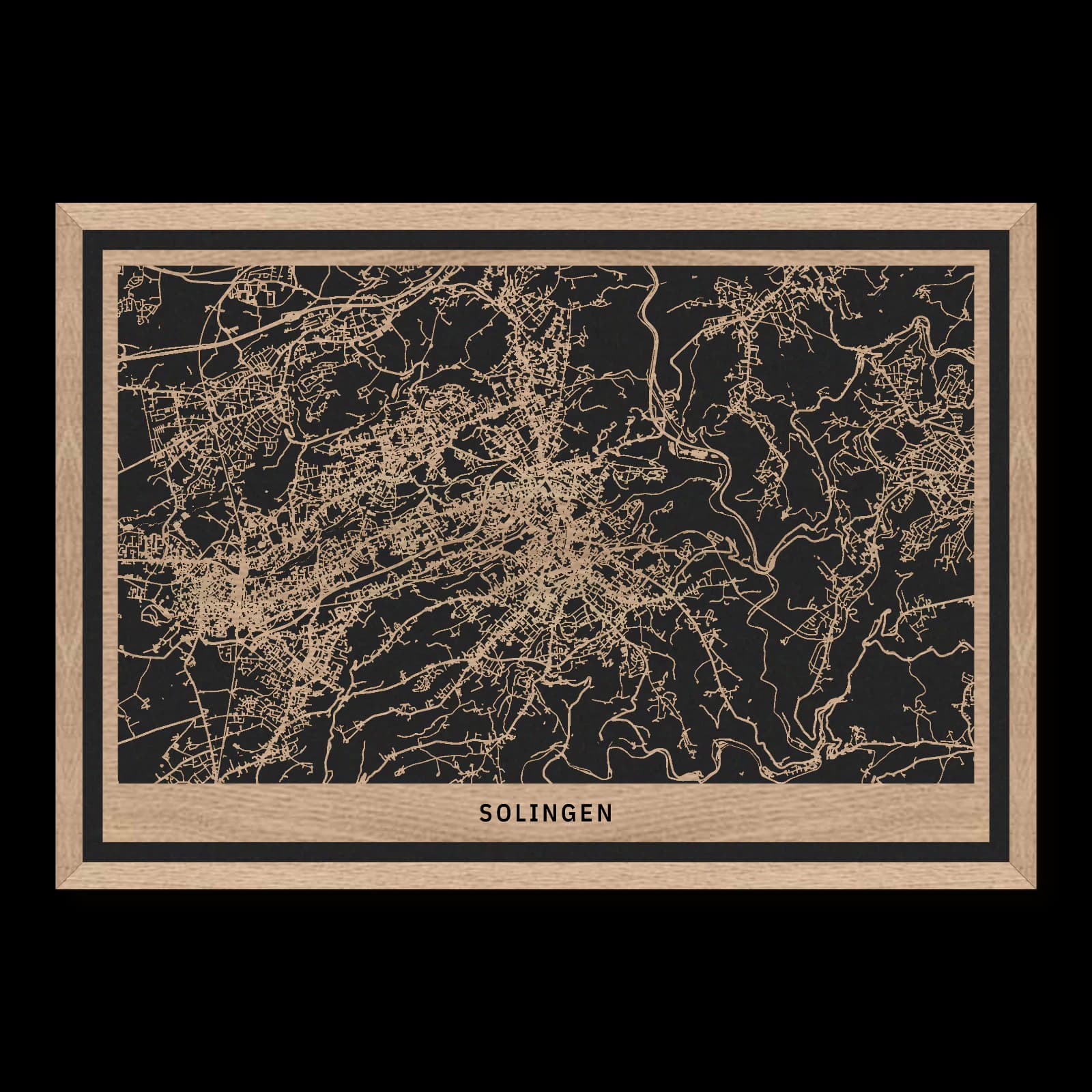
Rectangular wooden city map made from oiled oak – two layers with a black back plate and frame.
About the product
Solingen spans several established centres, from Ohligs and Gräfrath to the Wupper hills. The German Blade Museum, Müngsten Bridge and Burg Castle bring craft, engineering and landscape into the same broad city view. Wood provides a restrained surface for the branching streets and valley spaces. Their connections reveal a city shaped by distinct local centres and terrain rather than one compact historical core.
What does the map show?
- German Blade Museum
- Müngsten Bridge
- Burg Castle
- Ohligs
- Wupper hills
- Precisely cut and engraved
- Fine laser details with clear depth
- Carefully inspected and securely packed
- Handmade in Germany
Configuration
Shape: Rectangular · Design: Framed · Material: Oak · Sizes: 20 × 30 cm, 35 × 50 cm, 50 × 70 cm
The configuration shown in the cart and at the time of ordering is authoritative. The preview is not a dimensioned technical drawing.
Availability & production
- Availability
- Made to order
- Production time
- Ships in 3-5 business days
Production starts after successful payment and complete product configuration.
Materials & care
Depending on the variant, lacquered or oiled MDF or oiled real-wood veneer on MDF; optional stainless-steel mounting screws. Acrylic lacquer spray, hard-wax oil and white glue are used in production.
Wood is a natural material. Grain and color may vary slightly from the product images.
Clean with a dry, soft cloth and protect from prolonged moisture and direct heat.
Included & installation
The selected product in the ordered configuration, securely packed and prepared for installation.
- Maximum dimensions 50 × 70 cm and maximum product weight 2 kg.
- Wall-fixing screws and wall plugs are not included. Use fixings suitable for the wall type, substrate and product weight.
- Installation must be carried out by an adult. Keep optional mounting screws and other small parts away from children until installation.
Shipping & returns
Securely packed shipping. Return and cancellation information is available in the legal section.
Shipping costs and delivery options depend on the destination and format. The published cancellation right applies to non-personalised standard goods; it may be excluded for individually made products.
Manufacturer & product identifier
- Manufacturer
- Benjamin Nöst - Lightworks
Rorichmoorer Str. 76
26802 Moormerland, Deutschland
kontakt@lightworks.de - Product identifier
- LW-CAT-A14AA4E52180-S, LW-CAT-A14AA4E52180-M, LW-CAT-A14AA4E52180-L
Together with the order or production batch, the relevant SKU enables traceability. Safety questions and incidents can be reported to the email address shown above.
Product safety
- Decorative product for dry indoor use only; not a toy and not intended for children.
- Protect from moisture, high heat and open flames.
- Do not continue to hang the product after a fall, breakage or visible damage. Keep damaged parts away from children.
Solingen’s craft heritage, separate centres and Wupper valleys
Solingen’s urban centres occupy different positions within a landscape of pronounced valleys. Gräfrath brings blade-making heritage into the northern city, while Ohligs forms a western rail connection. Müngsten Bridge and Burg Castle extend the view southeastwards. The distances and terrain between these places are essential parts of the city’s character.
Engineering over the Wupper
The Wupper creates a deep landscape corridor southeast of Solingen’s central areas. Müngsten Bridge carries a railway high above this valley, its steel arch reaching 107 metres over the river. The structure makes the difference between transport level and valley floor particularly clear. It is therefore both an engineering landmark and a way to understand the surrounding terrain. Unlike an urban square, the bridge belongs to a landscape where routes and settlement occupy different elevations and where connecting one side with another presents a substantial spatial challenge.
The castle and the settlement below
Burg Castle stands farther southeast above the river landscape. The castle complex and the settlement of Unterburg below form separate parts of the same historical setting. Half-timbered and slate-clad houses contribute to the older settlement’s appearance, with waterways and crossings defining its position in the valley. The castle introduces another use of elevated ground, associated with rule and fortification. Together with Müngsten Bridge, it reveals how different historical needs responded to the same terrain: one through defensive prominence, the other through a high-level railway connection.
Blade-making knowledge in Gräfrath
In the north, the German Blade Museum lies close to Gräfrath’s historic market square. Its subjects range from early cutting tools to designed cutlery, connecting practical objects with craft, use and artistic decisions. This gives visitors a tangible introduction to Solingen’s blade-making associations. The museum’s position in an established local centre differs from the southeastern valley sites. Gräfrath consequently contributes its own urban and cultural setting. The collection explains an important strand of the city’s commercial history without suggesting that all of Solingen developed around one manufacturing place.
Ohligs and the western rail centre
Solingen’s main station stands in western Ohligs, away from the other historic centres. Its distance from Gräfrath and Burg Castle makes the separate locations of the centres apparent. Railways and roads connect areas that are not immediately adjacent. Residential districts and other built spaces fill the intervals. This pattern cannot be understood solely by looking at a tightly concentrated historic centre. Ohligs adds a western transport reference, demonstrating how local settlements and movement corridors belong to a more extensive, connected urban structure.
Different places within one city
Solingen’s dispersed geography is a defining part of its identity. Museum, station, railway bridge and castle perform different roles and occupy contrasting landscape settings. The alternation of streets, settlements and valleys makes their connections important to the whole picture. Craft history, local urban centres and substantial engineering remain visible within the same city. The Wupper hills give those relationships a clear landscape context. Solingen emerges as a place with several organising points, where the spaces and routes between its landmarks tell a story as significant as the landmarks themselves.
Sources
- Müngstener Brücke, Brückenpark und Wupperberge — https://solingen.de/inhalt/tour-1-muengstener-bruecke-brueckenpark-und-wupperberge
- Burg & Umgebung - schlossburg — https://www.schlossburg.de/information/burg-umgebung
- Deutsches klingenmuseum - Stadt Solingen — https://solingen.de/inhalt/deutsches-klingenmuseum
- ENTDECKE Solingen! — https://solingen.de/inhalt/entdecke-solingen-abo
Still deciding?
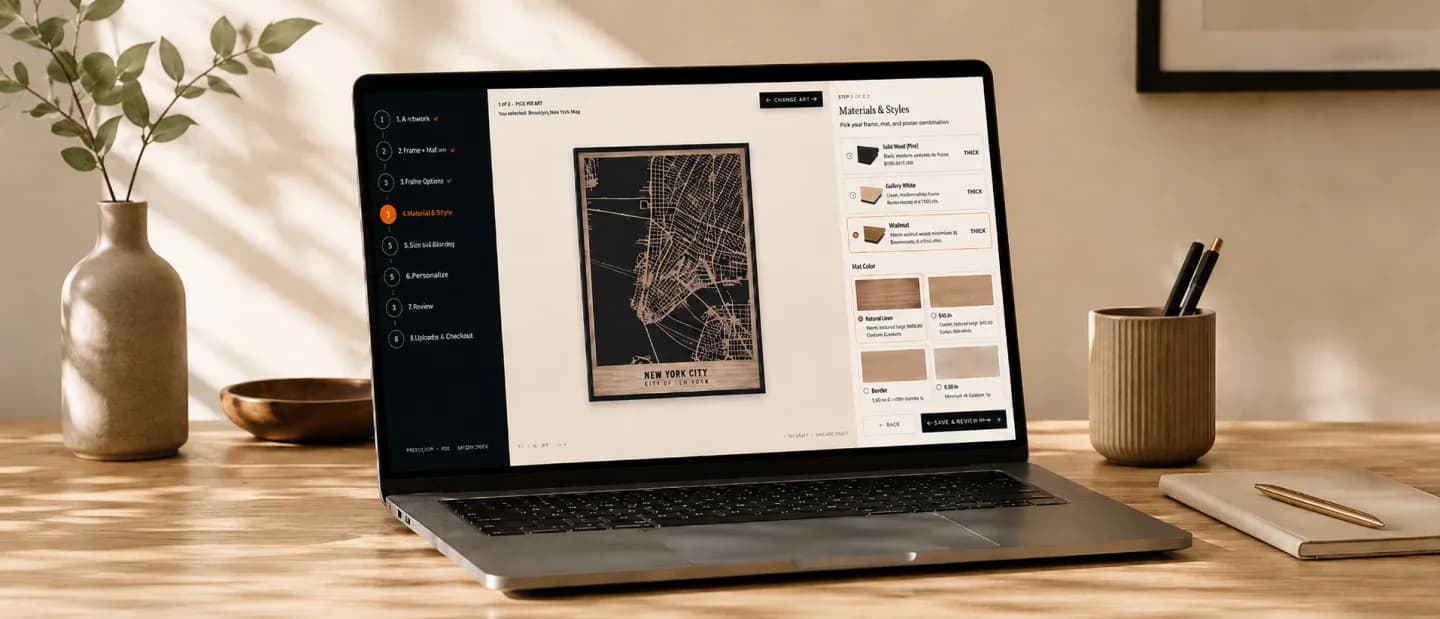
Configure your motif in the studio and see how your city map will look in your space.