
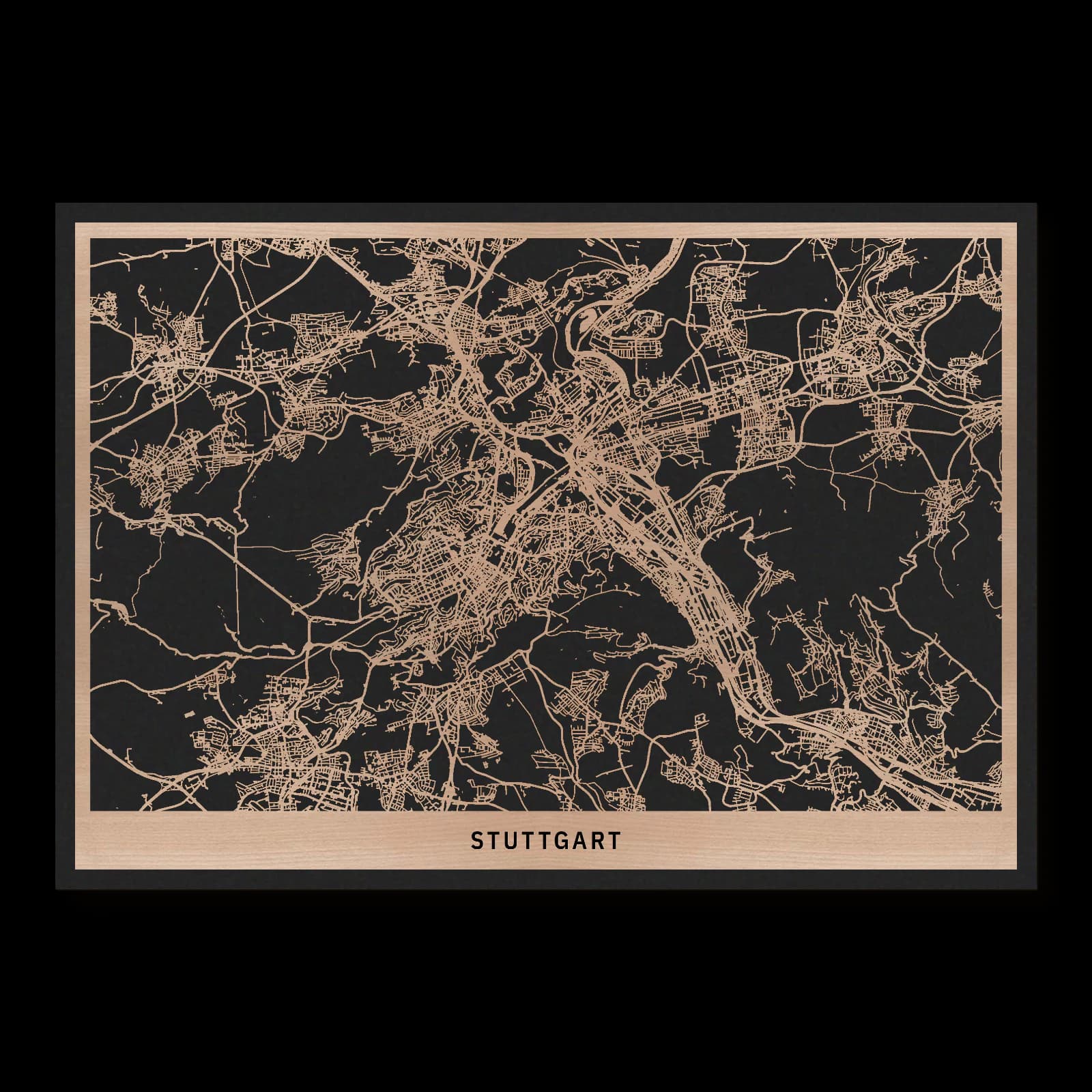
Stuttgart.City overview
A landscape wooden map of Stuttgart, layered with oiled beech veneer on MDF.
About the product
Roads turn with the terrain around Stuttgart’s central basin. Schlossplatz anchors the inner city, while Killesberg and Wilhelma open up larger spaces to the north. The television tower to the south and the Mercedes-Benz Museum in the Neckar valley extend the view beyond the compact centre. This layered wooden map uses oiled beech veneer on MDF. The cut city pattern sits in front of a backing panel, giving the street layout physical depth. Its landscape format accommodates the spread of Stuttgart’s neighbourhoods, linking the basin with the higher ground and the river valley.
What does the map show?
- Schlossplatz in the central basin
- Killesbergpark and Wilhelma to the north
- Mercedes-Benz Museum in the Neckar valley
- Television tower south of the inner city
- Precisely cut and engraved
- Fine laser details with clear depth
- Carefully inspected and securely packed
- Handmade in Germany
Configuration
Shape: Rectangular · Design: Layered · Material: Beech · Sizes: 20 × 30 cm, 35 × 50 cm, 50 × 70 cm
The configuration shown in the cart and at the time of ordering is authoritative. The preview is not a dimensioned technical drawing.
Availability & production
- Availability
- Made to order
- Production time
- Ships in 3-5 business days
Production starts after successful payment and complete product configuration.
Materials & care
Depending on the variant, lacquered or oiled MDF or oiled real-wood veneer on MDF; optional stainless-steel mounting screws. Acrylic lacquer spray, hard-wax oil and white glue are used in production.
Wood is a natural material. Grain and color may vary slightly from the product images.
Clean with a dry, soft cloth and protect from prolonged moisture and direct heat.
Included & installation
The selected product in the ordered configuration, securely packed and prepared for installation.
- Maximum dimensions 50 × 70 cm and maximum product weight 2 kg.
- Wall-fixing screws and wall plugs are not included. Use fixings suitable for the wall type, substrate and product weight.
- Installation must be carried out by an adult. Keep optional mounting screws and other small parts away from children until installation.
Shipping & returns
Securely packed shipping. Return and cancellation information is available in the legal section.
Shipping costs and delivery options depend on the destination and format. The published cancellation right applies to non-personalised standard goods; it may be excluded for individually made products.
Manufacturer & product identifier
- Manufacturer
- Benjamin Nöst - Lightworks
Rorichmoorer Str. 76
26802 Moormerland, Deutschland
kontakt@lightworks.de - Product identifier
- LW-CAT-780661DD57D4-S, LW-CAT-780661DD57D4-M, LW-CAT-780661DD57D4-L
Together with the order or production batch, the relevant SKU enables traceability. Safety questions and incidents can be reported to the email address shown above.
Product safety
- Decorative product for dry indoor use only; not a toy and not intended for children.
- Protect from moisture, high heat and open flames.
- Do not continue to hang the product after a fall, breakage or visible damage. Keep damaged parts away from children.
Stuttgart from the central basin towards the Neckar
Stuttgart’s major places occupy different kinds of terrain and urban setting. Schlossplatz belongs to the busy centre, Killesberg and the television tower to higher ground, while Wilhelma and the Mercedes-Benz Museum lead towards the Neckar. Their relationships reveal a city organised by more than one central street.
A square for public life
At Schlossplatz, several uses meet within a compact central setting. The New Palace, Königsbau and neighbouring streets provide a representative architectural frame. Lawns and fountains also make the square an everyday place to pause. This combination explains its importance: it is neither simply a traffic space nor merely the forecourt of one building.
The present character developed over time. A former parade ground became a garden space in the nineteenth century, changing its relationship with the people of the city. The square demonstrates how an open area can acquire different purposes while continuing to function as a recognisable centre. Its edges and its interior contribute in different ways to that continuity.
Northern landscapes within the city
Killesberg introduces a more expansive setting. Paths and connected open spaces establish a different scale from the tightly built streets around the centre. Yet neighbouring districts remain close, making the transition between parkland and urban development easy to recognise. The park belongs to the city’s structure rather than sitting outside it.
Wilhelma adds another substantial landscape. Its history includes a royal complex with architecture inspired by Moorish forms; its later public role combines zoological and botanical interests. In the wider city, it remains a clearly defined area among surrounding neighbourhoods. It illustrates how an older designed landscape can accommodate new purposes while preserving a distinct spatial identity.
Industry and higher ground
Further east, the Mercedes-Benz Museum stands in the Neckar area. It brings industrial and technological history into a view otherwise strongly marked by courtly buildings and parks. Its position also demonstrates how widely Stuttgart’s significant institutions are distributed. Understanding the city requires connections across several districts rather than a single line of central sights.
To the south, the television tower occupies the Hoher Bopser. Its pioneering reinforced-concrete construction influenced later towers, while its elevated site makes Stuttgart’s changes in level particularly apparent. Between the tower and Schlossplatz, terrain changes alongside the pattern of buildings.
Together these places reveal a dense centre, large independent institutions and landscape-shaped transitions. Following a road raises useful questions: does its direction respond to a slope, a park boundary or an earlier planning decision? Stuttgart’s distinctive form comes from these overlapping influences. The wider view allows them to remain visible at the same time rather than reducing the city to a single landmark.
Sources
- Stuttgart-Marketing: Schlossplatz Stuttgart — https://www.stuttgart-tourist.de/a-schlossplatz-stuttgart
- Wikipedia: Wilhelma — https://en.wikipedia.org/wiki/Wilhelma
- Wikipedia: Fernsehturm Stuttgart — https://en.wikipedia.org/wiki/Fernsehturm_Stuttgart
- Wikipedia: Mercedes-Benz Museum — https://en.wikipedia.org/wiki/Mercedes-Benz_Museum
- Wikipedia: Killesbergpark — https://en.wikipedia.org/wiki/Killesbergpark

Still deciding?
Configure your motif in the studio and see how your city map will look in your space.



