
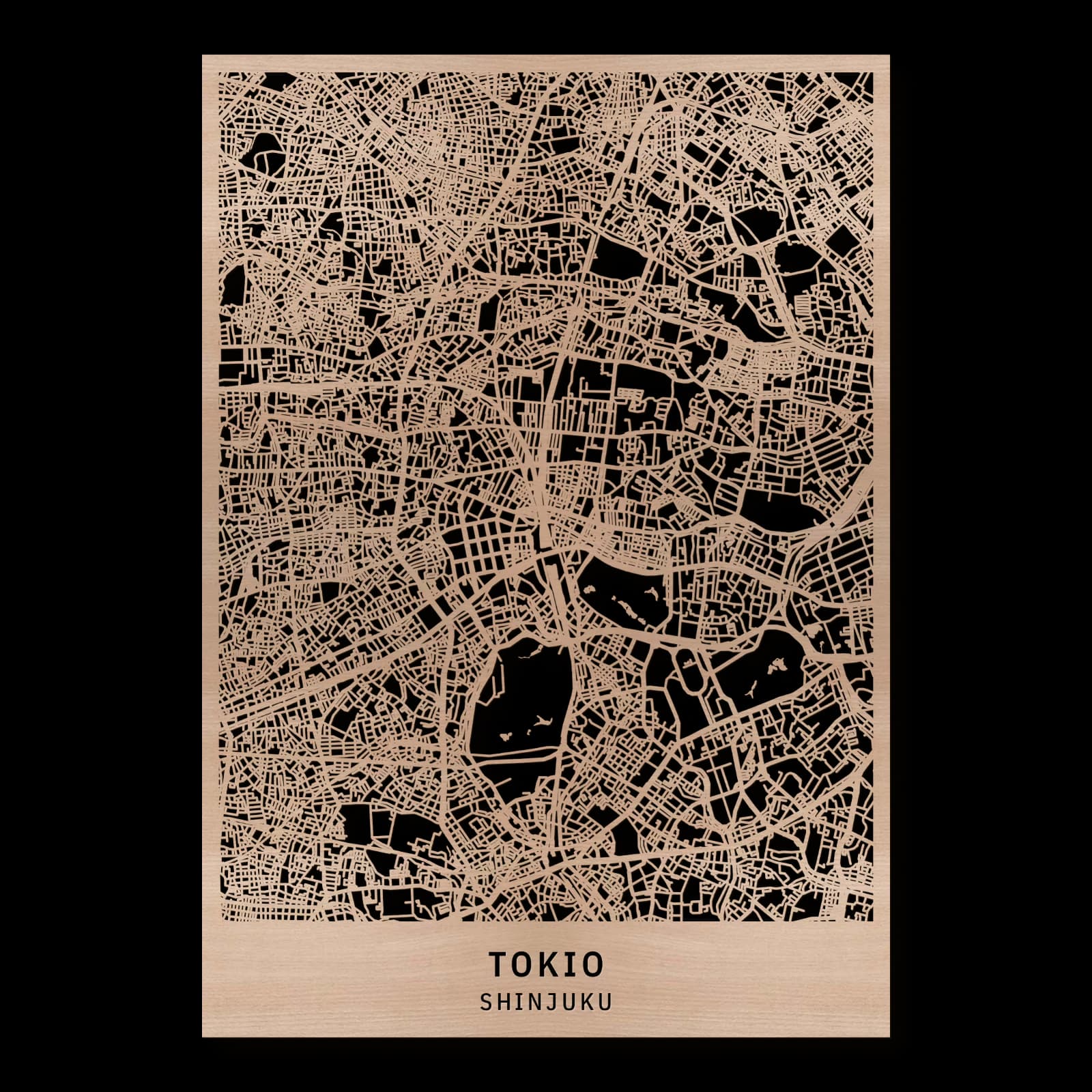
Tokyo.Shinjuku
Portrait wooden city map in oiled beech.
About the product
Shinjuku changes character on either side of its station. The Metropolitan Government Building stands to the west, Hanazono Shrine to the east and Shinjuku Gyoen to the southeast. All four places fall within this crop, locating the district’s contrasting settings around the rail hub. Made from oiled beech, the Classic map presents Shinjuku in portrait format without an additional backing plate. The engraving pairs Tokio with the district name. Its three available sizes retain the same geographic composition while offering different dimensions for the wall.
What does the map show?
- Shinjuku Station provides a central reference
- Crop includes the government building and Hanazono Shrine
- Shinjuku Gyoen lies to the southeast
- Classic oiled beech map in portrait format
- Precisely cut and engraved
- Fine laser details with clear depth
- Carefully inspected and securely packed
- Handmade in Germany
Configuration
Shape: Rectangular · Design: Classic · Material: Beech · Sizes: 20 × 30 cm, 35 × 50 cm, 50 × 70 cm
The configuration shown in the cart and at the time of ordering is authoritative. The preview is not a dimensioned technical drawing.
Availability & production
- Availability
- Made to order
- Production time
- Ships in 3-5 business days
Production starts after successful payment and complete product configuration.
Materials & care
Depending on the variant, lacquered or oiled MDF or oiled real-wood veneer on MDF; optional stainless-steel mounting screws. Acrylic lacquer spray, hard-wax oil and white glue are used in production.
Wood is a natural material. Grain and color may vary slightly from the product images.
Clean with a dry, soft cloth and protect from prolonged moisture and direct heat.
Included & installation
The selected product in the ordered configuration, securely packed and prepared for installation.
- Maximum dimensions 50 × 70 cm and maximum product weight 2 kg.
- Wall-fixing screws and wall plugs are not included. Use fixings suitable for the wall type, substrate and product weight.
- Installation must be carried out by an adult. Keep optional mounting screws and other small parts away from children until installation.
Shipping & returns
Securely packed shipping. Return and cancellation information is available in the legal section.
Shipping costs and delivery options depend on the destination and format. The published cancellation right applies to non-personalised standard goods; it may be excluded for individually made products.
Manufacturer & product identifier
- Manufacturer
- Benjamin Nöst - Lightworks
Rorichmoorer Str. 76
26802 Moormerland, Deutschland
kontakt@lightworks.de - Product identifier
- LW-CAT-36E3BC819236-S, LW-CAT-36E3BC819236-M, LW-CAT-36E3BC819236-L
Together with the order or production batch, the relevant SKU enables traceability. Safety questions and incidents can be reported to the email address shown above.
Product safety
- Decorative product for dry indoor use only; not a toy and not intended for children.
- Protect from moisture, high heat and open flames.
- Do not continue to hang the product after a fall, breakage or visible damage. Keep damaged parts away from children.
Shinjuku from its station to towers, shrine and garden
The two sides of Shinjuku Station offer noticeably different experiences. Large office complexes stand to the west, closely used streets to the east and substantial garden grounds to the southeast. The Metropolitan Government Building, Hanazono Shrine and Shinjuku Gyoen provide useful references for understanding these changes within one connected district.
A station that organises its surroundings
Shinjuku Station connects numerous railway routes and distributes movement in several directions. Its influence extends into the surrounding streets. Entrances, major paths and commercial areas respond to the people arriving, changing trains or beginning a journey through the neighbourhood.
Distinguishing between the station’s sides is particularly useful for orientation. The tracks form more than a line on the ground: they create a boundary with specific crossing points. Moving from one side to the other can also mean encountering different building scales and street spaces. Several local centres develop close to the same major interchange, each responding to it in a different way.
The larger scale to the west
Nishi-Shinjuku’s high-rise area lies west of the station. The Tokyo Metropolitan Government Building provides a particularly recognisable presence among substantial complexes and broader intervals. Its towers belong to a setting that differs markedly from the more closely enclosed commercial streets on the other side.
Looking at ground level is as useful as looking upwards. Routes between the large buildings explain how this environment works. Entrances, forecourts and connections with the street mediate between the scale of an institution and that of an individual person. These smaller elements make an important contribution to the experience of a district dominated by tall structures.
Other forms of space in the east
Hanazono Shrine lies east of the station. Its history reaches back before the Edo period, with a later relocation to an area previously used as a garden. Within densely developed surroundings, it retains a specific religious identity and a relationship with neighbouring space different from that of the commercial streets.
Shinjuku Gyoen opens a much larger garden area to the southeast. Earlier imperial use forms part of its history. Along its boundary, the transition from intensive urban activity to a continuous green landscape becomes particularly apparent. A relatively short movement can produce a substantial change in atmosphere and scale.
These contrasts make Shinjuku rewarding as a neighbourhood. The station gathers and distributes movement, the government building represents a large institutional presence, the shrine establishes a specific place within the built fabric and the garden introduces breadth. Their proximity does not make them interchangeable. Instead, Shinjuku’s character emerges from the ability to move between very different spatial experiences along short urban connections, discovering how each contributes to the district’s daily life.
Sources
- GO TOKYO: Shinjuku — https://www.gotokyo.org/en/destinations/western-tokyo/shinjuku/index.html
- Wikipedia: Hanazono Shrine — https://en.wikipedia.org/wiki/Hanazono_Shrine
- Wikipedia: Shinjuku Gyoen — https://en.wikipedia.org/wiki/Shinjuku_Gyoen
- Wikipedia: Tokyo Metropolitan Government Building — https://en.wikipedia.org/wiki/Tokyo_Metropolitan_Government_Building

Still deciding?
Configure your motif in the studio and see how your city map will look in your space.



