
Trier.City overview
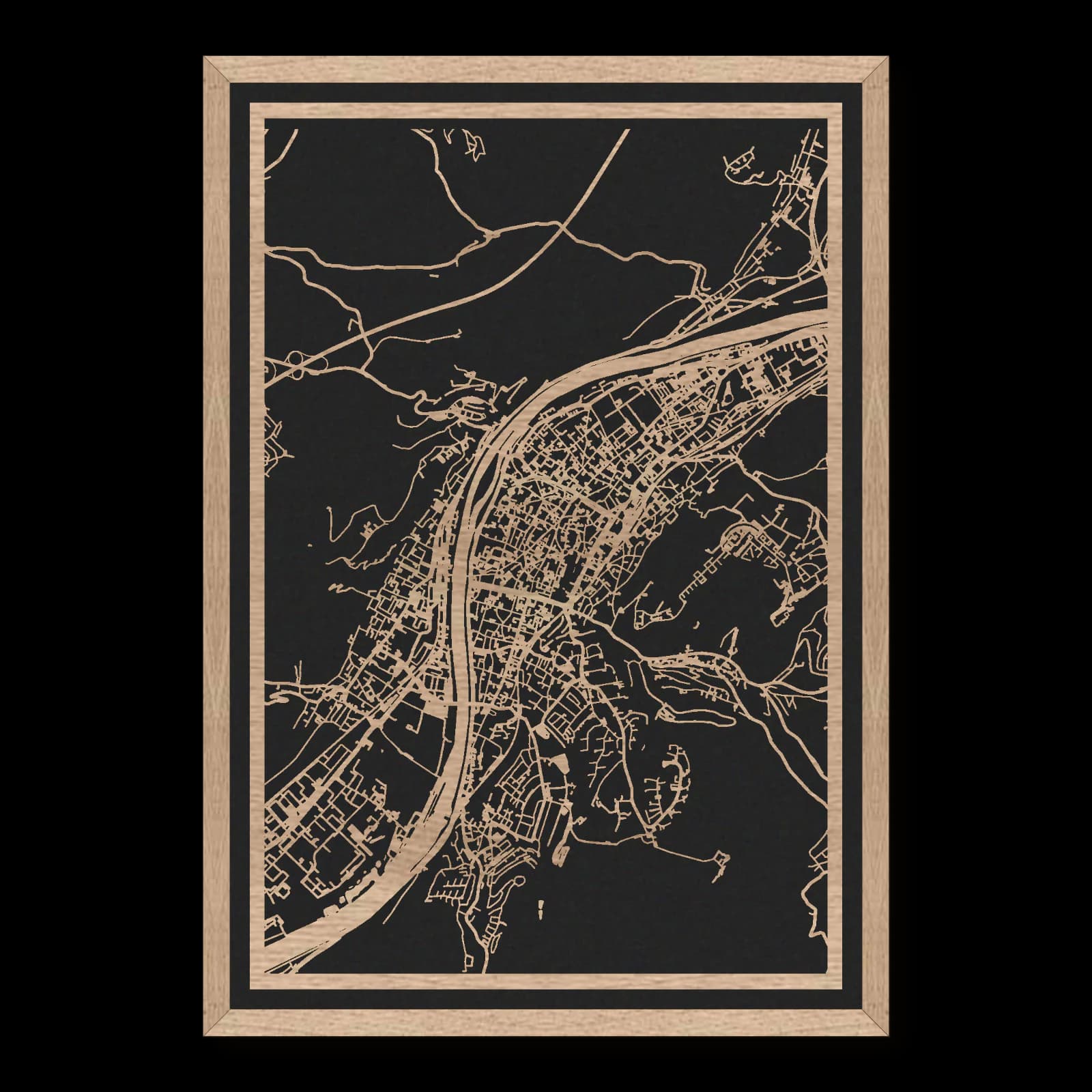
A framed oak city map linking Trier's historic places from the Porta Nigra to the Moselle.
About the product
Trier's Roman heritage reaches from its northern gateway to the Moselle and the amphitheatre southeast of the centre. This map includes the Porta Nigra, cathedral, Roman Bridge and amphitheatre within their surrounding streets. A portrait frame holds the extended city crop. Made from oiled oak in two layers, the map sets its cut street network against a black back plate.
What does the map show?
- Porta Nigra
- Trier Cathedral
- Roman Bridge
- Trier Amphitheatre
- Two wooden layers with a black back plate
- Precisely cut and engraved
- Fine laser details with clear depth
- Carefully inspected and securely packed
- Handmade in Germany
Configuration
Shape: Rectangular · Design: Framed · Material: Oak · Sizes: 20 × 30 cm, 35 × 50 cm, 50 × 70 cm
The configuration shown in the cart and at the time of ordering is authoritative. The preview is not a dimensioned technical drawing.
Availability & production
- Availability
- Made to order
- Production time
- Ships in 3-5 business days
Production starts after successful payment and complete product configuration.
Materials & care
Depending on the variant, lacquered or oiled MDF or oiled real-wood veneer on MDF; optional stainless-steel mounting screws. Acrylic lacquer spray, hard-wax oil and white glue are used in production.
Wood is a natural material. Grain and color may vary slightly from the product images.
Clean with a dry, soft cloth and protect from prolonged moisture and direct heat.
Included & installation
The selected product in the ordered configuration, securely packed and prepared for installation.
- Maximum dimensions 50 × 70 cm and maximum product weight 2 kg.
- Wall-fixing screws and wall plugs are not included. Use fixings suitable for the wall type, substrate and product weight.
- Installation must be carried out by an adult. Keep optional mounting screws and other small parts away from children until installation.
Shipping & returns
Securely packed shipping. Return and cancellation information is available in the legal section.
Shipping costs and delivery options depend on the destination and format. The published cancellation right applies to non-personalised standard goods; it may be excluded for individually made products.
Manufacturer & product identifier
- Manufacturer
- Benjamin Nöst - Lightworks
Rorichmoorer Str. 76
26802 Moormerland, Deutschland
kontakt@lightworks.de - Product identifier
- LW-CAT-226FAC819E9C-S, LW-CAT-226FAC819E9C-M, LW-CAT-226FAC819E9C-L
Together with the order or production batch, the relevant SKU enables traceability. Safety questions and incidents can be reported to the email address shown above.
Product safety
- Decorative product for dry indoor use only; not a toy and not intended for children.
- Protect from moisture, high heat and open flames.
- Do not continue to hang the product after a fall, breakage or visible damage. Keep damaged parts away from children.
Trier's Roman city within the Moselle valley
Trier's Roman inheritance is spread across the city rather than confined to a single archaeological site. The Porta Nigra, Roman Bridge and amphitheatre reveal different urban functions, while the cathedral preserves another long historical continuity. Their positions provide a framework for understanding the centre and its relationship with the Moselle.
Different buildings, different urban tasks
The Porta Nigra was a gateway in the Roman city. Its position north of the historic centre points to an earlier urban boundary. The cathedral stands farther south, the Roman Bridge crosses the Moselle to the southwest, and the amphitheatre occupies ground southeast of the centre. This distribution immediately establishes the breadth of Trier's surviving ancient landscape.
These monuments served different purposes. A gate regulated access, a bridge carried movement across water, and an amphitheatre provided space for public spectacles. Their forms consequently reveal aspects of a complete urban system. UNESCO recognises Trier for the exceptional concentration and quality of its surviving monuments, which represent several functions rather than a single architectural tradition.
The Porta Nigra also has a substantial history after antiquity. It was converted into a church during the Middle Ages, and later interventions restored its Roman appearance. The building therefore records changing ideas about use and preservation. Its significance includes both its original place in the Roman town and the ways later generations adapted an inherited structure.
A continuing centre of religious life
Trier Cathedral combines several historical periods within one building. Its development reaches back to late antiquity, with later centuries adding and altering substantial elements. Unlike a site preserved solely as an archaeological ruin, it remained part of a continuing religious tradition. Its large structure places that continuity within the closely built central city.
The cathedral and Porta Nigra occupy neighbouring parts of the historic core. They differ in origin and function, yet the streets between them hold both within a shared setting. This relationship illustrates how later religious and civic development overlapped with the earlier city. Trier's present character comes from that long process of change rather than from the survival of an entirely unaltered Roman settlement.
Across water and towards the arena
The Roman Bridge shifts attention to the Moselle. Its crossing makes the river's importance explicit: Trier depended on connections through the valley and between its banks. Where central monuments occupy particular plots, the bridge spans an open corridor. The adjoining streets and built areas respond to the water's direction and to the places where it can be crossed.
The amphitheatre establishes a further large-scale reference to the southeast. Together with the bridge, it broadens the city beyond its compact central streets. Gate, cathedral, crossing and arena create a varied geographical framework. Through their relationships, Trier's history becomes understandable as the development of an extensive city in a river valley, rather than a collection of unrelated ancient remains.
Sources
- UNESCO – Roman Monuments, Cathedral and Church of Our Lady in Trier — https://whc.unesco.org/en/list/367/
- Wikipedia – Porta Nigra — https://de.wikipedia.org/wiki/Porta_Nigra
- Wikipedia – Trierer Dom — https://de.wikipedia.org/wiki/Trierer_Dom
- Wikipedia – Römerbrücke (Trier) — https://de.wikipedia.org/wiki/R%C3%B6merbr%C3%BCcke_%28Trier%29
- Wikipedia – Amphitheater (Trier) — https://de.wikipedia.org/wiki/Amphitheater_%28Trier%29

Still deciding?
Configure your motif in the studio and see how your city map will look in your space.



