
Villingen-Schwenningen.City Overview
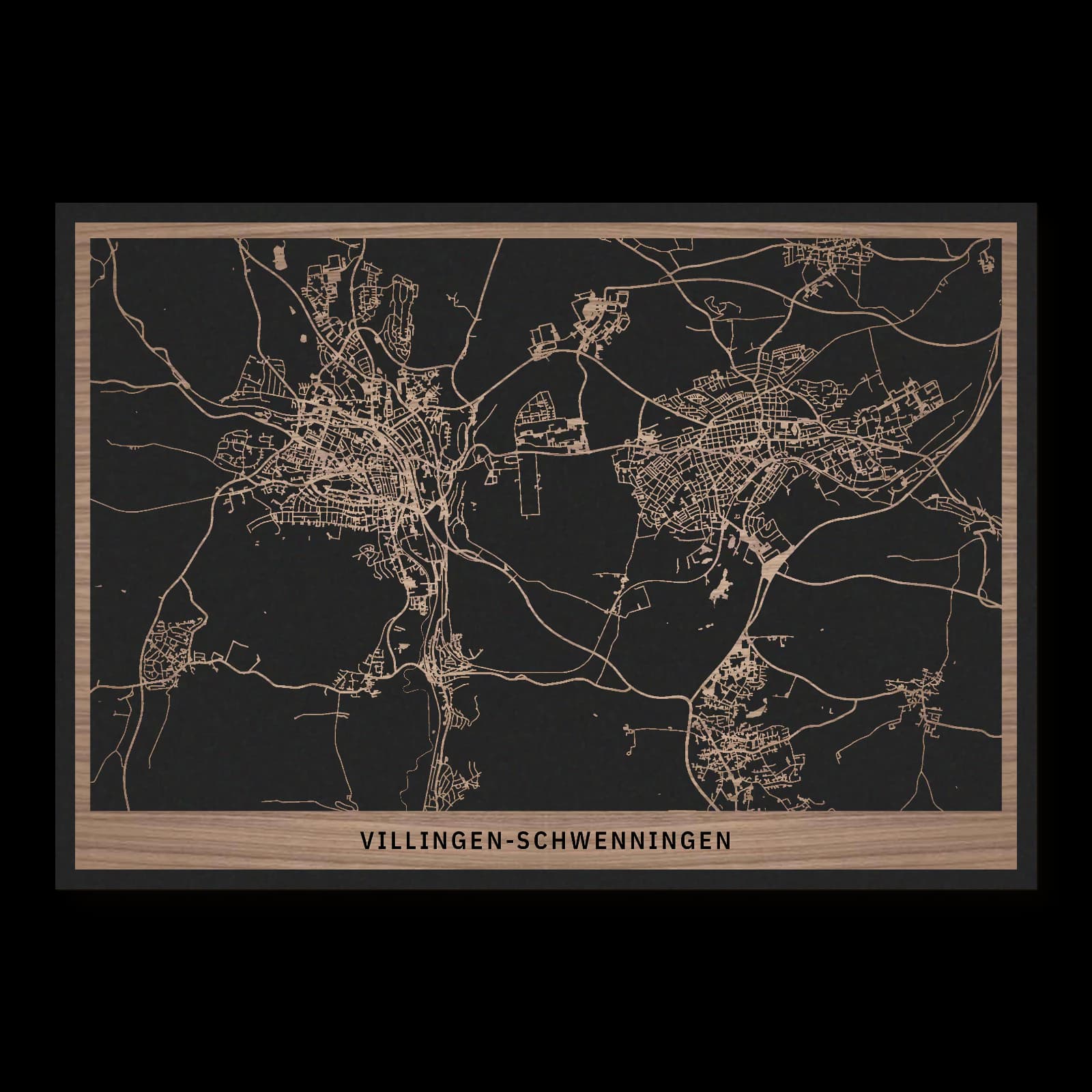
Rectangular wooden city map made from oiled walnut – two layers with a black back plate.
About the product
Two distinct centres give Villingen-Schwenningen its unusual form. Compact streets around Villingen Minster contrast with Schwenningen's more extensive urban pattern. This wooden city map connects both centres through the intervening landscape and reaches towards the Schwenninger Moos. Historic density in the west, industrial and residential growth in the east, and generous open spaces together express the character of the twin city.
What does the map show?
- Villingen centre and minster
- Schwenningen streets and railway district
- Open landscape at Schwenninger Moos
- Precisely cut and engraved
- Fine laser details with clear depth
- Carefully inspected and securely packed
- Handmade in Germany
Configuration
Shape: Rectangular · Design: Layered · Material: Walnut · Sizes: 20 × 30 cm, 35 × 50 cm, 50 × 70 cm
The configuration shown in the cart and at the time of ordering is authoritative. The preview is not a dimensioned technical drawing.
Availability & production
- Availability
- Made to order
- Production time
- Ships in 3-5 business days
Production starts after successful payment and complete product configuration.
Materials & care
Depending on the variant, lacquered or oiled MDF or oiled real-wood veneer on MDF; optional stainless-steel mounting screws. Acrylic lacquer spray, hard-wax oil and white glue are used in production.
Wood is a natural material. Grain and color may vary slightly from the product images.
Clean with a dry, soft cloth and protect from prolonged moisture and direct heat.
Included & installation
The selected product in the ordered configuration, securely packed and prepared for installation.
- Maximum dimensions 50 × 70 cm and maximum product weight 2 kg.
- Wall-fixing screws and wall plugs are not included. Use fixings suitable for the wall type, substrate and product weight.
- Installation must be carried out by an adult. Keep optional mounting screws and other small parts away from children until installation.
Shipping & returns
Securely packed shipping. Return and cancellation information is available in the legal section.
Shipping costs and delivery options depend on the destination and format. The published cancellation right applies to non-personalised standard goods; it may be excluded for individually made products.
Manufacturer & product identifier
- Manufacturer
- Benjamin Nöst - Lightworks
Rorichmoorer Str. 76
26802 Moormerland, Deutschland
kontakt@lightworks.de - Product identifier
- LW-CAT-5CAD46AD8F2B-S, LW-CAT-5CAD46AD8F2B-M, LW-CAT-5CAD46AD8F2B-L
Together with the order or production batch, the relevant SKU enables traceability. Safety questions and incidents can be reported to the email address shown above.
Product safety
- Decorative product for dry indoor use only; not a toy and not intended for children.
- Protect from moisture, high heat and open flames.
- Do not continue to hang the product after a fall, breakage or visible damage. Keep damaged parts away from children.
Villingen-Schwenningen: Two centres across the Baar landscape
Villingen and Schwenningen became one city in 1972, but their contrasting histories remain visible. A fortified medieval centre and a town strongly associated with clockmaking developed different street patterns. The wider view keeps both in focus, including the landscape and connections between them that are essential to understanding the present municipality.
A city with two starting points
Villingen-Schwenningen cannot be explained convincingly through a single centre. The two towns joined in 1972 while retaining distinct physical identities. A substantial area of roads, working spaces and open land lies between them. Although it does not resemble a conventional town centre, this intervening area matters to the shared city. Connections between the two cores operate at a different scale from the short routes within either one. Seeing the whole arrangement makes that difference clear and helps explain why the municipality continues to be experienced as a twin city.
Villingen's enclosed historic form
Villingen Minster stands within the western historic core, where surviving fortifications make the older town structure particularly legible. Gates and towers recall a clear division between the settlement and its surroundings. Streets and squares inside that framework occupy comparatively compact spaces. Beyond it, the pattern changes. The Hubenloch provides a landscape reference to the west, while the Magdalenenberg points towards a much earlier period of human settlement to the south. These places broaden Villingen's story beyond its walled centre and show how different historical layers share a relatively close setting.
Schwenningen and clockmaking
Schwenningen's development was closely linked to the clock industry. Its urban form therefore tells a different story from the medieval core to the west. The railway station, larger routes and spreading residential and working areas help explain that growth. Their contrast with Villingen is an essential feature of the present city. Comparing the two centres reveals how different economic circumstances produce different kinds of urban space. Administrative union did not erase those differences. Instead, it placed them within a common framework, making the relationship between the two towns a defining part of the wider cityscape.
Landscape between and beside the towns
The Neckar source and Schwenninger Moos draw attention to the natural setting on the Baar. The wetland offers a clear contrast to the built neighbourhoods and follows a landscape logic of its own. Between the centres, the Schwarzwald-Baar-Center represents a more recent shared zone of activity. Historic cores, modern connections and open ground consequently appear alongside one another. The broad view holds these different elements together without making them identical. It presents a city whose character comes from two independent histories and the spaces they now share, with the surrounding landscape remaining an active part of that relationship.
Sources
- Stadt Villingen-Schwenningen: Gemeinsame Geschichte — https://www.villingen-schwenningen.de/tourismus-erleben/stadtportrait/historisches/geschichte-villingen-schwenningen/
- Stadt Villingen-Schwenningen: Geschichte Schwenningen — https://www.villingen-schwenningen.de/tourismus-erleben/stadtportrait/historisches/geschichte-schwenningen/
- Stadt Villingen-Schwenningen: Tore und Türme — https://www.villingen-schwenningen.de/tourismus-erleben/vs-erleben/sehenswuerdigkeiten/stadtbezirk-villingen/tore-und-tuerme/
- Wikivoyage: Villingen-Schwenningen — https://de.wikivoyage.org/wiki/Villingen-Schwenningen

Still deciding?
Configure your motif in the studio and see how your city map will look in your space.



