
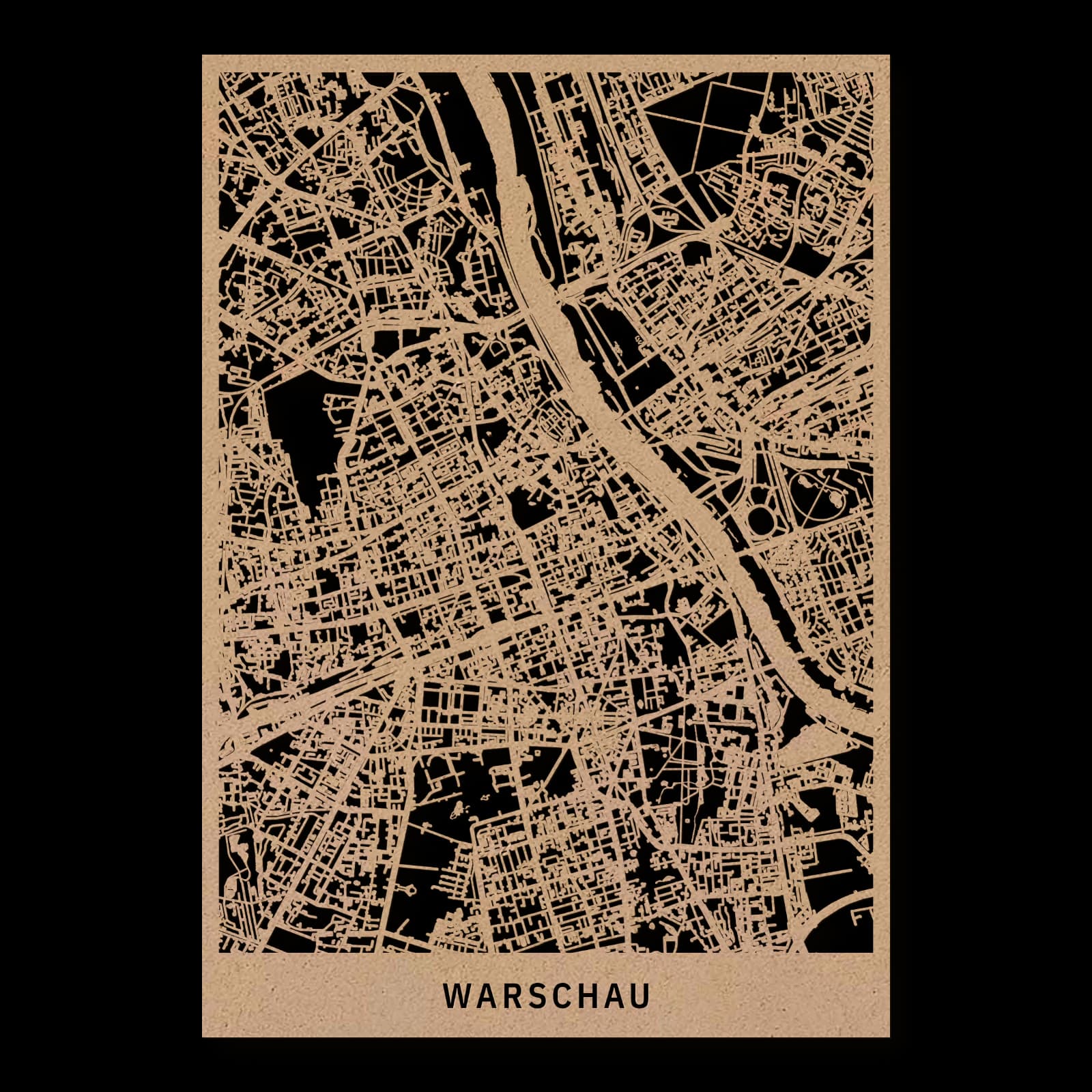
Warsaw.Old town, Praga and royal gardens
Rectangular wooden city map made from natural oiled MDF.
About the product
Warsaw’s reconstructed old town gives remembrance a visible urban form. The wooden map extends from the castle grounds across the Vistula to Praga and south towards Łazienki, with the Warsaw Rising Museum adding another historical reference. Parkland, residential neighbourhoods and river connections bring these places together through royal culture, commercial development and the events of the twentieth century.
What does the map show?
- Old town
- Royal Castle and gardens
- Vistula
- Praga
- Łazienki
- Warsaw Rising Museum
- Precisely cut and engraved
- Fine laser details with clear depth
- Carefully inspected and securely packed
- Handmade in Germany
Configuration
Shape: Rectangular · Design: Classic · Material: Natural · Sizes: 20 × 30 cm, 35 × 50 cm, 50 × 70 cm
The configuration shown in the cart and at the time of ordering is authoritative. The preview is not a dimensioned technical drawing.
Availability & production
- Availability
- Made to order
- Production time
- Ships in 3-5 business days
Production starts after successful payment and complete product configuration.
Materials & care
Depending on the variant, lacquered or oiled MDF or oiled real-wood veneer on MDF; optional stainless-steel mounting screws. Acrylic lacquer spray, hard-wax oil and white glue are used in production.
Wood is a natural material. Grain and color may vary slightly from the product images.
Clean with a dry, soft cloth and protect from prolonged moisture and direct heat.
Included & installation
The selected product in the ordered configuration, securely packed and prepared for installation.
- Maximum dimensions 50 × 70 cm and maximum product weight 2 kg.
- Wall-fixing screws and wall plugs are not included. Use fixings suitable for the wall type, substrate and product weight.
- Installation must be carried out by an adult. Keep optional mounting screws and other small parts away from children until installation.
Shipping & returns
Securely packed shipping. Return and cancellation information is available in the legal section.
Shipping costs and delivery options depend on the destination and format. The published cancellation right applies to non-personalised standard goods; it may be excluded for individually made products.
Manufacturer & product identifier
- Manufacturer
- Benjamin Nöst - Lightworks
Rorichmoorer Str. 76
26802 Moormerland, Deutschland
kontakt@lightworks.de - Product identifier
- LW-CAT-FB0906DBFFB0-S, LW-CAT-FB0906DBFFB0-M, LW-CAT-FB0906DBFFB0-L
Together with the order or production batch, the relevant SKU enables traceability. Safety questions and incidents can be reported to the email address shown above.
Product safety
- Decorative product for dry indoor use only; not a toy and not intended for children.
- Protect from moisture, high heat and open flames.
- Do not continue to hang the product after a fall, breakage or visible damage. Keep damaged parts away from children.
Warsaw’s reconstruction, royal landscapes and river districts
Warsaw’s historic centre is closely connected with destruction and reconstruction. The castle and gardens establish a northern reference within the central urban fabric. Praga lies across the Vistula, while Łazienki introduces a royal park landscape to the south. The Warsaw Rising Museum adds a separate institutional perspective on the city’s twentieth-century history.
A historic centre shaped by reconstruction
Warsaw’s historic centre was largely destroyed by German troops during the uprising of 1944. An extensive post-war reconstruction created the old town seen today. Its houses, churches and squares consequently represent both the recovery of a historic urban image and a more recent history of collective effort. These two relationships are essential to understanding the place. Streets form a connected historical pattern, but their present buildings cannot be separated from twentieth-century events. Memory and physical urban form are particularly closely linked. The old town’s significance therefore extends beyond the architectural periods that its reconstructed appearance evokes.
Castle grounds and southern royal landscapes
The Royal Castle and its gardens lie near the historic centre and river. Architecture and open grounds establish an important northern relationship. Farther south, Łazienki introduces a different royal landscape. The Palace on the Isle developed from a seventeenth-century bathhouse transformed during the eighteenth century. King Stanisław August Poniatowski received scholars and poets there for his celebrated Thursday discussions. Buildings, water and parkland create a distinctive ensemble. The two royal settings consequently express different connections between representation, culture and designed landscape. Their separate positions help explain how related historical purposes occupy more than one part of the city.
Praga across the Vistula
Praga developed on the Vistula’s right bank and remained separate from Warsaw until 1791. Its trading history was closely associated with supplying the city on the opposite bank. A significant Jewish merchant community contributed to this commercial character. The surroundings of St Florian’s Cathedral provide a concrete geographical reference for the eastern district. Its location beyond the river helps explain part of its distinct development. Praga adds other historical strands to the central portrait, while connections across the Vistula link both banks within today’s urban landscape. Separation and connection therefore both belong to the district’s relationship with Warsaw.
Remembrance within the connected city
The Warsaw Rising Museum stands west of the central historic areas. It provides an institutional reference to the uprising of 1944, complementing the reconstruction history visible in the old town itself. Further streets and residential neighbourhoods connect the museum, castle, Praga and Łazienki. Everyday uses bring places with different historical roles into the same living city. The Vistula supplies an important landscape direction, without explaining every district alone. Royal culture, trade, wartime remembrance and public green spaces occupy several urban settings. Their relationships help preserve the wider story of Warsaw, allowing individual monuments to contribute without standing in for the entire city.
Sources
- Historic Centre of Warsaw - UNESCO World Heritage Centre — https://whc.unesco.org/en/list/30/
- Walk around North Praga district - Go To Warsaw — https://go2warsaw.pl/en/walk-around-north-praga-district/
- Royal Łazienki Museum - Go To Warsaw — https://go2warsaw.pl/en/royal-lazienki-museum/
- Muzeum Powstania Warszawskiego — https://www.1944.pl/en
- The Royal Castle in Warsaw Museum - Zamek Królewski — https://www.zamek-krolewski.pl/en

Still deciding?
Configure your motif in the studio and see how your city map will look in your space.



