
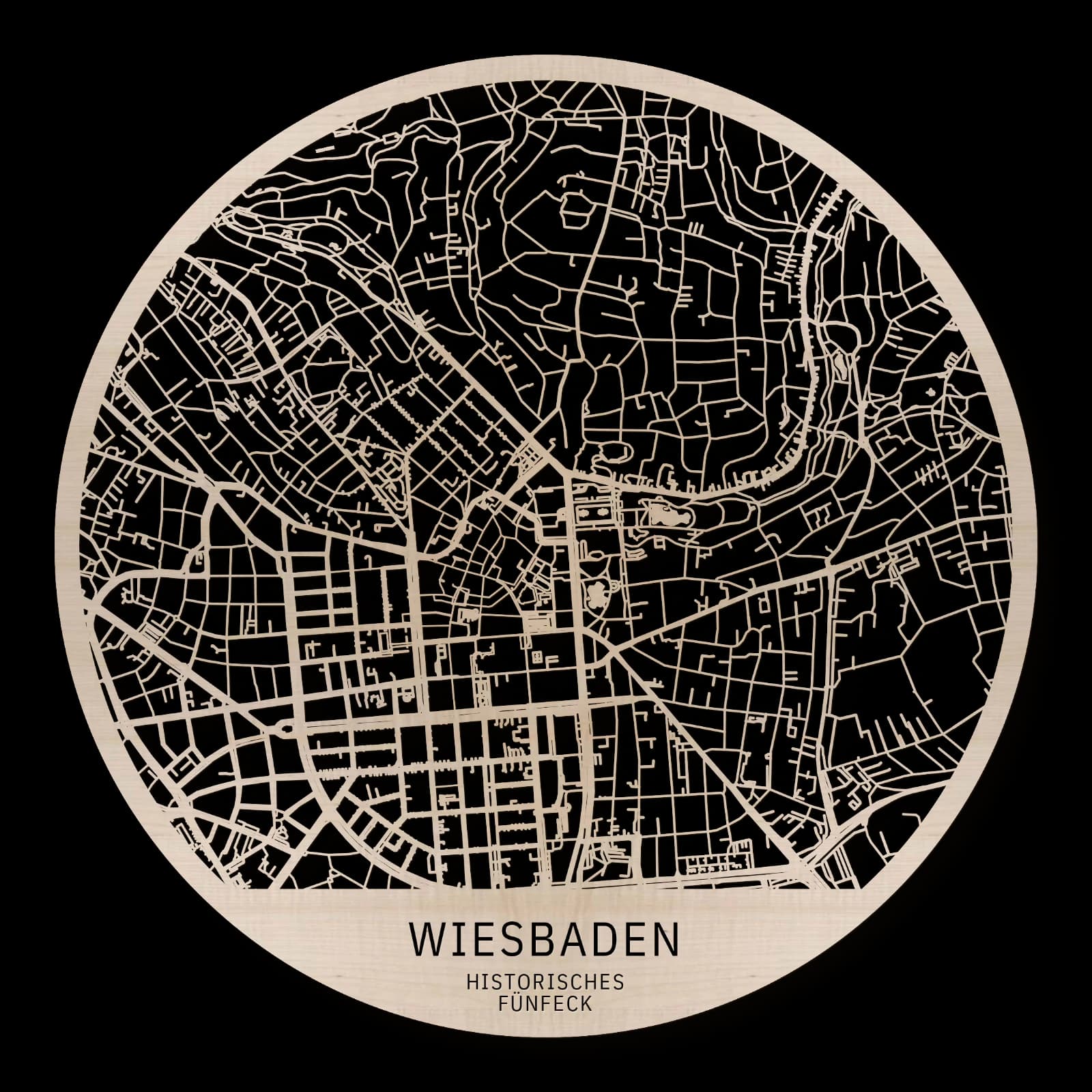
Wiesbaden.Historic Centre
Classic wooden city map in oiled maple, round format.
About the product
Kochbrunnen, Schlossplatz, the Marktkirche and Kurhaus give central Wiesbaden a closely connected group of reference points. Short streets move between enclosed squares and more open spa grounds. This view recalls a city shaped by thermal water, public gatherings and political history, with familiar towers rising above everyday routes. This round Classic map uses a single cut layer of oiled maple. Its compact streets connect the Marktkirche, Kochbrunnen and Kurhaus without a separate backing panel, keeping attention on the old centre.
What does the map show?
- Kurhaus Wiesbaden
- Marktkirche Wiesbaden
- Kochbrunnen
- Stadtschloss Wiesbaden
- Precisely cut and engraved
- Fine laser details with clear depth
- Carefully inspected and securely packed
- Handmade in Germany
Configuration
Shape: Round · Design: Classic · Material: Maple · Diameter: Ø 23 cm, Ø 35 cm, Ø 50 cm
The configuration shown in the cart and at the time of ordering is authoritative. The preview is not a dimensioned technical drawing.
Availability & production
- Availability
- Made to order
- Production time
- Ships in 3-5 business days
Production starts after successful payment and complete product configuration.
Materials & care
Depending on the variant, lacquered or oiled MDF or oiled real-wood veneer on MDF; optional stainless-steel mounting screws. Acrylic lacquer spray, hard-wax oil and white glue are used in production.
Wood is a natural material. Grain and color may vary slightly from the product images.
Clean with a dry, soft cloth and protect from prolonged moisture and direct heat.
Included & installation
The selected product in the ordered configuration, securely packed and prepared for installation.
- Maximum dimensions 50 × 70 cm and maximum product weight 2 kg.
- Wall-fixing screws and wall plugs are not included. Use fixings suitable for the wall type, substrate and product weight.
- Installation must be carried out by an adult. Keep optional mounting screws and other small parts away from children until installation.
Shipping & returns
Securely packed shipping. Return and cancellation information is available in the legal section.
Shipping costs and delivery options depend on the destination and format. The published cancellation right applies to non-personalised standard goods; it may be excluded for individually made products.
Manufacturer & product identifier
- Manufacturer
- Benjamin Nöst - Lightworks
Rorichmoorer Str. 76
26802 Moormerland, Deutschland
kontakt@lightworks.de - Product identifier
- LW-CAT-5A011C0E85C2-S, LW-CAT-5A011C0E85C2-M, LW-CAT-5A011C0E85C2-L
Together with the order or production batch, the relevant SKU enables traceability. Safety questions and incidents can be reported to the email address shown above.
Product safety
- Decorative product for dry indoor use only; not a toy and not intended for children.
- Protect from moisture, high heat and open flames.
- Do not continue to hang the product after a fall, breakage or visible damage. Keep damaged parts away from children.
Central Wiesbaden: thermal springs, palace and spa society
A thermal spring, a ducal palace and the Kurhaus stand within a few streets of one another in central Wiesbaden. Each represents a different part of the city's development. Moving between Kochbrunnen, Schlossplatz and the spa grounds reveals those distinctions, while the museum to the south adds a history of civic collecting.
Thermal water in an urban setting
Kochbrunnen gives Wiesbaden's thermal springs a visible place within the city centre. It is surrounded by streets, squares and older hotel buildings rather than secluded in a rural landscape. The spa city's history therefore begins here with a specific natural resource, not only with the architecture later built for its visitors.
A short sequence of streets leads towards Schlossplatz. Changes between smaller routes and larger public spaces make the centre's different focal points apparent. Several institutions coexist nearby, but their significance comes from different activities. Their proximity allows those roles to be compared directly.
A palace square with changing institutions
The city palace was built in the nineteenth century as a residence for the Dukes of Nassau. Since 1946 it has housed the Hessian state parliament. The building consequently links a courtly past with parliamentary government while remaining part of the familiar cityscape. The square in front provides a shared public setting for institutions with different purposes.
The Marktkirche establishes another presence through its brick towers. Designed by Carl Boos and built between 1853 and 1862, it belongs to nineteenth-century Wiesbaden. Its Gothic appearance should not be confused with a medieval construction date. Alongside the palace, the church expresses the representative ambitions of the expanding city during that period.
Social life and public collections
To the east, the Kurhaus and its surroundings introduce a more spacious arrangement. The present building opened in 1907 and gave the spa resort's social life a substantial architectural setting. Its open forecourt and landscaped context differ from the tighter streets around Kochbrunnen. The relationship between buildings and empty space is central to its effect.
Museum Wiesbaden, at the southern side of the area, adds another strand. Private collectors and civic associations contributed significantly to the origins of its collections. Public culture was therefore shaped by more than courtly display or the requirements of spa guests. Citizen involvement created its own institutions for knowledge and art.
Kochbrunnen and Kurhaus belong to the same spa history while occupying different urban settings. The spring sits within the tighter street network; the Kurhaus opens towards more generous spaces. At Schlossplatz, political and religious representation become immediate neighbours. The museum to the south adds an address for public collections rather than another spa building. The density of central Wiesbaden comes from these adjacent but distinct claims on a relatively small area, each requiring a different relationship between institution and surrounding streets.
Sources
- Museum Wiesbaden: Geschichte — https://museum-wiesbaden.de/geschichte
- Wikipedia: Kochbrunnen — https://en.wikipedia.org/wiki/Kochbrunnen
- Wikipedia: Stadtschloss Wiesbaden — https://en.wikipedia.org/wiki/Wiesbaden_City_Palace
- Wikipedia: Marktkirche Wiesbaden — https://en.wikipedia.org/wiki/Marktkirche,_Wiesbaden
- Wikipedia: Kurhaus Wiesbaden — https://en.wikipedia.org/wiki/Kurhaus,_Wiesbaden

Still deciding?
Configure your motif in the studio and see how your city map will look in your space.



