
Wiesbaden.
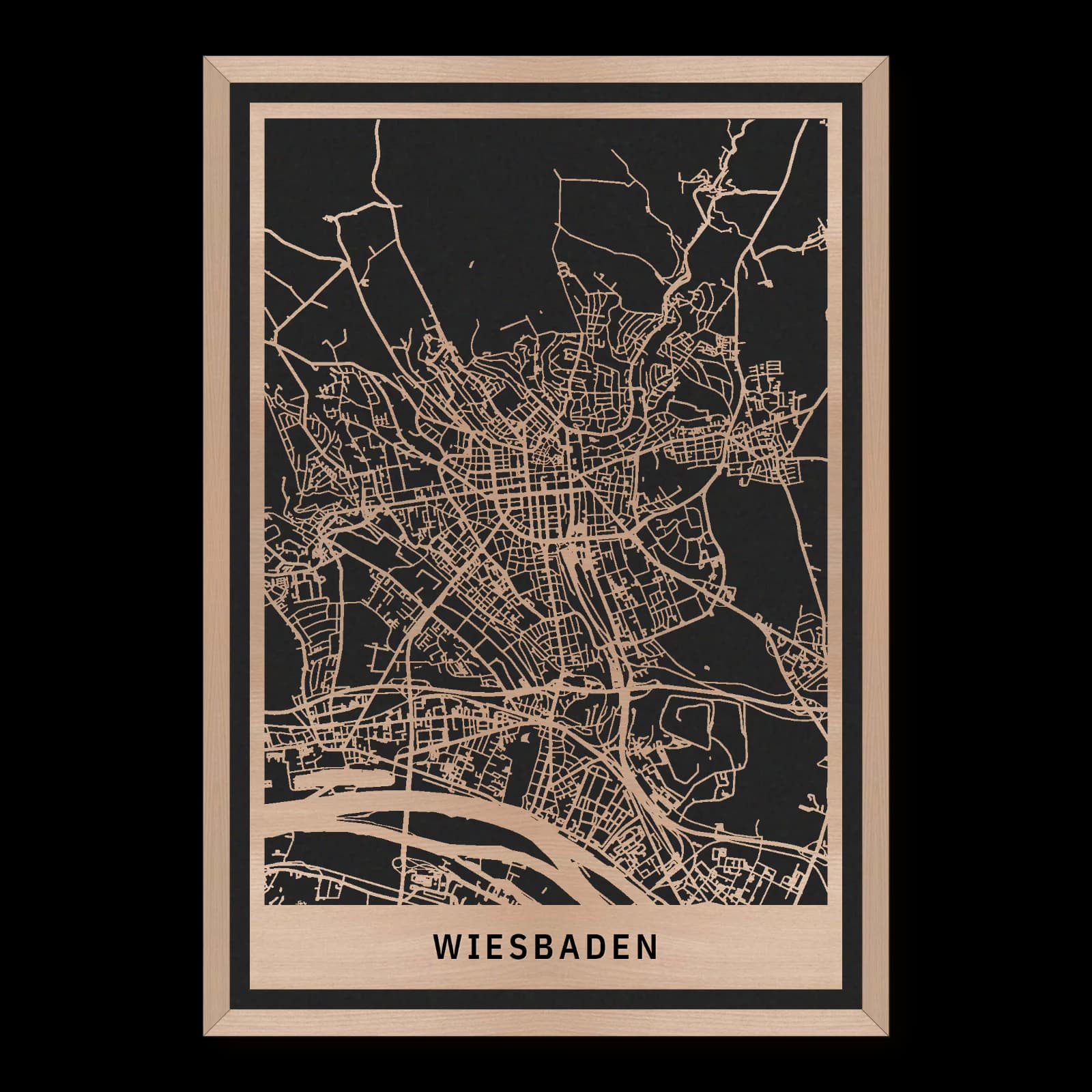
Framed wooden city map in oiled beech, portrait format.
About the product
Neroberg and Biebrich Palace frame a Wiesbaden that reaches well beyond the spa quarter. The Kurhaus, museum and main station connect prominent central settings with neighbourhoods extending towards the Rhine. Streets establish their own patterns between formal grounds, wooded slopes and ordinary urban blocks. Portrait format follows the city from Neroberg towards the Rhine. Oiled beech, frame and backing panel give the changing street pattern depth, leaving room for both the spa quarter and Biebrich.
What does the map show?
- Neroberg
- Kurhaus Wiesbaden
- Schloss Biebrich
- Wiesbaden Hauptbahnhof
- Precisely cut and engraved
- Fine laser details with clear depth
- Carefully inspected and securely packed
- Handmade in Germany
Configuration
Shape: Rectangular · Design: Framed · Material: Beech · Sizes: 20 × 30 cm, 35 × 50 cm, 50 × 70 cm
The configuration shown in the cart and at the time of ordering is authoritative. The preview is not a dimensioned technical drawing.
Availability & production
- Availability
- Made to order
- Production time
- Ships in 3-5 business days
Production starts after successful payment and complete product configuration.
Materials & care
Depending on the variant, lacquered or oiled MDF or oiled real-wood veneer on MDF; optional stainless-steel mounting screws. Acrylic lacquer spray, hard-wax oil and white glue are used in production.
Wood is a natural material. Grain and color may vary slightly from the product images.
Clean with a dry, soft cloth and protect from prolonged moisture and direct heat.
Included & installation
The selected product in the ordered configuration, securely packed and prepared for installation.
- Maximum dimensions 50 × 70 cm and maximum product weight 2 kg.
- Wall-fixing screws and wall plugs are not included. Use fixings suitable for the wall type, substrate and product weight.
- Installation must be carried out by an adult. Keep optional mounting screws and other small parts away from children until installation.
Shipping & returns
Securely packed shipping. Return and cancellation information is available in the legal section.
Shipping costs and delivery options depend on the destination and format. The published cancellation right applies to non-personalised standard goods; it may be excluded for individually made products.
Manufacturer & product identifier
- Manufacturer
- Benjamin Nöst - Lightworks
Rorichmoorer Str. 76
26802 Moormerland, Deutschland
kontakt@lightworks.de - Product identifier
- LW-CAT-D3DC9D6D6EC2-S, LW-CAT-D3DC9D6D6EC2-M, LW-CAT-D3DC9D6D6EC2-L
Together with the order or production batch, the relevant SKU enables traceability. Safety questions and incidents can be reported to the email address shown above.
Product safety
- Decorative product for dry indoor use only; not a toy and not intended for children.
- Protect from moisture, high heat and open flames.
- Do not continue to hang the product after a fall, breakage or visible damage. Keep damaged parts away from children.
Wiesbaden from Neroberg to the Rhine
Wiesbaden stretches through a sequence of distinct settings: wooded heights, formal spa grounds, central districts and the Rhine at Biebrich. Its station, museum and palace add further points of orientation. A wider view connects the familiar spa city with its southern neighbourhoods and reveals several different centres of historical development.
Heights and riverbanks
Neroberg provides a landscape reference above northern Wiesbaden. From there, the built city extends south towards the Rhine at Biebrich. This geography explains why the spa quarter alone cannot represent the whole city. Neighbourhoods with different histories and functions occupy the ground between wooded slopes and the riverbank.
The Kurhaus expresses Wiesbaden's public and social ambitions as a spa destination. Opened in 1907, the present building relates closely to its adjoining park and formal surroundings. Its effect depends on the space around it as well as on its architecture. Broad approaches and landscaped areas establish a scale distinct from ordinary residential streets.
Arrivals and civic collecting
Wiesbaden's main station stands south of the older centre. Opened in 1906, it responded to increasing travel and the demands of the spa city. Its position is revealing: modern transport received a substantial site rather than being squeezed entirely into the existing street network. Routes from the station then distribute movement through several parts of Wiesbaden.
Museum Wiesbaden introduces the role of civic collections and public knowledge. Its historical holdings developed through private collecting and the work of local associations. Art, antiquities and natural history were initially presented in other premises before the institution acquired its later architectural setting. This background complements a city image often dominated by spa culture and grand façades.
A different centre at Biebrich
Biebrich Palace occupies a Rhine-facing position as a Baroque residence of the rulers of Nassau. Its river frontage and park create a different arrangement from the Kurhaus ensemble. Both places contain representative architecture and substantial open grounds, yet belong to different political and social histories. Comparing their settings makes those distinctions easier to understand.
Ordinary urban districts connect the palace with the centre. Residential streets, business areas and transport routes turn a sequence of major destinations into a continuous living city. These connections deserve attention alongside the more conspicuous monuments.
Biebrich changes the familiar idea of Wiesbaden particularly clearly. Beside the Rhine, the city acquires a courtly and landscape setting distinct from both the spa district and Neroberg. The station, museum and more densely built inner neighbourhoods lie between river and wooded height. The Rhine is therefore more than an edge to a picture of a spa town. It opens another perspective on Wiesbaden, giving the palace, southern urban development and routes towards the water their own substantial place.
Sources
- Museum Wiesbaden: Geschichte — https://museum-wiesbaden.de/geschichte
- Wikipedia: Kurhaus Wiesbaden — https://en.wikipedia.org/wiki/Kurhaus,_Wiesbaden
- Wikipedia: Wiesbaden Hauptbahnhof — https://en.wikipedia.org/wiki/Wiesbaden_Hauptbahnhof
- Wikipedia: Schloss Biebrich — https://en.wikipedia.org/wiki/Biebrich_Palace
- Wikipedia: Neroberg — https://en.wikipedia.org/wiki/Neroberg

Still deciding?
Configure your motif in the studio and see how your city map will look in your space.



