
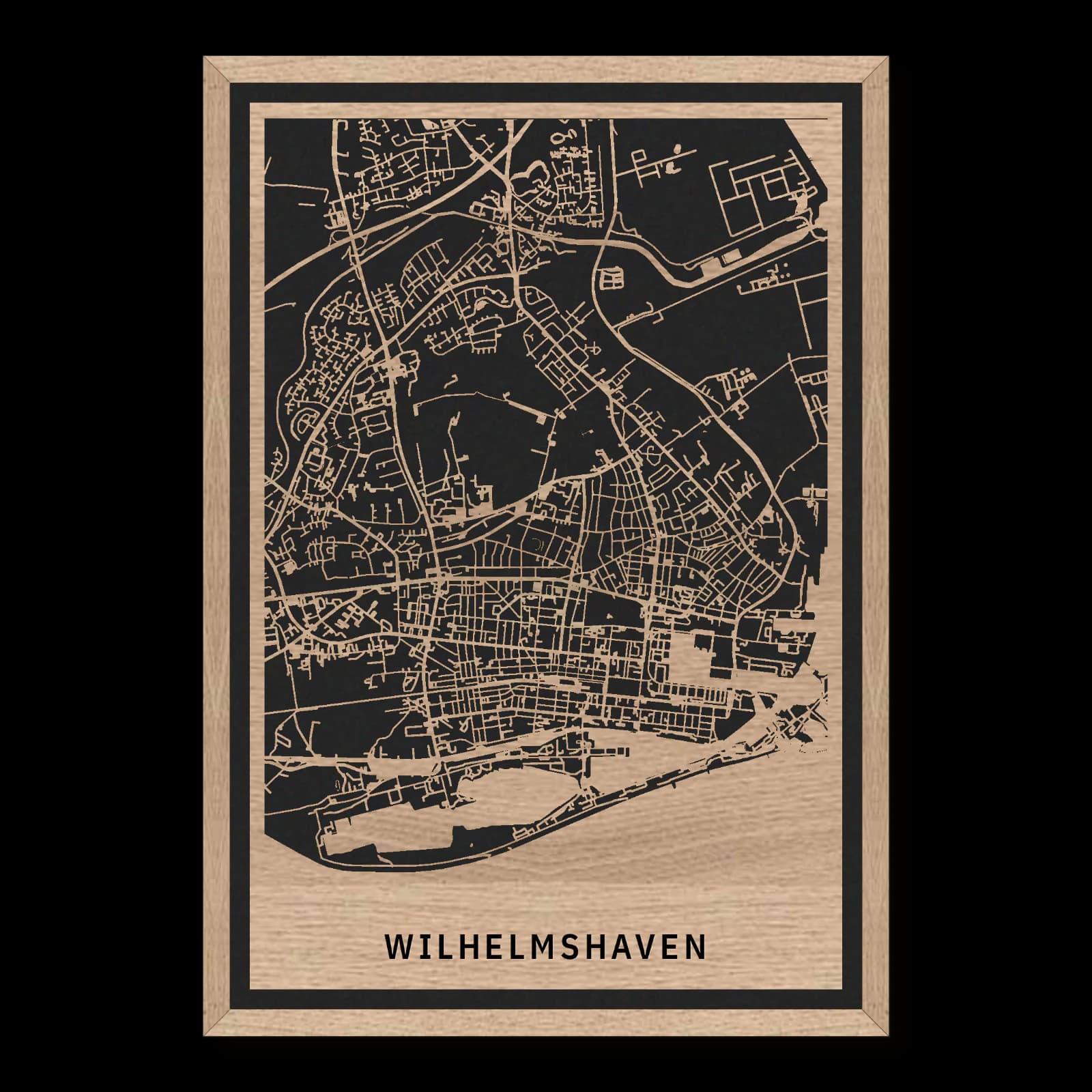
Wilhelmshaven.Harbour city and Rüstringen townscape
Rectangular wooden city map made from oiled oak – two layers with a black back plate and frame.
About the product
Harbour basins and ordered streets reveal Wilhelmshaven's development as a planned coastal city. The Kaiser Wilhelm Bridge introduces its maritime heritage, while the town hall, Neuende and Rüstringer Stadtpark extend the picture inland. This wooden map follows those connections across the urban area. Harbour engineering, older settlement and public green space contribute different layers to the city portrait.
What does the map show?
- Kaiser Wilhelm Bridge
- Wilhelmshaven Town Hall
- Rüstringen city park
- St Jakobi in Neuende
- Precisely cut and engraved
- Fine laser details with clear depth
- Carefully inspected and securely packed
- Handmade in Germany
Configuration
Shape: Rectangular · Design: Framed · Material: Oak · Sizes: 20 × 30 cm, 35 × 50 cm, 50 × 70 cm
The configuration shown in the cart and at the time of ordering is authoritative. The preview is not a dimensioned technical drawing.
Availability & production
- Availability
- Made to order
- Production time
- Ships in 3-5 business days
Production starts after successful payment and complete product configuration.
Materials & care
Depending on the variant, lacquered or oiled MDF or oiled real-wood veneer on MDF; optional stainless-steel mounting screws. Acrylic lacquer spray, hard-wax oil and white glue are used in production.
Wood is a natural material. Grain and color may vary slightly from the product images.
Clean with a dry, soft cloth and protect from prolonged moisture and direct heat.
Included & installation
The selected product in the ordered configuration, securely packed and prepared for installation.
- Maximum dimensions 50 × 70 cm and maximum product weight 2 kg.
- Wall-fixing screws and wall plugs are not included. Use fixings suitable for the wall type, substrate and product weight.
- Installation must be carried out by an adult. Keep optional mounting screws and other small parts away from children until installation.
Shipping & returns
Securely packed shipping. Return and cancellation information is available in the legal section.
Shipping costs and delivery options depend on the destination and format. The published cancellation right applies to non-personalised standard goods; it may be excluded for individually made products.
Manufacturer & product identifier
- Manufacturer
- Benjamin Nöst - Lightworks
Rorichmoorer Str. 76
26802 Moormerland, Deutschland
kontakt@lightworks.de - Product identifier
- LW-CAT-B20D04605627-S, LW-CAT-B20D04605627-M, LW-CAT-B20D04605627-L
Together with the order or production batch, the relevant SKU enables traceability. Safety questions and incidents can be reported to the email address shown above.
Product safety
- Decorative product for dry indoor use only; not a toy and not intended for children.
- Protect from moisture, high heat and open flames.
- Do not continue to hang the product after a fall, breakage or visible damage. Keep damaged parts away from children.
Wilhelmshaven: Harbour city and Rüstringen townscape
A Prussian naval harbour provided the starting point for modern Wilhelmshaven, but the city also absorbed older neighbouring settlements. Its union with Rüstringen is especially important. The harbour bridge, town hall, Neuende and public park reveal how military planning, civic ambition and earlier local history became parts of one urban area.
Building a naval harbour
The Jade Treaty of 1853 allowed Prussia to acquire land for a naval harbour. Wilhelmshaven received its name in 1869. The new settlement developed around a state project requiring docks, technical facilities and an urban population. Large basins and ordered routes in the southern city reflect that planned origin.
Opened in 1907, the Kaiser Wilhelm Bridge addresses a practical harbour problem. Land traffic needed a crossing, but vessels still required access through the water below. The movable bridge reconciled those demands. Its importance therefore extends beyond its recognisable appearance: it explains how the harbour shaped connections within the city and why infrastructure became a defining feature of Wilhelmshaven.
The Rüstringen contribution
The Prussian harbour town grew beside Rüstringen, which belonged to Oldenburg. The two cities were not united until 1937. Their separate development is essential to understanding the present urban area. Harbour installations alone cannot explain its housing, civic buildings and public landscapes.
Fritz Höger designed the town hall for Rüstringen, and the building was inaugurated in 1929. It represents the ambitions of a municipality with an identity of its own. Its inland position provides a counterweight to the waterfront. The streets between the town hall and harbour connect areas formed under different civic and economic circumstances.
Before and beyond the harbour
St Jakobi in Neuende points to settlement history older than the naval city. The church provides a reference for locating that earlier community within the later urban landscape. Its scale differs from the extensive harbour works. Both belong to Wilhelmshaven today, although they originated in quite different settings.
A park for the population
Rüstringer Stadtpark adds another important chapter. Designed by landscape architect Leberecht Migge and inaugurated in 1920, it was intended as a public park for the population as a whole. Paths, water and planted spaces created a shared landscape within an expanding city. This social purpose distinguishes it from a garden originally reserved for a court or private household.
The park, town hall and Neuende show why Wilhelmshaven should not be reduced to its maritime edge. The city combines planned naval infrastructure with older settlement and substantial civic spaces inland. Its geographical character emerges from the links between those components: the harbour created the modern town, but the later city acquired a broader and more varied structure.
Sources
- Stadt Wilhelmshaven — https://www.wilhelmshaven.de/Tourismus/Stadtportrait/Historie.php
- Stadt Wilhelmshaven — https://www.wilhelmshaven.de/Tourismus/Stadtportrait/Stadtgeschichte.php
- 1 – Natur- und Kulturschatz – Naturschätze WHV — https://www.naturschaetze-whv.de/stadtpark/sp_01_natur_und_kulturschatz/
- Stadt Wilhelmshaven – Stadtpark — https://www.wilhelmshaven.de/PDF/Amtliche_Dokumente/TBW/Stadtpark/ISEK_Endfassung_25_03_2019.pdf?m=1561467434

Still deciding?
Configure your motif in the studio and see how your city map will look in your space.