
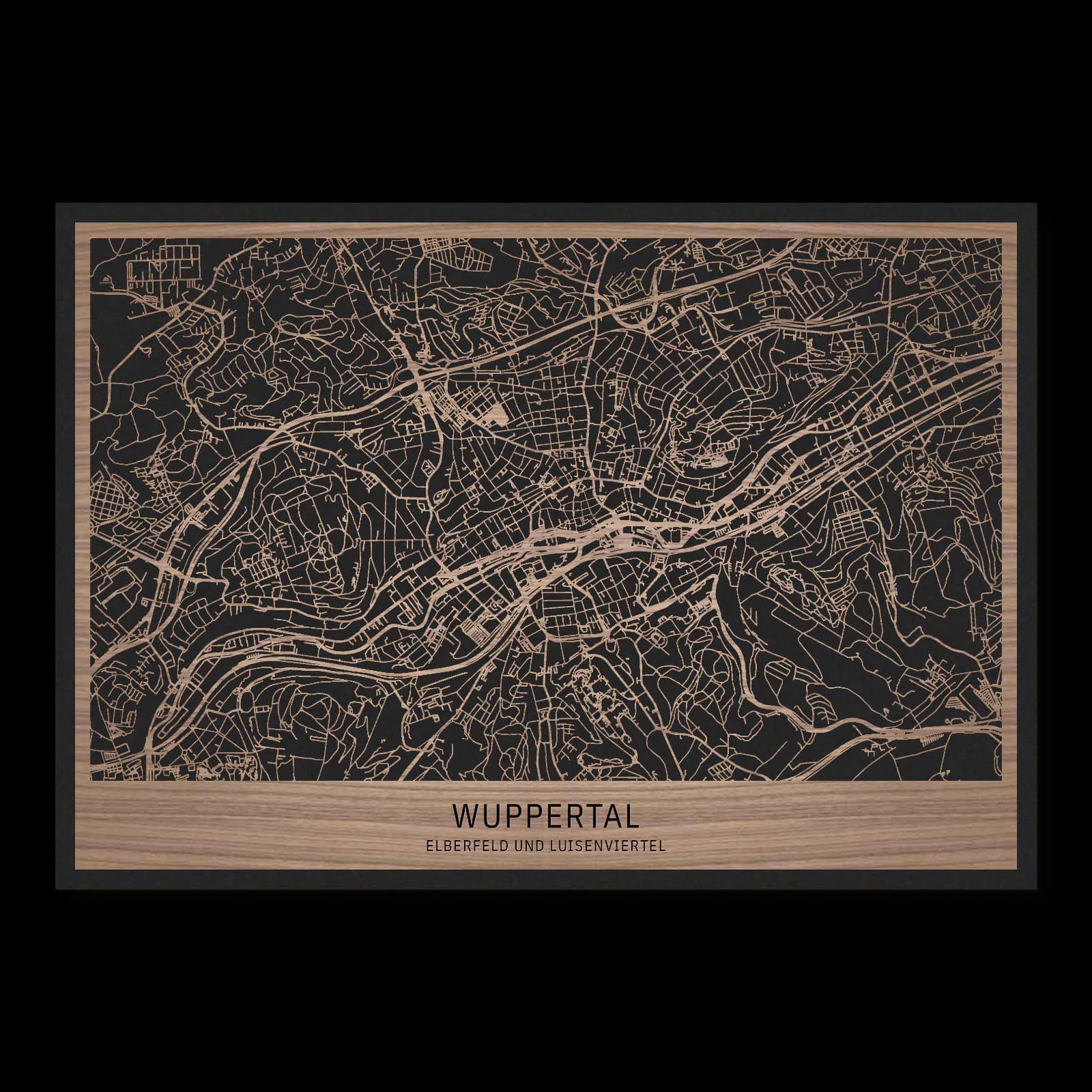
Wuppertal.Elberfeld and Luisenviertel
Rectangular wooden city map made from oiled walnut – two layers with a black back plate.
About the product
Three public buildings give western Elberfeld a distinctive cultural geography. St Laurentius anchors the Luisenviertel, the Von der Heydt Museum occupies the former town hall, and the Historic City Hall rises on the Johannisberg south of the Wupper. Church, municipal government and music each left a different architectural mark. Closely spaced streets and small squares connect these larger buildings to their surrounding neighbourhoods. Crossing the river also means moving between levels of the valley. The result is a compact urban setting in which everyday streets frame ambitious public architecture, expressing the civic and cultural life of a city shaped by industrial prosperity.
What does the map show?
- St Laurentius in the Luisenviertel
- Von der Heydt Museum in the former town hall
- Historic City Hall on the Johannisberg
- Precisely cut and engraved
- Fine laser details with clear depth
- Carefully inspected and securely packed
- Handmade in Germany
Configuration
Shape: Rectangular · Design: Layered · Material: Walnut · Sizes: 20 × 30 cm, 35 × 50 cm, 50 × 70 cm
The configuration shown in the cart and at the time of ordering is authoritative. The preview is not a dimensioned technical drawing.
Availability & production
- Availability
- Made to order
- Production time
- Ships in 3-5 business days
Production starts after successful payment and complete product configuration.
Materials & care
Depending on the variant, lacquered or oiled MDF or oiled real-wood veneer on MDF; optional stainless-steel mounting screws. Acrylic lacquer spray, hard-wax oil and white glue are used in production.
Wood is a natural material. Grain and color may vary slightly from the product images.
Clean with a dry, soft cloth and protect from prolonged moisture and direct heat.
Included & installation
The selected product in the ordered configuration, securely packed and prepared for installation.
- Maximum dimensions 50 × 70 cm and maximum product weight 2 kg.
- Wall-fixing screws and wall plugs are not included. Use fixings suitable for the wall type, substrate and product weight.
- Installation must be carried out by an adult. Keep optional mounting screws and other small parts away from children until installation.
Shipping & returns
Securely packed shipping. Return and cancellation information is available in the legal section.
Shipping costs and delivery options depend on the destination and format. The published cancellation right applies to non-personalised standard goods; it may be excluded for individually made products.
Manufacturer & product identifier
- Manufacturer
- Benjamin Nöst - Lightworks
Rorichmoorer Str. 76
26802 Moormerland, Deutschland
kontakt@lightworks.de - Product identifier
- LW-CAT-AFFB1AB45FA8-S, LW-CAT-AFFB1AB45FA8-M, LW-CAT-AFFB1AB45FA8-L
Together with the order or production batch, the relevant SKU enables traceability. Safety questions and incidents can be reported to the email address shown above.
Product safety
- Decorative product for dry indoor use only; not a toy and not intended for children.
- Protect from moisture, high heat and open flames.
- Do not continue to hang the product after a fall, breakage or visible damage. Keep damaged parts away from children.
Elberfeld’s civic rooms on either side of the Wupper
Elberfeld’s cultural identity is built into ordinary urban space. An old town hall became an art museum, a church gives a neighbourhood its focal point, and a concert venue occupies higher ground across the river. Their relationship reveals how civic ambition took architectural form around the Wupper.
Art in the former town hall
The Von der Heydt Museum occupies Elberfeld’s former town hall, a building that links municipal history with the presentation of art. Its classical architecture dates from the first half of the nineteenth century. Originally a statement of civic government, it subsequently acquired a different public purpose. This change of use is particularly revealing in a city whose cultural institutions developed alongside commercial and industrial wealth.
The museum’s name recalls the von der Heydt family and its contribution to the arts. That association connects private collecting and civic life rather than treating the museum as an isolated monument. Its position within the centre strengthens the relationship. Shopping streets, everyday routes and neighbouring buildings surround an institution that continues the public role of an older civic address.
A neighbourhood arranged around a church
To the west, St Laurentius provides a contrasting focus. Completed in 1835, the church stands at Laurentiusplatz in the Luisenviertel. It gives the surrounding network of smaller streets a recognisable centre. The square and its edges matter as much as the building alone: together they create a place where the neighbourhood opens out and becomes easier to read.
The streets between these landmarks have their own importance. Their relatively close grain allows the larger public buildings to emerge clearly from a continuous urban setting. Elberfeld’s character is found in that alternation between ordinary frontage and more formal architecture. The museum and church do not require a monumental avenue to connect them. A succession of corners, junctions and smaller spaces establishes the relationship through everyday city life.
A concert hall above the river
South of the Wupper, the Historic City Hall occupies the Johannisberg. Opened in 1900, it draws on Italian Renaissance forms and expresses the ambitions of a prosperous civic culture. Its elevated site gives it a different presence from the institutions on the northern side. Approaching it involves a change in level as well as a change in architectural scale.
The river remains the geographical link between these places. Bridges join the two sides, but the slope ensures that they do not feel interchangeable. Within a short distance, the city moves from neighbourhood streets to a former seat of government and then to a substantial music venue above the valley. These changes make Elberfeld’s cultural history tangible: distinct public activities occupy distinct urban positions, held together by the Wupper and the streets around it.
Sources
- Wikipedia – Von der Heydt-Museum — https://de.wikipedia.org/wiki/Von_der_Heydt-Museum
- Wikipedia – Stadthalle Wuppertal — https://de.wikipedia.org/wiki/Stadthalle_Wuppertal
- Wikipedia – St. Laurentius (Wuppertal-Elberfeld) — https://de.wikipedia.org/wiki/St._Laurentius_(Wuppertal-Elberfeld)
- Deutsche Zentrale für Tourismus – Wuppertal — https://www.germany.travel/en/cities-culture/wuppertal.html
- Wikipedia – Elberfeld — https://de.wikipedia.org/wiki/Elberfeld

Still deciding?
Configure your motif in the studio and see how your city map will look in your space.