
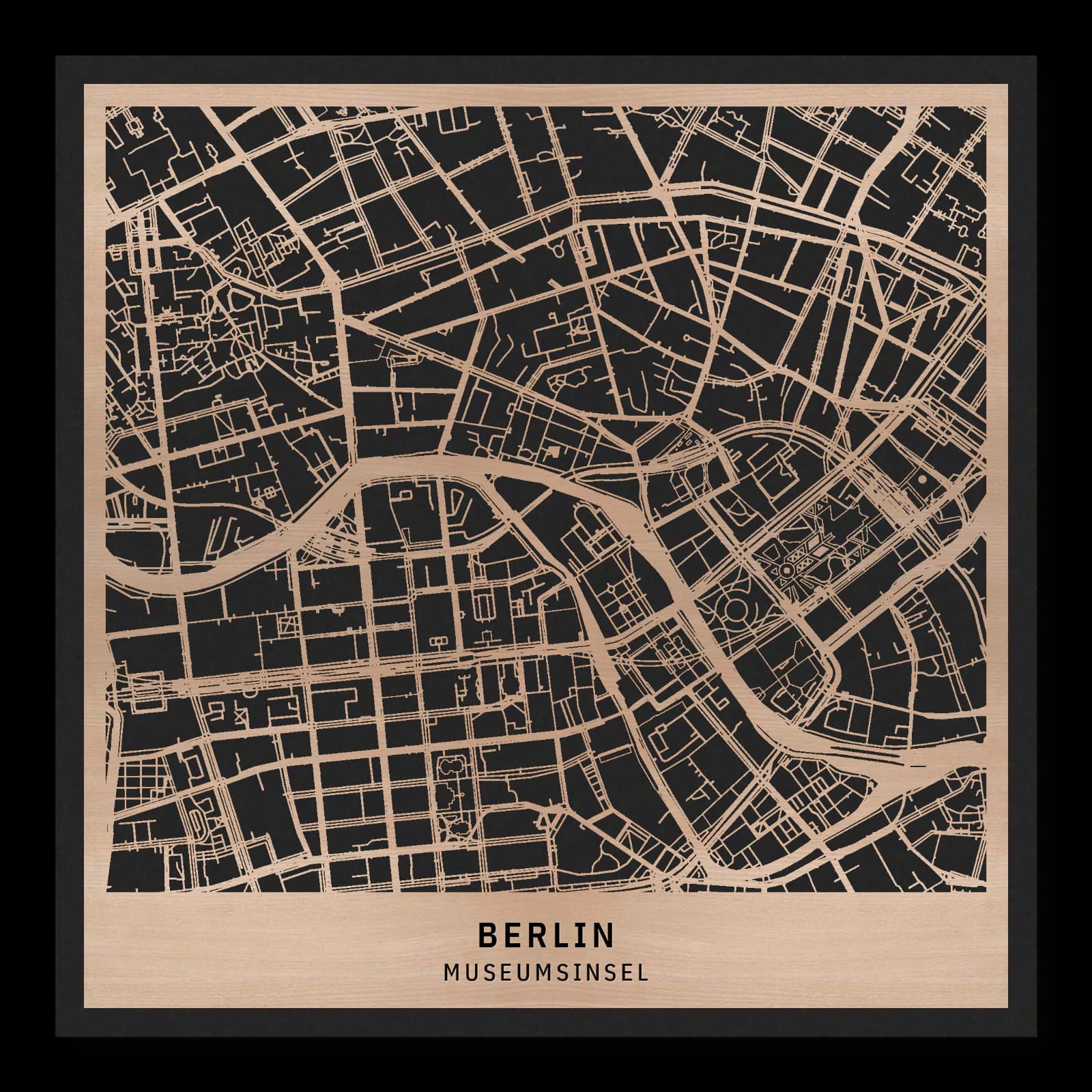
Berlin.Museum Island
Square wooden city map of Museum Island made from oiled beech – two layers with a black back plate.
About the product
Berlin’s Museum Island sits between branches of the Spree, linked to the surrounding streets by short bridges. This square map covers the Bode Museum, Altes Museum, Alte Nationalgalerie and Neues Museum, placing their neighbourhood in its wider urban setting. River edges and the connections to the mainland give the composition its direction. Oiled beech forms the cut map layer, with a black backing providing contrast and depth.
What does the map show?
- Bode Museum at the island’s tip
- Neighbourhood of the Altes and Neues Museums
- Spree branches and mainland connections
- Precisely cut and engraved
- Fine laser details with clear depth
- Carefully inspected and securely packed
- Handmade in Germany
Configuration
Shape: Square · Design: Layered · Material: Beech · Sizes: 23 × 23 cm, 35 × 35 cm, 50 × 50 cm
The configuration shown in the cart and at the time of ordering is authoritative. The preview is not a dimensioned technical drawing.
Availability & production
- Availability
- Made to order
- Production time
- Ships in 3-5 business days
Production starts after successful payment and complete product configuration.
Materials & care
Depending on the variant, lacquered or oiled MDF or oiled real-wood veneer on MDF; optional stainless-steel mounting screws. Acrylic lacquer spray, hard-wax oil and white glue are used in production.
Wood is a natural material. Grain and color may vary slightly from the product images.
Clean with a dry, soft cloth and protect from prolonged moisture and direct heat.
Included & installation
The selected product in the ordered configuration, securely packed and prepared for installation.
- Maximum dimensions 50 × 70 cm and maximum product weight 2 kg.
- Wall-fixing screws and wall plugs are not included. Use fixings suitable for the wall type, substrate and product weight.
- Installation must be carried out by an adult. Keep optional mounting screws and other small parts away from children until installation.
Shipping & returns
Securely packed shipping. Return and cancellation information is available in the legal section.
Shipping costs and delivery options depend on the destination and format. The published cancellation right applies to non-personalised standard goods; it may be excluded for individually made products.
Manufacturer & product identifier
- Manufacturer
- Benjamin Nöst - Lightworks
Rorichmoorer Str. 76
26802 Moormerland, Deutschland
kontakt@lightworks.de - Product identifier
- LW-CAT-BC9193201C2F-S, LW-CAT-BC9193201C2F-M, LW-CAT-BC9193201C2F-L
Together with the order or production batch, the relevant SKU enables traceability. Safety questions and incidents can be reported to the email address shown above.
Product safety
- Decorative product for dry indoor use only; not a toy and not intended for children.
- Protect from moisture, high heat and open flames.
- Do not continue to hang the product after a fall, breakage or visible damage. Keep damaged parts away from children.
Museum Island and the architecture of public collections
Museum Island developed through successive building projects rather than a single architectural gesture. Its compact setting makes those differences unusually easy to experience. Four neighbouring museums reveal changing ideas about public collections, while the riverbanks, courtyards and approaches explain how separate institutions became a recognisable cultural ensemble.
Opening collections to the city
The Altes Museum opened in 1830. Karl Friedrich Schinkel gave it a long colonnaded façade facing the Lustgarten, translating the idea of a public museum into a powerful urban presence. The approach is part of the experience: a broad front addresses an open space rather than disappearing into an ordinary row of buildings.
Inside, the rotunda is one of the building’s defining features. Outside, its position establishes a clear southern edge to the museum area. This relationship between institution and setting is a useful starting point for exploring the island. Each museum shapes the spaces around it, and the buildings do so in noticeably different ways.
Several generations of museum design
Opened in 1876, the Alte Nationalgalerie adopts a temple-like form and an elevated position. Its stairs and forecourt contribute to the impression of approaching a place set apart. Nearby colonnades and passages create more intimate spaces, changing the scale of movement between the larger buildings. Looking at these transitions reveals more than a catalogue of façades would.
The Neues Museum introduces a different architectural discussion. Its reopening in 2009 followed David Chipperfield’s work with the damaged historic building. Surviving elements and modern interventions remain legible alongside one another. The result invites attention to what has been preserved, what has been added and how both can belong to a functioning museum. History is encountered through the building as well as through the objects it contains.
Where the island narrows
At the northern tip, the Bode Museum sits directly between the branches of the river. It opened in 1904 as the Kaiser Friedrich Museum and received its present name in 1956. Its position gives it a particular role in the ensemble: the land narrows, water becomes more prominent and the bridges gather movement around the building.
Museum Island entered the UNESCO World Heritage List in 1999. The designation recognises an ensemble whose interest extends beyond individual collections. A short walk can pass from a monumental frontage into a sheltered courtyard, then across a bridge or alongside an open riverbank.
These changes make the island rewarding even when considered simply as a piece of city. Large buildings are held together by relatively small spaces. The museums remain distinct, but their approaches and the surrounding water establish a shared rhythm that is difficult to find elsewhere in central Berlin.
Sources
- visitBerlin: Museum Island — https://www.visitberlin.de/en/museum-island-in-berlin
- visitBerlin: Altes Museum — https://www.visitberlin.de/en/altes-museum-old-museum
- visitBerlin: Neues Museum — https://www.visitberlin.de/en/neues-museum-new-museum
- visitBerlin: Bode Museum — https://www.visitberlin.de/en/bode-museum
Still deciding?
Configure your motif in the studio and see how your city map will look in your space.