
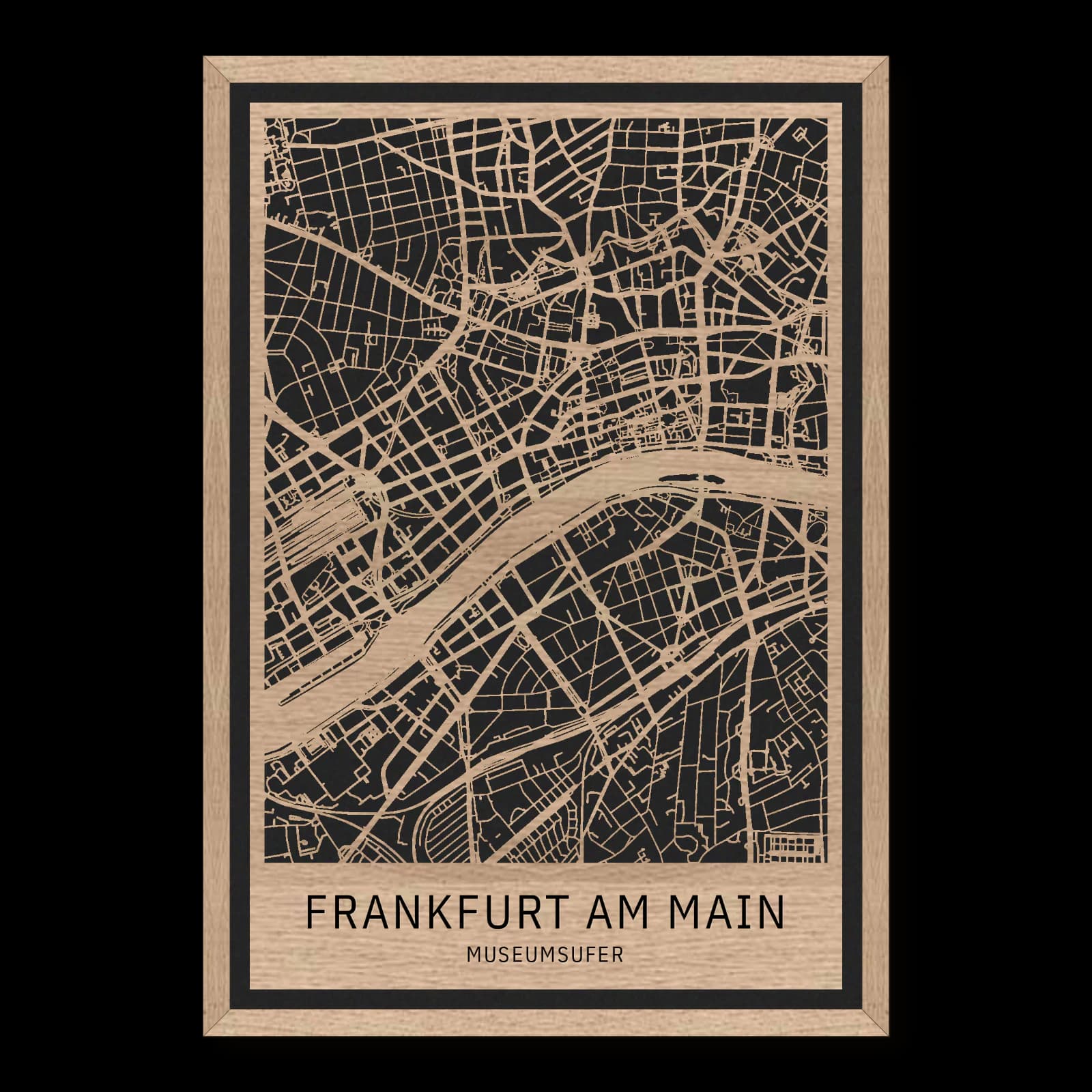
Frankfurt am Main.Museum Embankment
Framed wooden city map in oiled oak, portrait format.
About the product
Frankfurt's southern riverbank takes shape through the gardens and buildings of the Liebieghaus, Städel and Museum Angewandte Kunst. Beside them, the Main forms a continuous line, while the Eiserner Steg connects the cultural landscape with the city across the water. This view recalls the particular experience of the Museumsufer: moving between collections, returning to the river and discovering the streets just behind it. An oak frame gives this narrow riverside view a defined edge. Set above a backing panel, the cut street layer gains depth, while the Main keeps the museum buildings and routes towards the old town in relation.
What does the map show?
- Städel
- Liebieghaus
- Museum Angewandte Kunst
- Eiserner Steg
- Precisely cut and engraved
- Fine laser details with clear depth
- Carefully inspected and securely packed
- Handmade in Germany
Configuration
Shape: Rectangular · Design: Framed · Material: Oak · Sizes: 20 × 30 cm, 35 × 50 cm, 50 × 70 cm
The configuration shown in the cart and at the time of ordering is authoritative. The preview is not a dimensioned technical drawing.
Availability & production
- Availability
- Made to order
- Production time
- Ships in 3-5 business days
Production starts after successful payment and complete product configuration.
Materials & care
Depending on the variant, lacquered or oiled MDF or oiled real-wood veneer on MDF; optional stainless-steel mounting screws. Acrylic lacquer spray, hard-wax oil and white glue are used in production.
Wood is a natural material. Grain and color may vary slightly from the product images.
Clean with a dry, soft cloth and protect from prolonged moisture and direct heat.
Included & installation
The selected product in the ordered configuration, securely packed and prepared for installation.
- Maximum dimensions 50 × 70 cm and maximum product weight 2 kg.
- Wall-fixing screws and wall plugs are not included. Use fixings suitable for the wall type, substrate and product weight.
- Installation must be carried out by an adult. Keep optional mounting screws and other small parts away from children until installation.
Shipping & returns
Securely packed shipping. Return and cancellation information is available in the legal section.
Shipping costs and delivery options depend on the destination and format. The published cancellation right applies to non-personalised standard goods; it may be excluded for individually made products.
Manufacturer & product identifier
- Manufacturer
- Benjamin Nöst - Lightworks
Rorichmoorer Str. 76
26802 Moormerland, Deutschland
kontakt@lightworks.de - Product identifier
- LW-CAT-178F052F5727-S, LW-CAT-178F052F5727-M, LW-CAT-178F052F5727-L
Together with the order or production batch, the relevant SKU enables traceability. Safety questions and incidents can be reported to the email address shown above.
Product safety
- Decorative product for dry indoor use only; not a toy and not intended for children.
- Protect from moisture, high heat and open flames.
- Do not continue to hang the product after a fall, breakage or visible damage. Keep damaged parts away from children.
Frankfurt's museum bank: villas, collections and the Main
Along Schaumainkai, museums occupy remarkably different architectural settings. A former private villa, a purpose-built collection building and a modern extension share the riverbank without becoming a single complex. The Main provides their common address, while gardens and approaches reveal how each institution relates to the surrounding streets of Sachsenhausen.
A cultural district assembled over time
Frankfurt's Museumsufer was not built as one coordinated museum campus. Existing collections, converted residences and new architecture were brought into a larger cultural project developed in the late 1970s under cultural affairs director Hilmar Hoffmann. Preserving the villas and gardens along Schaumainkai formed part of that ambition. The spaces between institutions therefore matter as much as the buildings themselves.
The riverside promenade supplies an obvious direction, but individual entrances repeatedly draw visitors inland. Moving between an open riverbank and houses set within their grounds produces a different experience from arriving at one enormous museum square. Each institution retains its own approach and architectural history while contributing to a recognisable shared setting.
Three contrasting museum buildings
The Städel grew from the bequest of Frankfurt banker Johann Friedrich Städel. Its purpose-built home on Schaumainkai opened in 1878, well before the later Museumsufer programme. The building makes the gradual development of the cultural riverbank visible. Its relationship with the garden remains important when approaching from the Main, even before entering the galleries.
To the west, the Liebieghaus began as the residence of textile manufacturer Heinrich von Liebieg. Frankfurt acquired the villa in 1908 to house a sculpture collection. A private domestic setting was thus adapted for public cultural use. The garden mediates between the busy riverside street and the house, while the collection gives the former residence a reach far beyond its original purpose.
The Museum Angewandte Kunst introduces another arrangement. Richard Meier's building, completed in 1985, stands alongside the older Villa Metzler. Their proximity invites comparison between historic architecture and a modern museum conceived around it. This relationship suits an institution concerned with design and the cultural meanings of everyday objects: questions about form, use and context begin outside the exhibition rooms.
Connections beyond the collections
The Eiserner Steg brings pedestrians across the Main from the northern city centre. Its role shows why the Museumsufer should be understood as part of ordinary urban movement. Visitors can follow the river, enter a museum garden or continue into Sachsenhausen through adjoining streets.
Schaumainkai allows part of each collection's history to be understood before entering a gallery. The Liebieghaus retains the starting point of a private villa; the Städel building was intended to accommodate a public collection. Beside Villa Metzler, a modern museum directly addresses an older house. Gardens keep these origins legible along the street. The later Museumsufer project linked the addresses through a shared cultural purpose while leaving their architectural differences available to anyone approaching from the Main.
Sources
- Museumsufer Frankfurt: Geschichte — https://www.museumsufer.de/en/about-museumsufer-frankfurt/about-museumsufer-frankfurt-history/
- Museumsufer Frankfurt: Städel Museum — https://www.museumsufer.de/en/all-museums/staedel-museum/
- Museumsufer Frankfurt: Liebieghaus — https://www.museumsufer.de/en/all-museums/liebieghaus-skulpturensammlung/
- Museumsufer Frankfurt: Museum Angewandte Kunst — https://www.museumsufer.de/en/all-museums/museum-angewandte-kunst/
- Wikipedia: Eiserner Steg — https://en.wikipedia.org/wiki/Eiserner_Steg

Still deciding?
Configure your motif in the studio and see how your city map will look in your space.



