
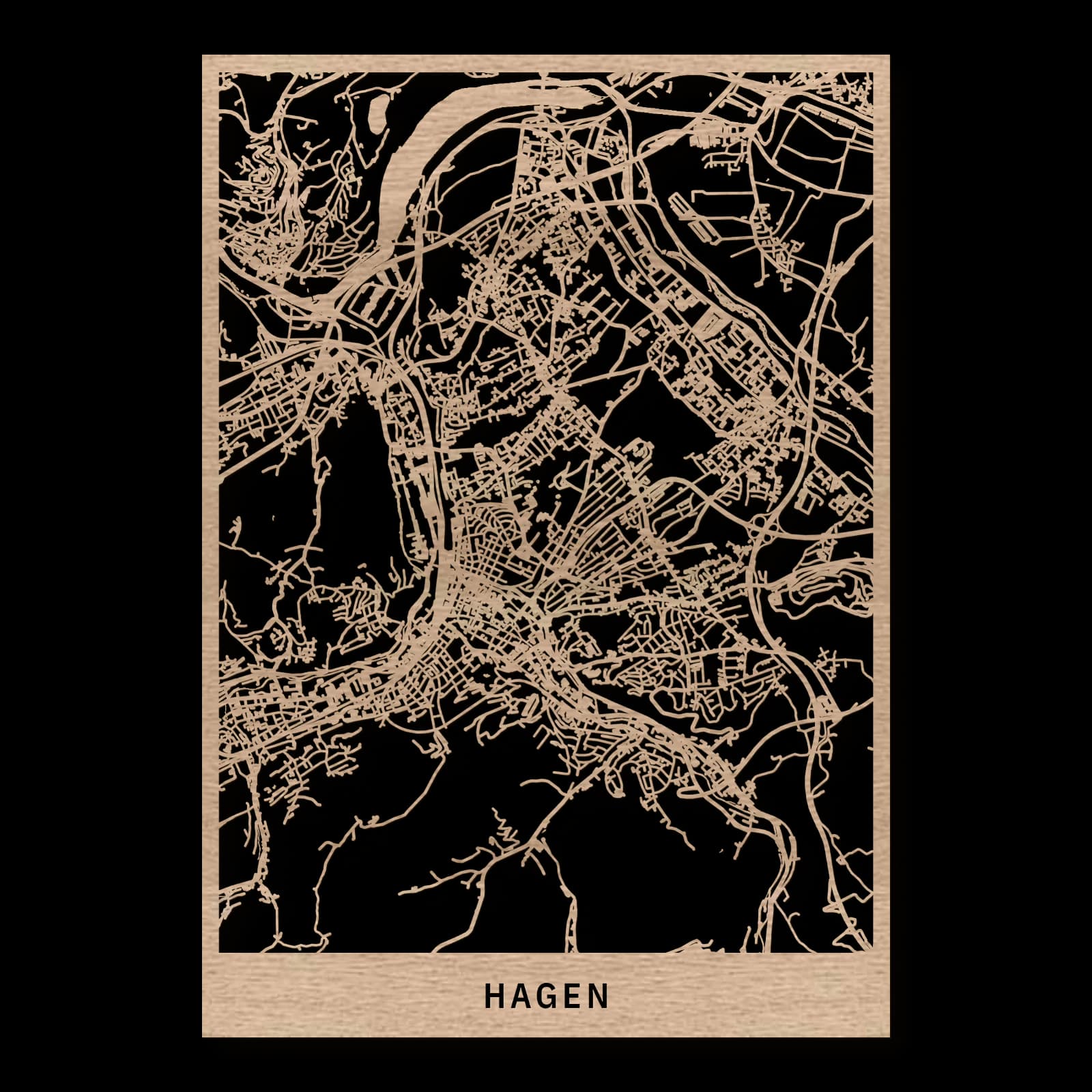
Hagen.Volme valley and wooded hills
Rectangular wooden city map made from oiled oak.
About the product
River valleys and wooded hills give Hagen its branching urban shape. From Hengsteysee to the LWL Open-Air Museum, built-up valleys alternate with greener outskirts, while the Osthaus Museum and Hohenhof provide cultural landmarks. Wood suits the natural character of this landscape-led map. Roads and waterways connect scattered neighbourhoods, revealing how closely the city's form follows its terrain.
What does the map show?
- Central station and museum district
- Hohenhof to the east
- LWL Open-Air Museum to the south
- Hengsteysee at the northern edge
- Precisely cut and engraved
- Fine laser details with clear depth
- Carefully inspected and securely packed
- Handmade in Germany
Configuration
Shape: Rectangular · Design: Classic · Material: Oak · Sizes: 20 × 30 cm, 35 × 50 cm, 50 × 70 cm
The configuration shown in the cart and at the time of ordering is authoritative. The preview is not a dimensioned technical drawing.
Availability & production
- Availability
- Made to order
- Production time
- Ships in 3-5 business days
Production starts after successful payment and complete product configuration.
Materials & care
Depending on the variant, lacquered or oiled MDF or oiled real-wood veneer on MDF; optional stainless-steel mounting screws. Acrylic lacquer spray, hard-wax oil and white glue are used in production.
Wood is a natural material. Grain and color may vary slightly from the product images.
Clean with a dry, soft cloth and protect from prolonged moisture and direct heat.
Included & installation
The selected product in the ordered configuration, securely packed and prepared for installation.
- Maximum dimensions 50 × 70 cm and maximum product weight 2 kg.
- Wall-fixing screws and wall plugs are not included. Use fixings suitable for the wall type, substrate and product weight.
- Installation must be carried out by an adult. Keep optional mounting screws and other small parts away from children until installation.
Shipping & returns
Securely packed shipping. Return and cancellation information is available in the legal section.
Shipping costs and delivery options depend on the destination and format. The published cancellation right applies to non-personalised standard goods; it may be excluded for individually made products.
Manufacturer & product identifier
- Manufacturer
- Benjamin Nöst - Lightworks
Rorichmoorer Str. 76
26802 Moormerland, Deutschland
kontakt@lightworks.de - Product identifier
- LW-CAT-9B0C07A26C02-S, LW-CAT-9B0C07A26C02-M, LW-CAT-9B0C07A26C02-L
Together with the order or production batch, the relevant SKU enables traceability. Safety questions and incidents can be reported to the email address shown above.
Product safety
- Decorative product for dry indoor use only; not a toy and not intended for children.
- Protect from moisture, high heat and open flames.
- Do not continue to hang the product after a fall, breakage or visible damage. Keep damaged parts away from children.
Hagen’s cityscape of valleys and hills
Hagen’s buildings do not follow a uniform grid. Valleys gather settlement and transport routes, while higher ground preserves larger green areas. Between Hengsteysee, the centre, Hohenhof and the open-air museum, industrial growth and ideas about art and design are closely related to the terrain. The distances between these places help explain that relationship.
Growth directed by the terrain
Hagen’s development as an industrial town was closely connected with its valleys and transport routes. The municipal history describes the transformation of a smaller settlement along a valley road into a rapidly growing industrial centre during the nineteenth century. The landscape directed that growth. Roads, railway lines and buildings concentrated where connections were relatively accessible, while higher ground became part of the city in different ways. These topographical distinctions explain Hagen’s varied density. It developed as several connected urban spaces rather than as a single, evenly built and regularly organised area.
Transport and culture in the centre
The main railway station lies northwest of the Osthaus Museum. Both belong to the central city but represent different functions. The station gathers local and longer-distance connections, while the museum reflects Hagen’s cultural development. Their relationship demonstrates that industrial history extends beyond factories and production. Economic growth also supported new cultural ambitions. The Osthaus Museum recalls the importance of art and design within that development. Closely connected streets occupy the area between the two places, forming part of the denser urban setting that gives central Hagen its continuity and everyday structure.
Hohenhof and a broader design ambition
Hohenhof stands east of the centre. Henry van de Velde designed the villa for Karl Ernst Osthaus, and it was built between 1906 and 1908. Architecture and garden belonged to a wider approach to design that also concerned the surrounding settlement. The place represents a particular response to the modern industrial city, seeking deliberate relationships between housing, art and landscape. Its more open position differs from the densely built valleys. That setting makes the connection between building, garden and wider terrain fundamental to understanding the house and its significance within Hagen.
Cultural places across a wider landscape
The LWL Open-Air Museum lies south of the centre and adds historic craft and production environments to the city’s story. Hengsteysee occupies the opposite, northern end of the broader view. Together, these places extend the urban perspective well beyond the central streets. Dense districts alternate with open ground and wooded heights between them. Hagen’s cultural landmarks are therefore distributed through a landscape rather than gathered in one compact centre. The terrain continues to shape their relationships, with connecting valleys and routes contributing as much to the overall city as the individual buildings.
Sources
- Stadt Hagen: Stadtgeschichte — https://www.hagen.de/das-ist-hagen/stadtgeschichte/
- Stadt Hagen: Stadt und Landschaft — https://www.hagen.de/das-ist-hagen/
- LWL: Historische Gartenanlage Hohenhof — https://www.gaerten-in-westfalen.de/de/garten-und-parks-in-westfalen-lippe/zu-den-garten-und-parks-in-westfalen-lippe/hagen-historische-gartenanlage-hohenhof/
- Stadt Hagen: Villa Hohenhof und Garten — https://iga2027-hagen.de/orte-erlebnisse/villa-hohenhof

Still deciding?
Configure your motif in the studio and see how your city map will look in your space.