
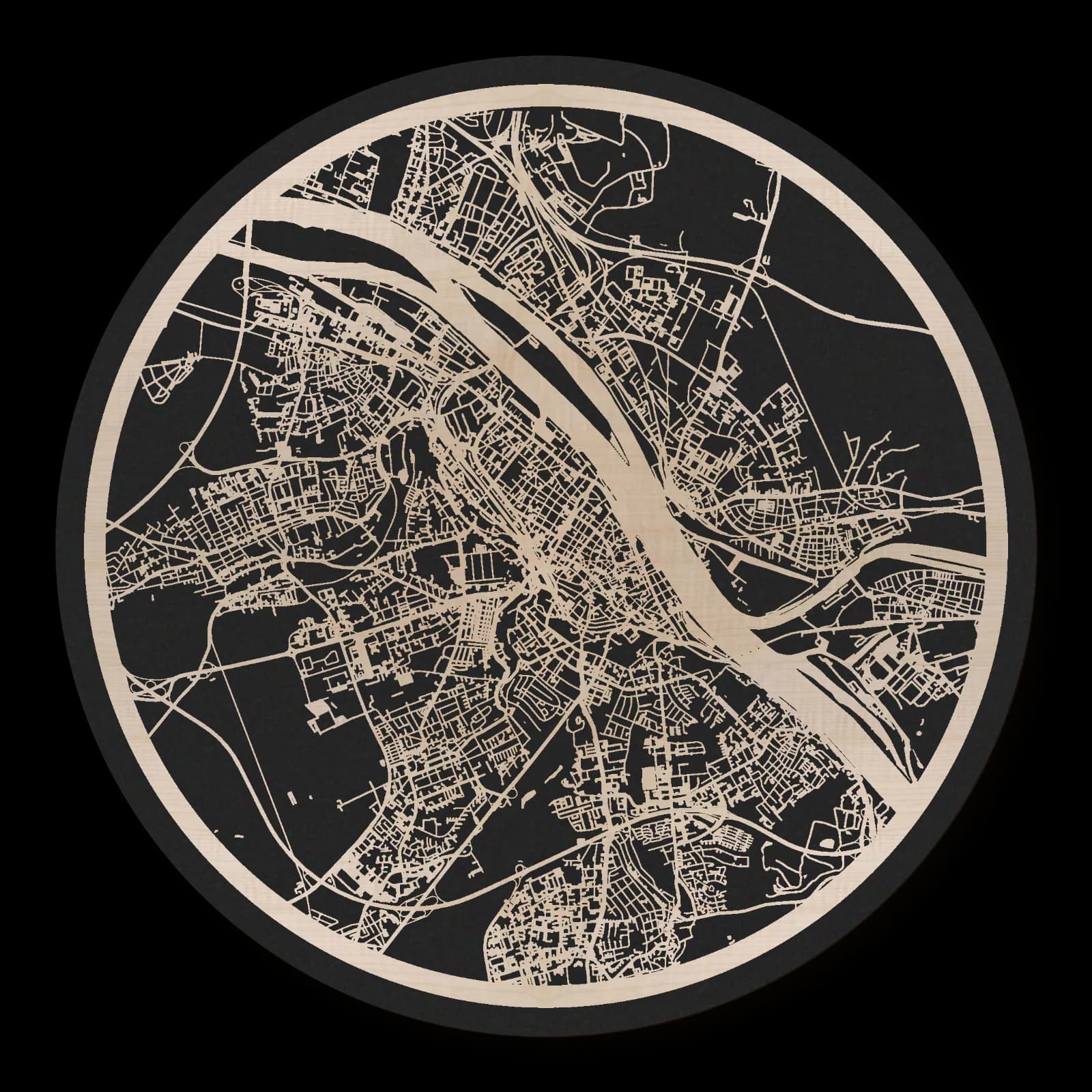
Mainz.Cathedral, Neustadt and Rhine
Layered wooden city map in oiled maple, round format.
About the product
Mainz connects its older cathedral centre with the Neustadt, citadel and western districts. Christuskirche and the main station provide additional landmarks, while the Rhine defines the eastern side. Looking from the cathedral towards the wider streets reveals how expansion changed the direction and scale of Mainz. The circular map connects the cathedral area, Neustadt and western neighbourhoods. Oiled maple forms the cut upper layer, set above a backing panel so the Rhine side remains part of the broader street plan.
What does the map show?
- Mainzer Dom
- Christuskirche Mainz
- Mainzer Zitadelle
- Mainz Hauptbahnhof
- Precisely cut and engraved
- Fine laser details with clear depth
- Carefully inspected and securely packed
- Handmade in Germany
Configuration
Shape: Round · Design: Layered · Material: Maple · Diameter: Ø 23 cm, Ø 35 cm, Ø 50 cm
The configuration shown in the cart and at the time of ordering is authoritative. The preview is not a dimensioned technical drawing.
Availability & production
- Availability
- Made to order
- Production time
- Ships in 3-5 business days
Production starts after successful payment and complete product configuration.
Materials & care
Depending on the variant, lacquered or oiled MDF or oiled real-wood veneer on MDF; optional stainless-steel mounting screws. Acrylic lacquer spray, hard-wax oil and white glue are used in production.
Wood is a natural material. Grain and color may vary slightly from the product images.
Clean with a dry, soft cloth and protect from prolonged moisture and direct heat.
Included & installation
The selected product in the ordered configuration, securely packed and prepared for installation.
- Maximum dimensions 50 × 70 cm and maximum product weight 2 kg.
- Wall-fixing screws and wall plugs are not included. Use fixings suitable for the wall type, substrate and product weight.
- Installation must be carried out by an adult. Keep optional mounting screws and other small parts away from children until installation.
Shipping & returns
Securely packed shipping. Return and cancellation information is available in the legal section.
Shipping costs and delivery options depend on the destination and format. The published cancellation right applies to non-personalised standard goods; it may be excluded for individually made products.
Manufacturer & product identifier
- Manufacturer
- Benjamin Nöst - Lightworks
Rorichmoorer Str. 76
26802 Moormerland, Deutschland
kontakt@lightworks.de - Product identifier
- LW-CAT-673038CECEF8-S, LW-CAT-673038CECEF8-M, LW-CAT-673038CECEF8-L
Together with the order or production batch, the relevant SKU enables traceability. Safety questions and incidents can be reported to the email address shown above.
Product safety
- Decorative product for dry indoor use only; not a toy and not intended for children.
- Protect from moisture, high heat and open flames.
- Do not continue to hang the product after a fall, breakage or visible damage. Keep damaged parts away from children.
Mainz: cathedral city, expansion and Jewish heritage
Mainz contains several historical frameworks: the cathedral and older centre, the southern citadel, the later Neustadt and an important Jewish heritage. The station and university add further reference points. Their distribution shows how religious, military and civic developments shaped different parts of the Rhine city and remain visible in its present arrangement.
The cathedral and its surroundings
Mainz Cathedral represents a long history of ecclesiastical and political importance. Its predominantly Romanesque appearance incorporates construction and alteration from several centuries. The powerful position of Mainz's archbishops explains why it was more than a local parish church. Streets of the older centre gather closely around the building.
The Rhine forms part of this setting. Moving inland from the river reveals transitions towards denser streets and the districts farther west. Mainz is not organised evenly around its cathedral. Later expansion and substantial institutions introduced other directions and scales into the urban pattern.
Defence and a growing city
The citadel occupies Jakobsberg south of the older centre. Its seventeenth-century form belongs to Mainz's history as a fortified city. The elevated position had strategic value, demonstrating how military requirements influenced the use of terrain. The complex establishes a clearly bounded, larger-scale area beside ordinary streets.
Christuskirche represents another stage of growth. Designed by Eduard Kreyßig and built around 1900, it belongs to the development of the Neustadt. Its conspicuous dome and broad street setting differ from the tighter surroundings of the cathedral. The church also reflects the increasing presence of a Protestant community within a city historically dominated by Catholic institutions.
Heritage beyond the familiar centre
The Old Jewish Cemetery is part of the World Heritage property comprising the ShUM sites. It recalls the major contribution of Jewish communities along the Upper Rhine to Ashkenazi cultural development. This is an independent strand of Mainz's significance, not merely an addition to its cathedral history. Its position west of the older centre draws attention beyond the best-known central squares.
The main station and university district establish more recent functional concentrations. Arrival, education and everyday travel organise these areas. Religious institutions, military planning, urban extension and modern public facilities therefore coexist within the wider city. Differences in plot size and relationships with streets remain visible.
The citadel asks for a different reading of Mainz from the cathedral: defence and a religious centre each required their own spaces. In the Neustadt, the scale shifts again towards a later urban extension. Jewish heritage should not appear merely as an addition to a sequence of Christian monuments. It belongs to a distinct history within the same city. These separate reference points preserve that plurality, while the main station and westward connections locate it within the geography of present-day Mainz.
Sources
- UNESCO World Heritage Centre: ShUM Sites of Speyer, Worms and Mainz — https://whc.unesco.org/en/list/1636/
- Wikipedia: Mainzer Dom — https://en.wikipedia.org/wiki/Mainz_Cathedral
- Wikipedia: Mainzer Zitadelle — https://en.wikipedia.org/wiki/Mainz_Citadel
- Wikipedia: Christuskirche Mainz — https://en.wikipedia.org/wiki/Christuskirche,_Mainz
- Wikipedia: Mainz — https://en.wikipedia.org/wiki/Mainz

Still deciding?
Configure your motif in the studio and see how your city map will look in your space.



