
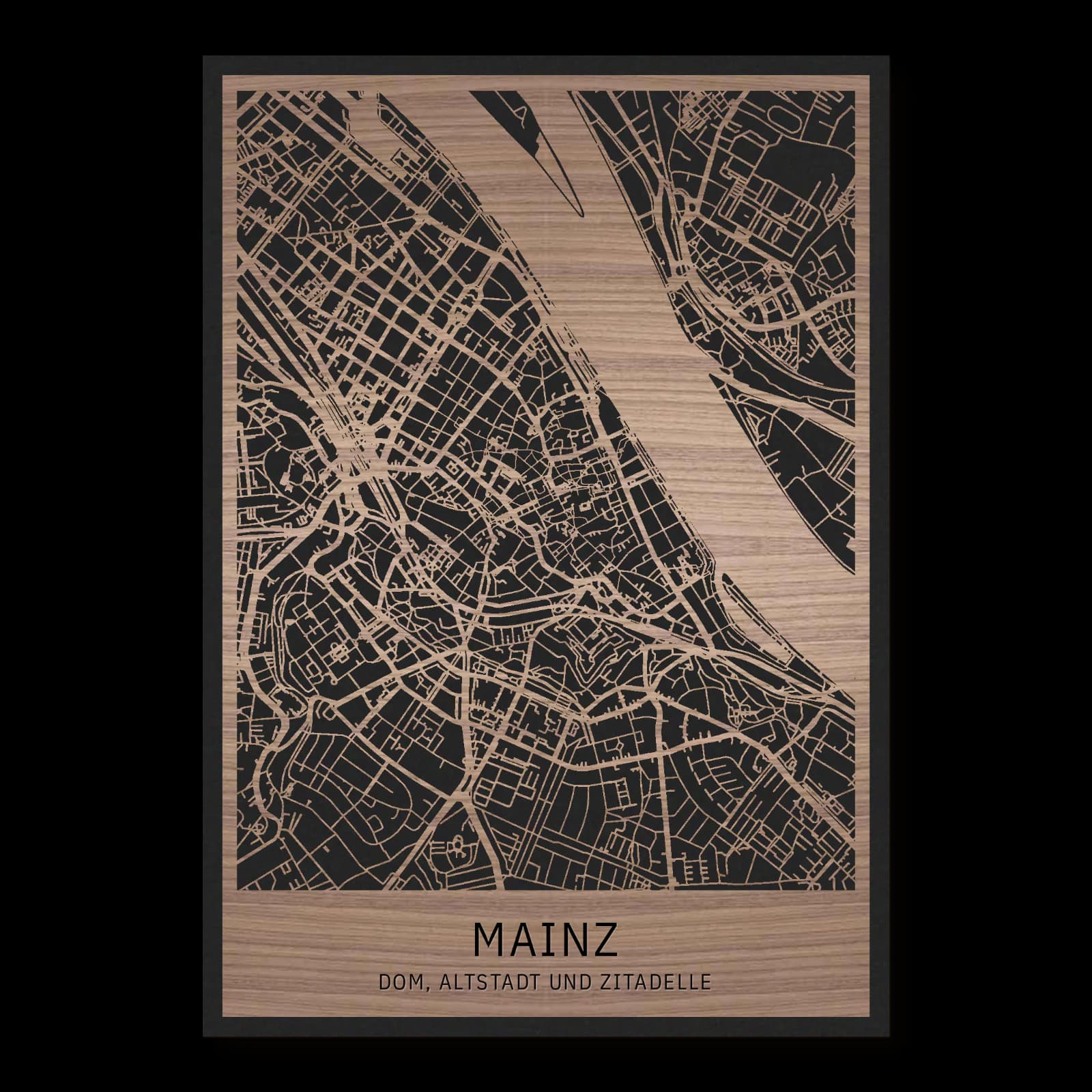
Mainz.Cathedral, old town and citadel
Rectangular wooden city map made from oiled walnut – two layers with a black back plate.
About the product
Narrow lanes and two elevated landmarks give the old town of Mainz a distinctive shape. St Stephen’s rises to the west, while the citadel occupies the Jakobsberg to the south. Between them, the cathedral anchors a closely built neighbourhood of small squares and short streets. The Augustinian church presents a different architectural presence, fitting its towerless Baroque façade into a continuous row of buildings. The area brings ecclesiastical ambition, everyday urban life and the history of fortification into close contact. Its character comes from changes in scale: intimate streets open towards large church buildings, while the angular citadel forms a firm edge above the town.
What does the map show?
- Cathedral precinct among narrow old town streets
- St Stephen’s on higher ground
- Citadel on the Jakobsberg
- Precisely cut and engraved
- Fine laser details with clear depth
- Carefully inspected and securely packed
- Handmade in Germany
Configuration
Shape: Rectangular · Design: Layered · Material: Walnut · Sizes: 20 × 30 cm, 35 × 50 cm, 50 × 70 cm
The configuration shown in the cart and at the time of ordering is authoritative. The preview is not a dimensioned technical drawing.
Availability & production
- Availability
- Made to order
- Production time
- Ships in 3-5 business days
Production starts after successful payment and complete product configuration.
Materials & care
Depending on the variant, lacquered or oiled MDF or oiled real-wood veneer on MDF; optional stainless-steel mounting screws. Acrylic lacquer spray, hard-wax oil and white glue are used in production.
Wood is a natural material. Grain and color may vary slightly from the product images.
Clean with a dry, soft cloth and protect from prolonged moisture and direct heat.
Included & installation
The selected product in the ordered configuration, securely packed and prepared for installation.
- Maximum dimensions 50 × 70 cm and maximum product weight 2 kg.
- Wall-fixing screws and wall plugs are not included. Use fixings suitable for the wall type, substrate and product weight.
- Installation must be carried out by an adult. Keep optional mounting screws and other small parts away from children until installation.
Shipping & returns
Securely packed shipping. Return and cancellation information is available in the legal section.
Shipping costs and delivery options depend on the destination and format. The published cancellation right applies to non-personalised standard goods; it may be excluded for individually made products.
Manufacturer & product identifier
- Manufacturer
- Benjamin Nöst - Lightworks
Rorichmoorer Str. 76
26802 Moormerland, Deutschland
kontakt@lightworks.de - Product identifier
- LW-CAT-A3C8514C24EF-S, LW-CAT-A3C8514C24EF-M, LW-CAT-A3C8514C24EF-L
Together with the order or production batch, the relevant SKU enables traceability. Safety questions and incidents can be reported to the email address shown above.
Product safety
- Decorative product for dry indoor use only; not a toy and not intended for children.
- Protect from moisture, high heat and open flames.
- Do not continue to hang the product after a fall, breakage or visible damage. Keep damaged parts away from children.
Mainz from cathedral lanes to the citadel
Mainz’s historic centre changes level as well as character. The cathedral sits within a busy network of streets, St Stephen’s commands higher ground, and the citadel occupies a fortified hilltop. Together they reveal how religious life and military needs shaped a compact neighbourhood that still has the texture of a lived-in town.
A cathedral within the neighbourhood
Mainz Cathedral is closely woven into the surrounding town. Houses, streets and squares approach its substantial walls, so the building is encountered through a succession of partial views as well as broader perspectives. Its largely Romanesque character and later additions reflect a long ecclesiastical history. Around it, much smaller urban spaces provide a contrasting scale. The relationship is particularly revealing because the cathedral does not stand apart from ordinary streets: the monumental building and the neighbouring town constantly frame one another.
A short distance south, the Augustinian church offers another way of occupying an old town. Its Baroque façade rises within a row of buildings rather than announcing itself through a detached tower. The church is surrounded by former convent buildings and other houses, giving the street frontage unusual importance. Comparing it with the cathedral draws attention to the different ways religious buildings could fit into an already crowded urban setting. One spreads across a large precinct; the other concentrates its outward presence on a single imposing front.
St Stephen’s and the rising ground
St Stephen’s stands west of the Augustinian church on higher terrain. The change in level helps explain why the old town cannot be understood simply as a collection of neighbouring monuments. Moving between these churches also means moving through a landscape. The streets connect places that occupy different positions above the lower centre, producing alternating views of roofs, towers and enclosed urban spaces.
Inside St Stephen’s, the windows designed by Marc Chagall add a much later chapter to the building’s history. Begun in 1978, they were intended as a contribution to reconciliation between Jewish and German communities. Their significance extends beyond decoration. They connect an older sacred building with a major concern of the twentieth century, giving the church a cultural identity distinct from its elevated position in the town.
The geometry of defence
The citadel on the Jakobsberg introduces an altogether different structure. Its present form developed around 1660 as part of Mainz’s fortifications. Bastions and enclosing walls express a coordinated defensive plan, contrasting with the small plots and irregular passages below. The hill therefore provides both a change of height and a change of urban scale.
Seen together, these places show how closely religious authority, domestic life and defence were situated in Mainz. St Stephen’s and the citadel occupy separate high points, while the cathedral remains embedded in the lower streets. The old town gains much of its character from the routes that bind these three positions together.
Sources
- Deutsche Zentrale für Tourismus – Mainz — https://www.germany.travel/en/cities-culture/mainz.html
- Wikipedia – Mainzer Dom — https://de.wikipedia.org/wiki/Mainzer_Dom
- Wikipedia – Zitadelle Mainz — https://de.wikipedia.org/wiki/Zitadelle_Mainz
- Wikipedia – St. Stephan (Mainz) — https://de.wikipedia.org/wiki/St._Stephan_(Mainz)
- Wikipedia – Augustinerkirche (Mainz) — https://de.wikipedia.org/wiki/Augustinerkirche_(Mainz)

Still deciding?
Configure your motif in the studio and see how your city map will look in your space.



