
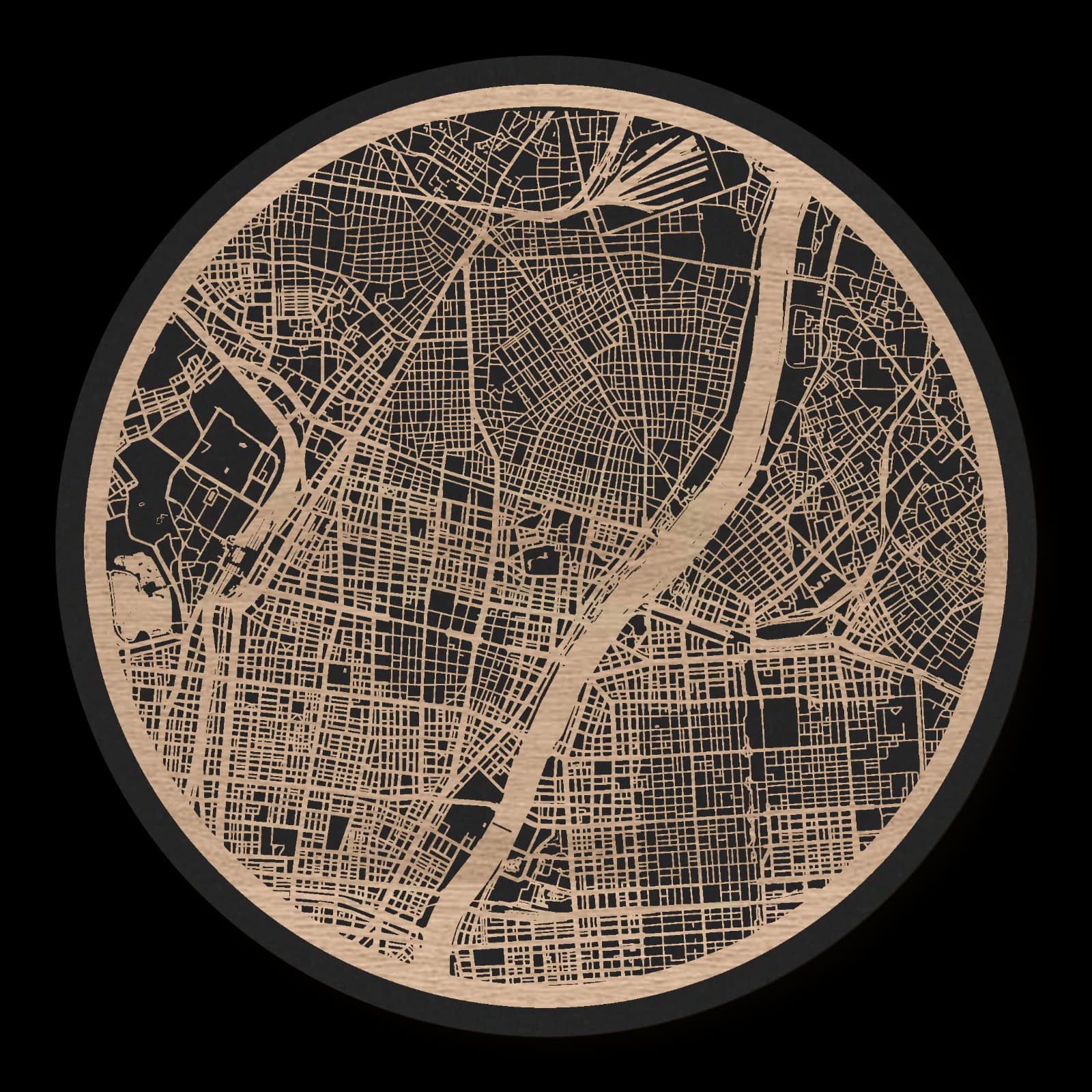
Tokyo.Asakusa beside the Sumida
Round wooden city map in oiled oak, with two layers and a black backing plate.
About the product
Asakusa’s temple approach and the Sumida riverbank establish two different directions through the neighbourhood. This crop includes Kaminarimon, Sensoji, Asakusa Shrine and Sumida Park, with smaller streets connecting their settings. The round oiled oak map has no engraving, allowing the street composition to occupy the design on its own. A black backing plate lies behind the cut front layer, providing contrast and a second physical layer. Available in three diameters, it gives this particular part of Tokyo a circular outline.
What does the map show?
- Crop includes Sensoji and Kaminarimon
- Asakusa Shrine and Sumida Park nearby
- Round oiled oak map without engraving
- Two layers with a black backing plate
- Precisely cut and engraved
- Fine laser details with clear depth
- Carefully inspected and securely packed
- Handmade in Germany
Configuration
Shape: Round · Design: Layered · Material: Oak · Diameter: Ø 23 cm, Ø 35 cm, Ø 50 cm
The configuration shown in the cart and at the time of ordering is authoritative. The preview is not a dimensioned technical drawing.
Availability & production
- Availability
- Made to order
- Production time
- Ships in 3-5 business days
Production starts after successful payment and complete product configuration.
Materials & care
Depending on the variant, lacquered or oiled MDF or oiled real-wood veneer on MDF; optional stainless-steel mounting screws. Acrylic lacquer spray, hard-wax oil and white glue are used in production.
Wood is a natural material. Grain and color may vary slightly from the product images.
Clean with a dry, soft cloth and protect from prolonged moisture and direct heat.
Included & installation
The selected product in the ordered configuration, securely packed and prepared for installation.
- Maximum dimensions 50 × 70 cm and maximum product weight 2 kg.
- Wall-fixing screws and wall plugs are not included. Use fixings suitable for the wall type, substrate and product weight.
- Installation must be carried out by an adult. Keep optional mounting screws and other small parts away from children until installation.
Shipping & returns
Securely packed shipping. Return and cancellation information is available in the legal section.
Shipping costs and delivery options depend on the destination and format. The published cancellation right applies to non-personalised standard goods; it may be excluded for individually made products.
Manufacturer & product identifier
- Manufacturer
- Benjamin Nöst - Lightworks
Rorichmoorer Str. 76
26802 Moormerland, Deutschland
kontakt@lightworks.de - Product identifier
- LW-CAT-0EF465A0696D-S, LW-CAT-0EF465A0696D-M, LW-CAT-0EF465A0696D-L
Together with the order or production batch, the relevant SKU enables traceability. Safety questions and incidents can be reported to the email address shown above.
Product safety
- Decorative product for dry indoor use only; not a toy and not intended for children.
- Protect from moisture, high heat and open flames.
- Do not continue to hang the product after a fall, breakage or visible damage. Keep damaged parts away from children.
Asakusa from the temple approach to the Sumida
Asakusa’s best-known route leads through Kaminarimon and Nakamise to Sensoji. The neighbourhood becomes more varied when the nearby shrine and Sumida riverbank are included. Short connections between these places move through busy shopping streets, religious spaces and more open views beside the water.
A route shaped by its destination
Kaminarimon establishes a recognisable entrance to Sensoji. Beyond the gate, Nakamise continues towards the temple as a shopping street. Trade and religious destination share the same approach rather than occupying completely separate parts of the neighbourhood. The route itself is therefore central to the experience of Asakusa.
The spaces change gradually. A gateway concentrates entry, the street carries movement onwards and the area opens out near the larger temple buildings. Following this sequence offers more than a series of isolated monuments. The order in which places are reached, and the activities encountered along the way, are part of their meaning.
Temple tradition and a separate shrine
Sensoji’s foundation tradition relates the discovery of a Kannon statue in the Sumida during the seventh century. This should be understood as religious tradition rather than a modern historical record. It demonstrates the importance of the connection between temple and river in the place’s own account of its origins.
The present temple also reflects much later changes. Its main hall was rebuilt in 1958 following destruction during the Second World War. An apparently timeless scene therefore contains a more recent history of reconstruction. Nearby Asakusa Shrine is a distinct religious place and should not simply be treated as another name for the Buddhist temple. Their proximity adds another layer to the setting.
Changing direction towards the river
East of the temple area, the neighbourhood opens towards the Sumida. Orientation changes at the bank. Instead of approaching a building, attention follows the line of the river. The narrow park creates an interval between water and streets, while nearby buildings appear differently from those along the enclosed Nakamise approach.
The short distance makes this transition especially rewarding. A gateway, commercial street, religious grounds and open waterfront can all be experienced within the same compact area. Each has a different rhythm and encourages a different pace of attention.
Asakusa’s character comes from the connection between them. The temple gives the main approach its destination, shops accompany the journey, and the river supplies a second direction through the district. Continuing towards the bank after exploring the temple area reveals a neighbourhood whose daily activity and religious identity remain closely linked to its waterside position, rather than a single historic attraction detached from the surrounding city.
Sources
- Sensō-ji: Asakusa Kannon Sensoji — https://www.senso-ji.jp/english/
- GO TOKYO: Asakusa — https://www.gotokyo.org/en/destinations/eastern-tokyo/asakusa/index.html
- Wikipedia: Asakusa Shrine — https://en.wikipedia.org/wiki/Asakusa_Shrine

Still deciding?
Configure your motif in the studio and see how your city map will look in your space.



